Welcome to CEU by Net! This Small Catalog Contains Only the Most Recently Added, Revised, and Re-Classified Courses.
Consider Our Annual Subscription for Only $49. Earn Unlimited CE Hours, CEUs, and PDHs for an Entire Year at No Additional Charge.
To See All Categories of Courses, Click COURSES on Our Menu Bar, or go here to Our Home Page. Scroll Down the List Until You Find an Area That Interests You.
We will be adding new courses to our catalog throughout the year.
When you are in a payment screen, PLEASE DO NOT click the purchase button more than ONCE! It may take a few moments to process your purchase.
|
|
|

|
|
2026 HHSC-Approved Course 7T - Human Trafficking of Adolescents—Ethics, Culture, Identification, Assessment, and Rescue |
|
| |
Earn and download a certificate immediately upon completion of this module.

Only $22.00
No charge if you have a subscription
|
|
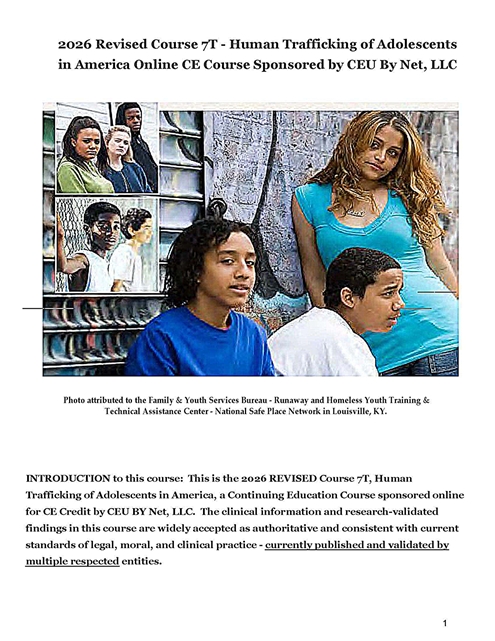
2026 HHSC-Approved Course 7T - Human Trafficking of Adolescents—Ethics, Culture, Identification, Assessment, and Rescue
This revised Human Trafficking Course 7T was approved by Texas HHSC on March 24, 2026 for ALL healthcare providers in Texas, in accordance with Chapter 116 of the Texas Occupations Code, House Bill 2059, 86th Session, 2019. It replaces previous Course 8T.
This course also earns credit NATIONWIDE for NBCC, NAADAC, IC&RC, and most State licensing boards.
** When you take this course for TEXAS Mental Health license renewal, you automatically earn 3 CEUs for Distinct Populations, PLUS 4 CEUs for General credit, PLUS the 1-HOUR required TRAFFICKING/ETHICS COURSE CREDIT. These course credits are immediately uploaded to CE BROKER for Texas Mental Health licensees.
** This course earns 7 credit hours for Texas TCB-TCBAP (including your Trafficking Certificate), that can be applied to multiple required counseling areas including abuse and neglect, HIV and other sexually transmitted diseases, assessment, prevention, etc..
** NATIONWIDE: NAADAC, IC&RC, and MOST STATE boards approve 7 credit hours for both mental health and addiction licensees in multiple clinical areas, including ETHICS. NBCC and California BBS approve 5 Credit Hours for this course in multiple areas including Laws and Ethics, HIV, etc..
Areas addressed in this course: NBCC, NAADAC, IC&RC and most Behavioral Health Boards recognize Credit Hours for multiple clinical areas, including Human Trafficking, Ethics, Abuse and Neglect, Domestic Violence, Crisis and Trauma-Informed Care, Assessment, Federal Laws and Rules, Community Coordination, etc..
GOALS OF THE COURSE
1. EARN CE CREDITS NATIONWIDE to renew your behavioral health license. Earn 7 Credit Hours for NAADAC, IC&RC, and MOST STATE BOARDS and 5 Credit Hours for NBCC and California BBS.
For TEXAS Mental Health licenses, earn 1.0 CE hour for Human Trafficking/Ethics (CEB Course Tracking #20-1373197), PLUS 3.0 CE Hours for Distinct Populations and 4.0 CE Hours applied to General (CEB Course Tracking #20-1368444). For TEXAS TCBAP-TCB earn the Trafficking Certificate plus 7 CE Hours. Approved by TEXAS HHSC for ALL TEXAS healthcare service providers.
2. Learn the focus, approach, and achievements of the US Department of Justice and its partner organizations in the National Strategy to Combat Human Trafficking. Learn the Texas Statute requirements for reporting abuse and neglect of persons ages 65 and older and disabled persons.
3. Understand the Federal laws applicable to all states and the legal definition of Human Trafficking for minors vs. adults, as defined in the Trafficking Victims Protection Act (TVPA); know how to recognize the various forms of sex and labor trafficking to which victims are subjected, which violate their Human Rights; and understand the volitional difference between Human Trafficking and Prostitution with adults.
4. Know the characteristics and methods of Human Trafficking perpetrators and the diverse settings in which they operate.
5. Learn a research-based, ETHICAL, and DISTINCT POPULATIONS (cultural) approach to assisting adolescent victims of Human Trafficking with the personal SAFETY strategies and methods of escape from the perpetrator.
6. Become familiar with the research-validated, REVISED Trafficking ASSESSMENT developed by Polaris that is necessary for the successful prosecution of human trafficking perpetrators. Includes victim-centered language and questions, awareness of trauma-sensitive dynamics, sensitivity to safety issues, and respect for the victim's right to PRIVACY and CONFIDENTIALITY.
7. Understand the importance of gathering information to be used by law enforcement—and the inherent limitations placed on CLIENT CONFIDENTIALITY to successfully prosecute the perpetrator.
8. Understand the typical etiology of how Human Trafficking exploitation and abuse occur in the lives of homeless and runaway youth, and the reasons why escape is difficult or impossible without TRAUMA Informed assistance and INTERAGENCY COORDINATION between LAW enforcement, SOCIAL SERVICES, and behavioral health professionals.
9. Understand the role of drugs, alcohol, homelessness, and survival sex in the deprivation of human rights, which is characteristic of Human Trafficking.
10. Know an ethical way to work with trafficking victims to develop a safety plan at various stages in the human trafficking situation—while a victim is in the situation, during the process of leaving, and once the victim has left—and how to ensure safety for staff within the program.
Note: You are free to read, download, save, and print the Study Guide(s) and Quiz(zes) for this Course, before deciding to enroll in the course. These course materials are public domain, and CEU By Net is sponsoring the course for CE Credit. You may STUDY THIS COURSE and the quiz AT NO CHARGE. You may enroll in the course at any time. You must take the quiz ONLINE, by logging into your
My Home Page
, clicking on the course you want to complete, completing the quiz or quizzes required, and submitting the Feedback Form. You will then instantly receive your course completion certificate! For more information on this course - and to see a COPY of the online quiz - click the '+' symbols, below:
|
|
|
HHSC-Approved Course 7T - Human Trafficking - Study Guide 1 |
|
| |
Click here
to view this study material.
Click here
to view and print the quiz you will take for this material.
|
|
|
|
|
HHSC-Approved Course 7T - Human Trafficking - Study Guide 2 |
|
| |
Click here
to view this study material.
Click here
to view and print the quiz you will take for this material.
|
|
|
|
|
HHSC Approved Course 7T - Human Trafficking - Study Guide 3 |
|
| |
Click here
to view this study material.
Click here
to view and print the quiz you will take for this material.
|
|
|
|
|
|
|
|
|
|
2026 Update of Course 2G_Ethics & Scope of Practice for Texas LPC |
|
| |

Earn and download a certificate immediately upon completion of this module.
Only $10.00
No charge if you have a subscription
|
|
2026 Update of Course 2G_Ethics & Scope of Practice for Texas LPC
In November 2025, the Texas Secretary of State, the Behavioral Health Executive Council, and the Board of Examiners of Licensed Professional Counselors re-published revised RULES for LPCs with some modifications from the previous year. The updated Rules are made available in the new LPC Rule Book dated November 2025 - which is effective from Nov 2025 through 2026. The updated Rules are also published on the TX Secretary of State (SOS) website, where you will always find the MOST CURRENT and OFFICIAL version of any Rule.
THIS COURSE is therefore entitled '2026 Update of Course 2G — Ethics & Scope of Practice for Texas LPCs.'
The course is presented online by CEU By Net, LLC, and is downloadable in a PDF format for studying offline if desired. The quiz must be taken online and certificates are available online immediately.
The course earns 2.5 Ethics CEUs for Texas LPCs and meets the re-licensure requirement for a course in Texas-Specific Ethics. The course also earns 1.75 NBCC Credit Hours for NCCs who are licensed in Texas.
NOTE: There is NO NEED to consult the SOS website to take this course. To prepare for the course quiz, enroll in the course, open or download the Study Guide and the quiz, and study online or offline. Quiz questions are drawn from the Study Guide for this course.
In this course, we have also included a section on the meaning and implications of Scope of Practice and a brief review of the changes in 42 CFR, Part 2 — the Federal law pertaining to the release of confidential information about the treatment of individuals with Substance Use Disorders.
Goals for Learning:
1. Obtain an understanding of (1) the meaning of 'Scope of Practice,' (2) its importance in the retention of your Texas LPC license, and (3) its importance in the event of a lawsuit alleging unacceptable or unethical practice.
2. Know the meaning and the use of the term 'Prevailing Standard of Professional Care,' its relevance to compliance with the LPC Rules of Practice, and its significance to the outcome of civil suits alleging inappropriate treatment of a client.
3. Reinforce the LPC Rules of Practice, including some specific rules often overlooked or misunderstood.
4. Understand that the version of any Rule that is published on the website of the Texas Secretary of State shall control, in the event of a conflict with the published LPC Rule Book.
5. Become aware of the finalized changes in Federal regulation 42 CFR, Part 2 that facilitate the exchange of SUD treatment information between healthcare providers, including LPCs.
Note: You are free to read, download, save, and print the Study Guide(s) and Quiz(zes) for this Course, before deciding to enroll in the course. These course materials are public domain, and CEU By Net is sponsoring the course for CE Credit. You may STUDY THIS COURSE and the quiz AT NO CHARGE. You may enroll in the course at any time. You must take the quiz ONLINE, by logging into your
My Home Page
, clicking on the course you want to complete, completing the quiz or quizzes required, and submitting the Feedback Form. You will then instantly receive your course completion certificate! For more information on this course - and to see a COPY of the online quiz - click the '+' symbols, below:
|
|
|
2026 Update 2G_Ethics & Scope of Practice Texas LPC |
|
| |
Click here
to view this study material.
Click here
to view and print the quiz you will take for this material.
|
|
|
|
|
|
|
|
|
|
Course 6TBI—TBI Toolkit for Counselors |
|
| |
Earn and download a certificate immediately upon completion of this module.
Only $22.00
No charge if you have a subscription
|
|
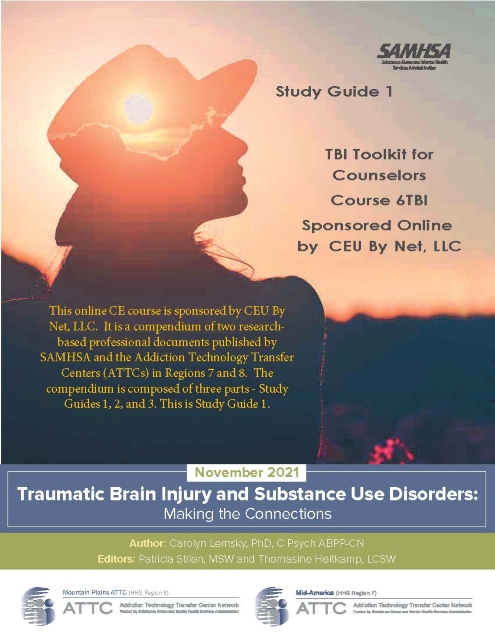
Course 6TBI—TBI Toolkit for Counselors
This Course 6TBI—TBI Toolkit for Counselors—trains mental health and addiction professionals in the medical definition and implications of Traumatic Brain Injury (TBI) from mild brain damage to coma, and from infant to adult. Understand the significant difference in the therapeutic approach needed for assessing and counseling clients with both TBI and substance abuse issues compared to traditional assessment and counseling approaches with SUD and MI clients who do not have a Traumatic Brain Injury.
The course awards 6 CEUS. For NBCC and California, earns 4 Credit Hours
Goals of the Course:
1. Know the medical definition and implications of Traumatic Brain Injury (TBI) within the various lobes of the brain—from mild brain damage to coma, and from infant to adult.
2. Know the causes and varying levels of mental impairment sustained in Traumatic Brain Injury—caused by the impact of hard objects against the skull or by hypoxia and anoxia when the brain is deprived of oxygen, such as occurs in drug overdoses or choking during intimate partner violence.
3. Understand the vital function of the frontal lobe—including how TBI, drugs, and alcohol impact the function of this critical area of the brain; know what occurs when a client with TBI chooses to use alcohol and other substances during and after recovery.
4. Learn the adaptations needed for individual and group counseling of clients with co-occurring TBI and substance abuse issues, compared to traditional counseling approaches with clients who do not have a Traumatic Brain Injury.
5. As a behavioral health provider, understand the difficulty of the recovery process for clients with TBI to prevent misattribution of behaviors as uncooperative or passive.
6. Understand how and why confusion and memory deficits inherent in TBI complicate follow-through with plans and new routines, and learn the strategic way to address these issues.
7. Know research-validated approaches to working with adults and children with TBI with varying levels of cognitive impairment and those with co-occurring behavioral health issues that complicate the treatment of the physical aspects of the injury.
Published and authored by: Author Carolyn Lemsky, PhD, C Psych ABPP-CN, Mountain Plains Addiction Technology Transfer Center; Mid-America Addiction Technology Transfer Center; Editors Patricia Stilen, MSW and Thomasine Heitkamp, LCSW; SAMHSA
Note: You are free to read, download, save, and print the Study Guide(s) and Quiz(zes) for this Course, before deciding to enroll in the course. These course materials are public domain, and CEU By Net is sponsoring the course for CE Credit. You may STUDY THIS COURSE and the quiz AT NO CHARGE. You may enroll in the course at any time. You must take the quiz ONLINE, by logging into your
My Home Page
, clicking on the course you want to complete, completing the quiz or quizzes required, and submitting the Feedback Form. You will then instantly receive your course completion certificate! For more information on this course - and to see a COPY of the online quiz - click the '+' symbols, below:
|
|
|
Course 6TBI - ToolKit for TBI - Guide 1 |
|
| |
Click here
to view this study material.
Click here
to view and print the quiz you will take for this material.
|
|
|
|
|
Course 6TBI - ToolKit for TBI - Guide 2 |
|
| |
Click here
to view this study material.
Click here
to view and print the quiz you will take for this material.
|
|
|
|
|
Course 6TBI - ToolKit for TBI - Guide 3 |
|
| |
Click here
to view this study material.
Click here
to view and print the quiz you will take for this material.
|
|
|
|
|
|
|
|
|
|
Course 4SUD - Surviving the Overdose—But Now What |
|
| |

Earn and download a certificate immediately upon completion of this module.
Only $21.00
No charge if you have a subscription
|
|
Course 4SUD - Surviving the Overdose—But Now What
This Course 4SUD — 'Surviving the Overdose—But Now What?' is sponsored online by CEU By Net. The course earns 4 Clock Hours of credit for multiple National and State Mental Health and Addiction Licensing and Certification Boards including NAADAC, IC&RC, Texas Mental Health Boards, Texas' TCBAP-TCB-TAAP, Florida CE Broker, and Florida Certification Board for CAP. The course also awards 2.5 Credit Hours for NBCC and California BBS.
Based on these credentials, the course is an acceptable source of continuing education for most state mental health and addiction licensing boards.
The course material in this sponsored course is newly revised and published in 2024 by the Substance Abuse and Mental Health Services Administration (SAMHSA). The training document contains two sections, both of which are published by SAMHSA—'Now What? The Role of Prevention Following a Nonfatal Opioid Overdose' and 'The Overdose Prevention and Response TOOLKIT.'
The publication focuses on the essential discharge activity and the immediate follow-up actions that are necessary when individuals and their family or friends leave the ER following survival of a near-fatal overdose. The goal is to prevent the risk of a repeated overdose and fatality.
The discharge protocol may or may not include a plan for abstinence or connection to a SUD treatment program. The intervention is a HARM REDUCTION model, which emphasizes that the path to recovery must be determined by the individual. After a near-fatal overdose, the individual may not choose abstinence and may not be ready for SUD treatment interventions despite their near-death experience. The role of the Recovery Specialist is to support the individual in their goals and assist in development of a plan to keep the individual SAFE despite continued use of drugs.
The second section of the course—the SAMHSA 'Toolkit'—provides enlightening information about Opioids including Fentanyl that are causing thousands of deaths annually, and other drugs and lethal combinations such as cocaine and methamphetamines that are also increasingly responsible for fatal overdoses.
The information in this course addresses the physical impact of the various drugs and the critical signs (including cessation of breathing) of impending fatal overdose, plus the steps to take when witnessing and responding to an overdose, including restoration of breathing and the administration of Opioid Overdose Reversal Medications (OORM) such as naloxone. The inevitable physical experience of acute withdrawal and some ways to safely reduce the impact are also addressed.
GOALS OF THIS COURSE:
1. Know the immediate and subsequent actions that are necessary when individuals and their family or friends leave the ER after a near-death overdose—including connecting them to people and practices that reduce the risk of re-overdose and fatality.
2.Learn how to support and keep overdose survivors SAFE with Harm Reduction planning—however that is defined by the individual, which may or may not include abstinence or participation in a SUD treatment program.
3. Understand the nature of the physical impact on the body of the various opioid and stimulant drugs and the critical signs (including cessation of breathing) of an impending fatal overdose.
4. Know how to use a lifesaving Opioid Overdose Reversal Medication (OORM) kit, including when and how to administer the medication (by injection or nasal spray), when to repeat a dose, and what to do after breath is restored.
5. Learn the physical impact on the body associated with the various lifesaving Opioid Overdose Reversal Medications (OORMs), and ways to possibly reduce the severity of the associated withdrawal experience.
6. Know why a 'community approach' to post-overdose recovery is essential, and how to facilitate it.
7. Learn the unique issues associated with Prescription Opioids and how to help patients develop a personal plan to maintain safety—including the response to changes in pain levels due to medication tolerance.
8. Have immediate access to multiple resources recommended by SAMHSA, via active links.
Note: You are free to read, download, save, and print the Study Guide(s) and Quiz(zes) for this Course, before deciding to enroll in the course. These course materials are public domain, and CEU By Net is sponsoring the course for CE Credit. You may STUDY THIS COURSE and the quiz AT NO CHARGE. You may enroll in the course at any time. You must take the quiz ONLINE, by logging into your
My Home Page
, clicking on the course you want to complete, completing the quiz or quizzes required, and submitting the Feedback Form. You will then instantly receive your course completion certificate! For more information on this course - and to see a COPY of the online quiz - click the '+' symbols, below:
|
|
|
Guide 1 - Course SUD |
|
| |
Click here
to view this study material.
Click here
to view and print the quiz you will take for this material.
|
|
|
|
|
Guide 2 - Course 4SD |
|
| |
Click here
to view this study material.
Click here
to view and print the quiz you will take for this material.
|
|
|
|
|
|
|
|
|
|
Course 4V - Public Mass Shootings - Predictive Factors, Challenges, & Prevention |
|
| |
Earn and download a certificate immediately upon completion of this module.
Only $21.00
No charge if you have a subscription
|
|
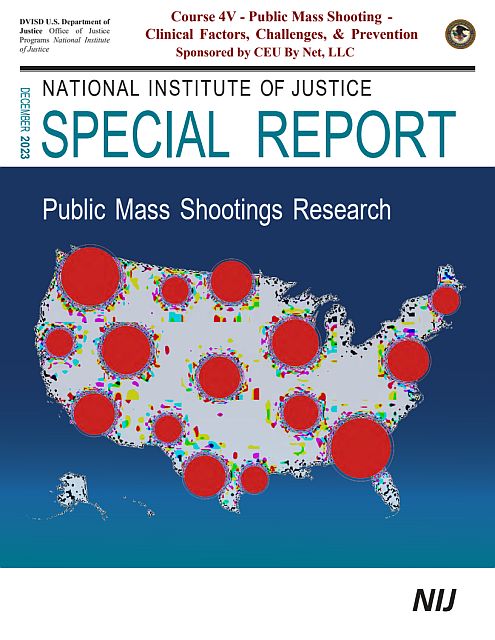
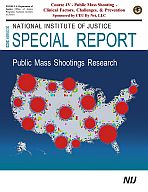
Public Mass Shootings — Predictive Factors, Challenges, & Prevention
This Course 4V, Public Mass Shootings — Predictive Factors, Challenges, & Prevention — is sponsored online by CEU By Net. The course earns 4 Clock Hours of credit for multiple State Mental Health and Addiction Boards including Texas Mental Health Boards, Florida CE Broker, Texas' TCBAP-TCB-TAAP, Florida Certification Board for CAP, IC&RC, and NAADAC. The course also awards 2.5 Credit Hours for California BBS and NBCC.
Based on these credentials, the course is an acceptable source of continuing education for most state mental health and addiction licensing boards.
This Special Report was published in December 2023 by the U.S. Department of Justice, Office of Justice Programs, National Institute of Justice, Nancy La Vigne, Ph.D., Director.
Say the authors, “This Special [Dec 2023] Report of the National Institute of Justice (NIJ) presents a synthesis of select findings from over 60 publications on 18 NIL-supported research projects on public mass shootings, including school mass shootings, since 2014. It also identifies areas of need and interest for future research and recommendations."
Goals of this course:
1. Learn to recognize patterns of behavior that may foreshadow mass shootings — specifically public mass shootings.
2. Understand some of the mental well-being challenges faced by people who plan and commit mass public shootings—such as the trauma of being bullied or friendless—and the strategic responses that may avert tragedy when indicators appear.
3. Learn key factors and challenges that currently serve as barriers to the advance detection and prevention of public mass shootings, particularly in K-12 schools.
4. Understand the widespread CULTURAL impact of public mass shooting in America — including the impact on the American POLITICAL environment and the significance of SOCIAL MEDIA as a key to recognizing impending mass shootings.
5. Understand why indicators of planned shootings, including leaking of plans online and verbally to peers, are often not pursued — particularly in K-12 schools — and specific activities to overcome this 'culture of silence' obstacle.
6. Learn the recommendations of the National Institute of Justice for interventions to use when shooting plans are detected and recommendations of actions to avoid after a shooting occurs.
7. Understand the impact of media coverage that currently distorts public and cultural perceptions about those who commit mass public shootings, and therein discourages accurate prediction and prevention of such events.
8. Know the varying functions of different types of firearms, the preferences of mass shooters, and the implications for legislative action at the State and local levels.
Note: You are free to read, download, save, and print the Study Guide(s) and Quiz(zes) for this Course, before deciding to enroll in the course. These course materials are public domain, and CEU By Net is sponsoring the course for CE Credit. You may STUDY THIS COURSE and the quiz AT NO CHARGE. You may enroll in the course at any time. You must take the quiz ONLINE, by logging into your
My Home Page
, clicking on the course you want to complete, completing the quiz or quizzes required, and submitting the Feedback Form. You will then instantly receive your course completion certificate! For more information on this course - and to see a COPY of the online quiz - click the '+' symbols, below:
|
|
|
Course 4V - Public Mass Shootings - Guide 1 |
|
| |
Click here
to view this study material.
Click here
to view and print the quiz you will take for this material.
|
|
|
|
|
Course 4V - Public Mass Shootings - Guide 2 |
|
| |
Click here
to view this study material.
Click here
to view and print the quiz you will take for this material.
|
|
|
|
|
|
|
|
|
|
Course 8K - Harm Reduction Strategies & Challenges with Co-Occurring HIV, SUD, & Mental Disorders |
|
| |
Earn and download a certificate immediately upon completion of this module.
Only $23.00
No charge if you have a subscription
|
|
Course 8K - Harm Reduction Strategies & Challenges with Co-Occurring HIV, SUD, and Mental Disorders
This Continuing Education course is sponsored online by CEU By Net, LLC. The course is an expansion of the shorter Course 1K, to which we have added Chapters 1, 2, and 3 extracted from the larger document written and copyrighted by SAMHSA, published in the public domain by the U.S. Department of Health and Human Services.
YOU CAN VIEW AND PRINT THIS COURSE AND THE QUIZZES BY CLICKING LINKS AT THE BOTTOM OF THIS COURSE DESCRIPTION.
This continuing education course earns 8 CEUs for TCBAP-TCB-TAAP, NAADAC, IC&RC, Florida Certification Board (FCB), Florida and Texas Mental Health Boards and most states. Also earns 6 credit hours for NBCC and California BBS. EACC Approval for 8 PDHs in Domains I, II, III - expired June 30, 2024.
Based upon these credentials, 8 course credits are accepted by MOST MENTAL HEALTH and ADDICTION licensing boards nationwide.
This CE course contains 4 of the 5 chapters of the SAMHSA document entitled 'Prevention and Treatment of HIV Among People Living with Substance Use and/or Mental Disorders' -- published by SAMHSA in the public domain in 2020 with a May 2021 forward by Elinore F. McCance-Katz, MD, Ph.D., Assistant Secretary for Mental Health and Substance Use, U.S. Department of Health and Human Services.
The course document is the result of a collaboration of expert panels of federal, state, and non-governmental participants who provided input for each of the chapters in the document. Panel members include accomplished scientists, researchers, service providers, community administrators, federal and state policymakers, and people with lived experience.
Compared to Course 1K, this Course 8K presents a more extensive examination of current approaches and challenges encountered in the prevention and treatment of HIV in people living with co-occurring SUD and/or SMI or SED. The course also presents current evidence of the effectiveness of programs and strategies used to treat and prevent HIV and other sexually transmitted diseases among people with co-occurring behavioral health disorders.
The course includes practical information from currently operating treatment and prevention models to consider when selecting and implementing your own programs and practices.
The emphasis in the design of the three research-validated programs is upon PREVENTION and TREATMENT of HIV and HARM REDUCTION in people who use and inject drugs and may engage in unprotected sex. The models encourage the improvement of overall mental and physical health in clients with HIV and co-occurring disorders through psychosocial programming.
The three model programs feature practices to increase adherence and uptake of viral suppression and preventative drugs, including pre-exposure prophylaxis (PrEP), post-exposure prophylaxis (PEP), syringe exchange programs (SEP), Contingency Management (CM), Patient Navigation (PN), and linkage and retention.
We have extracted the extensive list of references for all of these chapters, and placed them at the end of the course as attachments with active links to the referenced documents. You can review and download any of this reference material for use now and in the future. You will not be tested on the reference documents but they provide valuable added perspective to the course material and resources which you can use in your program or practice now and in the future.
The document is the result of a collaboration of expert panels of federal, state, and non-governmental participants who provided input for each of the chapters in the document. Panel members include accomplished scientists, researchers, service providers, community administrators, federal and state policymakers, and people with lived experience
.
The Goals of This Course:
1. Learn the details of three research-validated service delivery models in diverse settings in which HIV and other sexually transmitted diseases can be effectively prevented and treated, including persons living with HIV and concurrent SUD and/ or Mental Illness, and those who may engage in unprotected sex and injectable drug use leading to HIV and other sexually transmitted diseases.
2. Learn effective approaches with varying CULTURAL populations to encourage uptake and consistent compliance with (a) Pre-Exposure Prophylaxis (PrEP - prevention of HIV when exposed to the virus), and (b) Post-Exposure Prophylaxis (PEP), and (c) suppression of the HIV virus in those who have contracted HIV (ART - Antiretroviral Therapy)..
3. Understand the roles of Biomedical Intervention, Psychosocial Intervention, and awareness of cultural characteristics in the prevention and treatment of HIV and other Sexually Transmitted Diseases in persons with concurrent behavioral health disorders (SUD and mental illness).
4. Learn how Syringe Exchange programs are successfully integrated within communities and the most effective approach to implementation with persons with concurrent behavioral health disorders.
5. Learn the role of Peer Health Navigation (PHN) and Contingency Management (CM) in achieving behavioral and biomedical targets, including transgender women of color who are at risk for or have HIV and concurrent behavioral health disorders.
6. Know why it is critical that programs primarily serving people with serious mental illness and SUD (a) assess their clients for HIV risk, (b) conduct HIV testing, and (c) provide medically and behaviorally integrated HIV prevention and treatment services to address their complex needs.
7. Understand the errors in the design of HIV programs which result in unsuccessful or reduced HIV viral suppression -- particularly with those living with a concurrent diagnosis of SUD and/or Mental Illness.
8. Understand that the model HIV treatment and prevention programs presented in this course must be modified as needed, to meet the needs, living circumstances, and cultural characteristics of the local population.
Note: You are free to read, download, save, and print the Study Guide(s) and Quiz(zes) for this Course, before deciding to enroll in the course. These course materials are public domain, and CEU By Net is sponsoring the course for CE Credit. You may STUDY THIS COURSE and the quiz AT NO CHARGE. You may enroll in the course at any time. You must take the quiz ONLINE, by logging into your
My Home Page
, clicking on the course you want to complete, completing the quiz or quizzes required, and submitting the Feedback Form. You will then instantly receive your course completion certificate! For more information on this course - and to see a COPY of the online quiz - click the '+' symbols, below:
|
|
|
Guide 1 - Course 8K |
|
| |
Click here
to view this study material.
Click here
to view and print the quiz you will take for this material.
|
|
|
|
|
Guide 2 - Course 8K |
|
| |
Click here
to view this study material.
Click here
to view and print the quiz you will take for this material.
|
|
|
|
|
Guide 3 - Course 8K |
|
| |
Click here
to view this study material.
Click here
to view and print the quiz you will take for this material.
|
|
|
|
|
|
|
|
|
|
Course 1K - Introduction to Effective Harm-Reduction Strategies for Prevention and Treatment of HIV in Persons with Co-Occurring Behavioral Health Disorders |
|
| |
Earn and download a certificate immediately upon completion of this module.
Only $18.00
No charge if you have a subscription
|
|
Course 1K - Introduction to Effective Harm-Reduction Strategies for Prevention and Treatment of HIV in Persons with Co-Occurring Behavioral Health Disorders
This short Continuing Education course is sponsored online by CEU By Net, LLC. The course content is written and copyrighted by SAMHSA, published in the public domain in 2020 with a forward updated in May 2021. SAMHSA presents current, research-validated strategies for the prevention and treatment of persons who are living with HIV concurrent with SUD and/or Mental Disorders, with an emphasis on HARM REDUCTION. The course materials examine three currently operating community-based programs that utilize emerging and best practices for working with this population and identify the challenges and strategies for implementation.
The three model programs utilize client-centered, harm-reduction approaches in diverse settings that have demonstrated effectiveness in treating persons with concurrent HIV and Substance Use and/or Mental Disorders, as well as prevention of HIV in this vulnerable behavioral health population. The strategies described are part of a comprehensive HIV program.
The programs feature practices to increase uptake and improve adherence to pre-exposure prophylaxis (PrEP), post-exposure prophylaxis (PEP), syringe exchange programs (SEP), Contingency Management (CM), Patient Navigation (PN), and linkage and retention.
This continuing education course earns 2 CEUs for TCBAP-TCB-TAAP and Texas BHEC, NAADAC, IC&RC, and Florida Certification Board (FCB), Florida Mental Health Board, CE Broker and most states. Earns 1.75 for Florida Mental Health licenses, and 1.25 credit hours for NBCC and California BBS. EACC 2 PDHs Domain I, II, III expires June 13, 2025
Based upon these credentials, the course credits are accepted by MOST MENTAL HEALTH and ADDICTION licensing boards nationwide.
This CE course contains Chapter 4 of the larger SAMHSA document entitled 'Prevention and Treatment of HIV Among People Living with Substance Use and/or Mental Disorders' -- published by SAMHSA in the public domain in 2020 with a May 2021 forward by Elinore F. McCance-Katz, MD, Ph.D., Assistant Secretary for Mental Health and Substance Use, U.S. Department of Health and Human Services.
The document is the result of a collaboration of expert panels of federal, state, and non-governmental participants who provided input for each of the chapters in the document. Panel members include accomplished scientists, researchers, service providers, community administrators, federal and state policymakers, and people with lived experience
The Goals of This Course:
1. Learn the details of three research-validated service delivery models in diverse settings in which HIV can be effectively prevented and treated in persons living with HIV and concurrent SUD and/ or Mental Illness, including those who may engage in unprotected sex including those who may engage in unprotected sex leading to HIV and other sexually transmitted diseases.
2. Learn the effective approach to encouraging uptake and consistent compliance with Pre-Exposure Prophylaxis (PrEP) and post-exposure prophylaxis (PEP) in various CULTURAL populations, including transsexual women and gay men.
3. Understand the roles of Biomedical Intervention, Psychosocial Intervention, and awareness of cultural characteristics in the prevention and treatment of HIV in persons with concurrent behavioral health disorders (SUD and mental illness).
4. Learn how Syringe Exchange programs are successfully integrated within communities and the most effective approach to implementation with persons with concurrent behavioral health disorders.
5. Learn the role of Peer Health Navigation (PHN) and Contingency Management (CM) in achieving behavioral and biomedical targets in transgender women of color who are at risk for or have HIV and concurrent behavioral health disorders.
6. Know why it is critical that programs primarily serving people with serious behavioral health disorders assess their clients for HIV risk, conduct HIV testing, and provide integrated HIV prevention and treatment services to address their complex needs.
Note: You are free to read, download, save, and print the Study Guide(s) and Quiz(zes) for this Course, before deciding to enroll in the course. These course materials are public domain, and CEU By Net is sponsoring the course for CE Credit. You may STUDY THIS COURSE and the quiz AT NO CHARGE. You may enroll in the course at any time. You must take the quiz ONLINE, by logging into your
My Home Page
, clicking on the course you want to complete, completing the quiz or quizzes required, and submitting the Feedback Form. You will then instantly receive your course completion certificate! For more information on this course - and to see a COPY of the online quiz - click the '+' symbols, below:
|
|
|
Guide for Course 1K |
|
| |
Click here
to view this study material.
Click here
to view and print the quiz you will take for this material.
|
|
|
|
|
|
|
|
|
|
Course 3TMH The Ethics and Technical Requirements for Using Telemental Health for Treatment of Persons with PTSD and Associated Conditions |
|
| |
Earn and download a certificate immediately upon completion of this module.
Only $20.00
No charge if you have a subscription
|
|
Course 3TMH The Ethics and Technical Requirements for Using Telemental Health for Treatment of Persons with PTSD and Associated Conditions
This is Course 3TMH - The Ethics and Technical Requirements for Using Telemental Health for Treatment of Persons with PTSD and Associated Conditions. REGISTERED AS DISTINCT POPULATIONS FOR TEXAS WITH CE BROKER for LPC,LMFT,and LCSW and psychologists. .
The continuing education course is sponsored online by CEU By Net, LLC. The course earns 4.0 Credit Hours in DISTINCT POPULATIONS for Texas LCSWs, LPCs, and LMFTs, and 4 CEUs for NAADAC, IC&RC, TCBAP-TCB-TAAP, the Florida Certification Board for CAP, and 4 CEUs for Florida Mental Health. Based upon these credentials, the course is accepted by most state boards for 4 hours of mental health and SUD credit. The course awards 2.75 credit hours for California BBS and NBCC. The course was re-approved by EACC for 3.75 PDHs Domain I, II & III, effective May 6, 2024. Expired May 5, 2025.
The course is a compendium of documents primarily created and published by multiple branches of the US Government's mental health and addiction treatment delivery system. The research described in this course focuses primarily upon Telehealth treatment of PTSD through remote Video Teleconferencing. However, the core premises, consents, provider-client interaction, documentation techniques, follow-up, and training methods also apply to other TMH modalities and diagnoses.
The materials in this course are public domain and are written and published by the US Department of Veteran Affairs' National Center for PTSD, the US Department of Health and Human Services' Substance Abuse and Mental Health Services Administration (SAMHSA), and the Addiction Technology Transfer Center Network (ATTC) - South Southwest ATTC located at the University of Texas School of Social Work, and the National Frontier and Rural ATTC.
The course is divided into two sections, with a quiz for each section - both of which must be passed to download the certificate. The first part of this course is the research-based document written by the VA's National Center for PTSD, focusing on the ethical and therapeutic approach to delivery of Telemental Health assessment and treatment of Military Veterans with PTSD. The materials provide a description of how to implement telemental health through Clinical Video Teleconferencing (CVT) in which clients are not in the same location as the service provider.
The interaction between client and provider can be transmitted via a tablet, phone, computer, and/or video camera. The publication presents research-based data that demonstrate that remote Video Telemental Health is as effective as in-person, in-office treatment of PTSD, and is sometime more effective. Further, providers and clients are able to remotely accomplish all the essential clinical functions required for successful treatment, including:
• clinical assessment
• trauma-focused psychotherapy including CPT for individuals and groups, Prolonged Exposure (PE), and CBT-I for trauma-based insomnia
• psychoeducational interventions
• cognitive testing
• general psychiatry and medication management
Other areas in this first publication include:
• Alliance, Dropout, and Patient Preferences in CVT Treatment
• Clinical and Practical Considerations for CVT
• Pros and Cons of Telemental Health for PTSD
• Considerations for Risk Assessment
• Additional Resources and activity pertaining to informed consent.
Beyond this first publication on the subject of CVT in the treatment of PTSD, the balance of the course contains planning and documentation checklists and guidance for use in setting up a Telemental Health program regardless of the diagnosis of clients served, including activity needed to ensure ethical practice and confidentiality. Topics addressed include:
• Obtaining Informed Consent for Telemental Health Services
• The use and documentation of the Teach-Back method to promote and ensure the client's understanding of information, homework assignments, and medication protocols provided during the tele-session, including checklists for documentation of interventions and response.
• Guidelines, formats, and checklists for assessing the organization's capacity to deliver telemental health services from a technical and manpower perspective.
GOALS of the course:
1. Review current research that demonstrates that treatment of PTSD can be effectively delivered to people with PTSD [Including Veterans of deployment to the Middle East] through remote home-based video teleconferencing—including Cognitive Processing Therapy (CPT) for individuals and groups using Prolonged Exposure (PE) and Cognitive Behavioral Therapy for Insomnia (CBT-I).
2. Know how to remotely implement technical precautions, documentation including informed consent, and intervention approaches which are necessary to ensure the safety, confidentiality, and ethical treatment of clients who receive treatment through remote electronic communication,
3. Learn that the use of Evidence Based Practices (EBPs) in conjunction with home-based Clinical Video Teleconferencing (CVT) is empirically demonstrated to be as effective as - and sometimes more effective than - in-person, in-office treatment of PTSD.
4. Recognize the prevalence of untreated PTSD in tribal reservations, rural areas, post-deployment veteran populations, and nationwide due to the Covid-19 pandemic and other situational trauma, and the role that Telemental Health can play in the remote treatment of affected individuals.
5. Learn the use and documentation of the Teach-Back method to promote and ensure the client's understanding of instructions, homework assignments, and medication protocols provided during the telehealth session, including checklists for documentation of interventions and client response.
6. With structured checklists and recommended actions, providers learn that essential clinical functions can be effectively performed remotely, including clinical assessment, trauma-focused psychotherapy with individuals and groups, psychoeducational interventions, cognitive testing, general psychiatry, and medication management.
7. Learn the details of what has and has not been changed by SAMHSA in its significant modification of 42 CFR Part 2 in July 2020, pertaining to confidentiality and exchange of clinical information.
8. Learn the step-by-step process of evaluating and putting into place the technical requirements and IT hardware and software systems needed for trouble-free Telemental Health sessions.
Note: You are free to read, download, save, and print the Study Guide(s) and Quiz(zes) for this Course, before deciding to enroll in the course. These course materials are public domain, and CEU By Net is sponsoring the course for CE Credit. You may STUDY THIS COURSE and the quiz AT NO CHARGE. You may enroll in the course at any time. You must take the quiz ONLINE, by logging into your
My Home Page
, clicking on the course you want to complete, completing the quiz or quizzes required, and submitting the Feedback Form. You will then instantly receive your course completion certificate! For more information on this course - and to see a COPY of the online quiz - click the '+' symbols, below:
|
|
|
Course 3TMH - Guide 1 |
|
| |
Click here
to view this study material.
Click here
to view and print the quiz you will take for this material.
|
|
|
|
|
Course 3TMH - Guide 2 |
|
| |
Click here
to view this study material.
Click here
to view and print the quiz you will take for this material.
|
|
|
|
|
|
|
|
|
|
Course 4S - Developmental Model of Clinical Supervision in Behavioral Health |
|
| |
Earn and download a certificate immediately upon completion of this module.
Only $24.00
No charge if you have a subscription
|
|
Course 4S - Developmental Model of Clinical Supervision in Behavioral Health
Course 4S - 'The Developmental Model of Clinical Supervision in Behavioral Health' - is sponsored online by CEU By Net and is registered with (CEB) for Texas Clinical Supervision credit. We upload your credits within 60 seconds of course completion to CEB. The course earns 4 Credit Hours in Clinical Supervision for most Texas and states, for social workers, mental health and addiction counselors, LMFTs, NAADAC, IC&RC, TCBAP-TCB-TAAP, Florida Certification Board for CAP. General Credit for Florida Mental Health. Re-approved by EACC for 4 PDHs, Domains I, II, III expires June 13, 2025. For NBCC and California BBS, the course awards 3.0 Credit Hours in Clinical Supervision.
Based on these credentials, the course is accepted by most state boards for behavioral health CE credit. SOME BOARDS may require formal review and approval of the course for purposes of Supervisor Training credit.
This sponsored course presents the Blended or Integrated Developmental Model of Supervision, first articulated and published by Stoltenberg, McNeill, and Delworth (1998), in which both the Supervisee and the Supervisor progress through specific DEVELOPMENTAL LEVELS or STAGES of professional identity and functionality. Originally published by SAMHSA-CSAT (2009 - Rockville Maryland) as part of ‘Treatment Improvement Protocol (TIP) No. 52’, it was revised and updated by SAMHSA-CSAT in 2014 and was subsequently indexed and is currently published online by National Center for Biotechnology Information, U.S. National Library of Medicine, National Institutes of Health (NIH) 8600 Rockville Pike, Bethesda MD, 20894 USA as ‘Part 1, Chapter 1, Clinical Supervision and Professional Development of the Substance Abuse Counselor: Information You Need to Know.’ Mental Healh Clinical Supervision content, references, and bibliographical notations are included within the text from NBCC, AAMFT, NASW, and numerous recognized mental health research publications.
The course addresses in detail the purposes, principles, ETHICS, METHODS, and TECHNIQUES of CLINICAL SUPERVISION of Behavioral Health SUPERVISEES by licensed Supervisors, including the LEGAL necessity of written documentation of all supervisory interactions, observations, and assessments including formative and summative performance evaluations.
The course further addresses the legal issues and vulnerabilities (Risk Management) involved in the supervision of mental health and SUD professionals by licensed supervisors, and the need for ethical and legal DIRECT OBSERVATION of the supervisee's work with clients. The benefits and disadvantages of each of the OBSERVATION METHODS is described.
The course explains the nature of the collaborative relationship between Supervisors and Supervisees, and the Supervisor's function as role model and mentor for Supervisees, as well as the role of GATEKEEPER for licensure in the profession.
GOALS of THIS COURSE:
1. Understand the purpose and essential functions of the supervisory relationship and process -- teacher, consultant, coach, mentor/role model, and guardian of the welfare of the organization's clients.
2. Understand the Supervisor's role as 'Gatekeeper' for the behavioral health professions.
3. Know the central principles and guidelines of Clinical Supervision and Risk Management pertaining to ethical and legal vulnerability of both the supervisor and the supervisee, dual relationships and boundary issues, informed consent, confidentiality, and supervisor-specific responsibilities including prevention of supervisee burnout and compassion fatigue.
4. Understand the legal distinction between 'direct liability' and 'vicarious liability' (respondeat superior), and how these apply to the ethical and legal need for DIRECT OBSERVATION of supervisees' work and DOCUMENTATION of supervisory actions and interactions.
5. Know how to implement the steps in a 'decision tree' to effectively manage a situation in which the supervisor is concerned about a possible ETHICAL or LEGAL violation by a supervisee.
6. According to the Developmental Model of Supervision, know and be able to recognize the levels/stages of development of Behavioral Health Supervisees, and the levels/stages of Supervisor development.
7. Know the various methods and techniques of MONITORING and EVALUATING the development and clinical performance of supervisees, including DIRECT and INDIRECT methods of observation and the benefits and limitations which apply to each.
8. Understand the difference between clinical and administrative supervision, and learn approaches to balancing both responsibilities when necessary.
9. Know how to integrate CULTURAL COMPETENCE into supervision and how to prevent, recognize and address issues of problematic cultural competence between the supervisee and the client, and between the supervisor and the supervisee.
10. Learn about the June 2020 changes in Federal statute ‘42 CFR, Part 2,’ pertaining to confidentiality for persons receiving treatment for SUD, and the revision of NBCC's ETHICS policy for Online Counseling, which was expanded to include Provision of Distance Professional Services in multiple distance media formats.
Note: You are free to read, download, save, and print the Study Guide(s) and Quiz(zes) for this Course, before deciding to enroll in the course. These course materials are public domain, and CEU By Net is sponsoring the course for CE Credit. You may STUDY THIS COURSE and the quiz AT NO CHARGE. You may enroll in the course at any time. You must take the quiz ONLINE, by logging into your
My Home Page
, clicking on the course you want to complete, completing the quiz or quizzes required, and submitting the Feedback Form. You will then instantly receive your course completion certificate! For more information on this course - and to see a COPY of the online quiz - click the '+' symbols, below:
|
|
|
Guide 1_Course 4S |
|
| |
Click here
to view this study material.
Click here
to view and print the quiz you will take for this material.
|
|
|
|
|
Guide 2_Course_4S |
|
| |
Click here
to view this study material.
Click here
to view and print the quiz you will take for this material.
|
|
|
|
|