 Welcome to CEU By Net's Managed Healthcare Courses Catalog, offering nationally approved continuing education credit and certificates with straight talk about how to survive the 'Managed Healthcare Model' of service delivery. Welcome to CEU By Net's Managed Healthcare Courses Catalog, offering nationally approved continuing education credit and certificates with straight talk about how to survive the 'Managed Healthcare Model' of service delivery.
These unique courses explain the role of 'Medical Necessity' in a Managed Healthcare Model, to determine if an individual with a mental health or substance use disorder meets the payor's criteria for receiving a specific treatment service.
The Medical Necessity criteria for treatment are most commonly established by insurance companies or contractors who are purchasing healthcare services from a treatment provider.
Learn why Medical Necessity is at the core of the 'Managed Healthcare Model' of service delivery. Understand why Medical Necessity determines if you will be paid for delivery of behavioral health treatment services. Know how Medical Necessity is defined.
Our courses explain the clinical process of demonstrating the 'Medical Necessity' for specific healthcare services that you want to provide to the client, if you want to be paid for delivery of the service.
In these online continuing education courses, we explain the importance of effectively documenting the 'what, why, how, and duration' of the treatment services you plan to deliver. How do you ethically describe the client's need for the service? And how do you ethically describe the client's response to the service after you have delivered it, in order to be paid?
We demonstrate twelve 'Documentation Styles' which often result in denial of the APPROVAL to provide the services, or in denial of PAYMENT of the service after it is delivered.
In Course 2B, learn How to audit your own Program Records before the HMO, Insurance Company or State Medicaid Contractor appears to conduct an Onsite Care Management Review!
We address the impact of Managed Care upon private practitioners, agencies, and traditional Provider Networks (read: 'Narrow Networks' and 'Integrated or Vertical Networks'). Managed Care also has a significant impact on the funding of treatment services.
Want to go directly to the list of managed care courses? Go to the bottom of this page. Click the + sign in front of any course that interests you, where you can read the course description and enroll in the course.
The format of our Managed Care courses is different from the format of the majority of our courses because they are PDF self-guided slideshows. The majority of CE Credit Hours on this site are earned through traditional text-based professional publications and training manuals.
 We Offer UNLIMITED COURSES AND CREDIT HOURS for an entire year with our Unlimited CEUs Annual Subscription - and it's only $49.00 per year. Earn CE credit for NBCC, NAADAC, and IC&RC, for every course on our website. Based on these credentials, most state boards accept our CE Credit Hours. We Offer UNLIMITED COURSES AND CREDIT HOURS for an entire year with our Unlimited CEUs Annual Subscription - and it's only $49.00 per year. Earn CE credit for NBCC, NAADAC, and IC&RC, for every course on our website. Based on these credentials, most state boards accept our CE Credit Hours.
Does This Information Apply to YOU? Yes.
Health Care Reform (aka, 'Managed Care') is now a fact of life, REGARDLESS of the state in which you practice, or what a new Federal Administration may do to modify the Affordable Care Act.
While many states are not new to Managed Care, the pervasiveness of working under such a regulated system of health care IS still new to many providers. It's driven by the national need to control the cost of healthcare at all levels.
Even if your program primarily REFERS clients to other agencies for more intensive services, you need to understand the constraints under which they provide treatment.
Why is this such an important issue for mental health and addiction treatment providers? With the expanded implementation of Health Care Reform at the federal, state, and local levels, virtually all insurance carriers and their provider networks are affected.
CEU By Net's Managed Care Courses cover the gamut of issues which concern behavioral health treatment providers, in this age of expanding health care reform.
We offer some 'combo' courses that award multiple certificates - Course Modules 4A and 5A. Or if you want a simpler approach, take individual courses to focus on specific target areas.
-
Module Course 4A – This Is Managed Behavioral Health Care — and Its Impact On YOU.
Contains two modules — MC 101 and MC201, described below. Each module earns a certificate.
-
Module Course 5A – Welcome to Care Management! a.k.a., 'Do They Really Need Treatment?'
Course 5A contains all three of the modules below, and each module awards a certificate.
The Modules
-
MC101 Managed Care in Public Health Programs: It’s Not Your Grandpa’s Chevy
-
MC201 The Good, The Bad, and The Ugly of Managed Care Contracts, Including Clinical and Program Options for Professionals
-
MC301 Professional and Clinical Issues in Managed Care—The Necessary Shifts in Program Design and Treatment Approach Under a Level of Care System
|
|
|

|
|
Course 3B - The Big Transition in the AOD Field: Managed Care, the ACA, Justifying Need for Treatment - Oh How It's Changed! |
|
| |

Earn and download a certificate immediately upon completion of this module.

Only $23.00
No charge if you have a subscription
|
|
Course 3B - The Big Transition in the AOD Field: Managed Care, the ACA, Justifying Need for Treatment - Oh How It's Changed!
This RECENTLY REVISED and expanded Course 3B focuses primarily upon addiction and SUDs treatment issues in the Health Care Reform environment.
The course is approved for 5 clock hours of CE credit by multiple State Boards including Texas and Florida, and by TCBAP-TAAP, IC&RC, California CCADE and CADTP, NAADAC, and the Florida Certification Board (FCB). EACC 5 PDHs Domain I expires June 30, 2024 It also earns 3.25 CA BBS Hours, and 3.25 NBCC Hours. Based upon these credentials, this course is accepted by most state boards for multiple licenses.
This course is authored and copyrighted by Marsha Naylor, MA, LPC, CEU By Net, Pendragon Associates LLC. See bio in site's 'About Us' page.
With the Affordable Care Act (ACA) as the springboard, we explore the intent and the impact of Managed Care Plans upon AOD treatment providers and their clients. The issues we consider include how to work effectively with the Care Management process, including the key features of clinical documentation which ultimately determine approval or denial of our treatment requests.
We also discuss one of the more controversial approaches to implementation of the ACA, now being piloted by several ACA Plans around the country - i.e., 'Vertical Integration of Care'. In Vertical Integration, physical health and behavioral health providers deliver and coordinate treatment to the patient "under one umbrella" - likely under the direction of a Primary Care Physician. In such scenarios, a Bundled Payment may be made to the treatment group, which is then shared by all providers involved in the care episode.
In addition, this course addresses the 'nitty gritty' of:
-- the major CHANGES in SA-CD programming, brought about by Managed Care in general, and
-- the traditional practices which no longer have a place in the new "scheme of things", as the Health Plan administrators see it.
-- the 'admission criteria' for the more intensive levels of care, and the discharge criteria from same
-- the interventions which are viewed as the most effective in bringing about stabilization and continued progress,
-- the type of written documentation that is needed to demonstrate the 'medical necessity' of specific treatments, and the justification for continuation of those treatments
-- the role of diagnosis and functionality in determining the 'medical need' for treatment, and
the significance of relapse, progress, or lack of progress.
This course is appropriate for chemical dependency counselors, social workers, mental health counselors, marriage and family therapists, case managers, rehabilitation workers, EAP providers, school psychologists and counselors, , and others who work with persons who have AOD issues which need assessment, treatment, or referral for same.
FOR EAP COUNSELORS who may or may not be delivering the actual AOD treatment for their clients (in many programs, you will be referring and ensuring continuity rather than treating), it is nevertheless critical that you document your client’s need for treatment in the same thorough and clinically acceptable way that the treatment program must do. Otherwise, the insurance company or other behavioral health administrator will focus upon the disparity in the EAP record vs. the treatment record, and approval for services may then be at risk.
Offers a bird's eye view of how ASSESSMENT of the client's NEED FOR TREATMENT must be documented to secure an authorization, and HOW the treatment or interventions must be delivered and documented under managed systems of care ..... and how to CONSTRUCTIVELY ADAPT to these changes when it's ethically possible.
You can VIEW the Study Guides and Quizzes for FREE through the links at the bottom of this course description.
GOALS of This Course:
1. Understand the main features of the Affordable Care Act (ACA), and how they affect addiction professionals, AOD clients, and referral patterns for various modalities of treatment.
2. Know the essential clinical shifts imposed upon the AOD treatment professional and traditional CD programming, under a managed system of care.
3. Understand the changing expectations for documentation in service records.
4. Know some workable and creative service options which may be negotiated with health care contractors - and how to maximize the provider's autonomy in referral and treatment decisions.
5. Know how AOD treatment and intervention programs and individual service plans are designed, within the new health care reform environment, and what will likely be approved by the contractor.
6. Understand HOW the health care contractors make those controversial treatment DECISIONS for substance abusing and chemically dependent individuals - and HOW TO ASK for 'WHAT' in terms of services and/or referral for your clients with AOD issues.
7. Learn about 'Vertical Integration of Care' - the major shift in store for many mental health and AOD providers - in terms of how 'care teams' are likely to be formed, who's in charge, and how they will be paid (Hint: One check from insurance, to be shared by ALL who participated in the care of the client).
>br>
Course 3B presents some specialized treatment and case management scenarios which can be discussed with an MCO or other contractor for services, which can provide effective services and treatment to recidivistic AOD clients, under a 'Care Management' system.
Also provides an understanding of HOW the health care contractors make those controversial treatment DECISIONS for substance abusing and chemically dependent individuals - and HOW TO ASK for 'WHAT' in terms of services and/or referral for your clients with AOD issues. Maximize your client’s chances of getting what he or she actually needs, based upon competent assessment in a new health care environment.
For EAP workers who may or may not be delivering the actual AOD treatment for their clients (in many programs, you will be referring and ensuring continuity rather than treating), it is nevertheless critical that you document your client’s need for treatment in the same thorough and clinically acceptable way that the treatment program must do. Otherwise, the insurance company or other behavioral health administrator will focus upon the disparity in the EAP record vs. the treatment record, and approval for services may then be at risk.
We also present clear 1-2-3 guidance on how to DOCUMENT both your assessment and the services you deliver under a managed system of care – and an introduction to RECOUPMENT of funds already paid to you (which typically occurs due to inadequate DOCUMENTATION OF SERVICES in client records). The course explains how to AUDIT your own professional documentation, so that it fits in well with the new CARE MANAGEMENT or Utilization Review (UR) process.
Some material in this course is included in MiniCourses 1B and 1C and elsewhere, but this course does it from the AOD perspective.
THE GOALS OF THIS COURSE:
The goals of Course 3B focus upon managing change within the traditional chemical and substance dependency culture under managed systems of care, i.e., understanding how it affects our interpretation of ‘need for treatment’ and our interventions to promote sobriety.
1. Understanding the New Managed Care Treatment Contracts and How They Affect Us and Our Clients.
2. The Essential Clinical Shifts Imposed Upon the CD Treatment Professional and Traditional CD Programming, Under a Care Management System
3. Changing Expectations for Documentation in Service Records.
4. Know Some Workable and Creative Service Options Which CD Treatment Professionals May Negotiate with Health Care Contractors, Given the Provider’s Greater Autonomy In Referral and Treatment Decisions.
To view Study Guide 1 now CLICK HERE
To view Study Guide 2 now CLICK HERE
To view Study Guide 3 now CLICK HERE
To view Study Guide 4 now CLICK HERE
To view and print QUIZ 1 (which follows Study Guide 2), CLICK HERE.
To view and print QUIZ 2 CLICK HERE.
To view and print QUIZ 3 for free, CLICK HERE.
|
|
|
|
|
|
|
|
Ethics 3D - The Ethics of Treatment Documentation When Insurance Is Paying The Bill |
|
| |

Earn and download a certificate immediately upon completion of this module.
Only $24.00
No charge if you have a subscription
|
|
Ethics 3D - When Insurance and State Contracts Are Paying the Bill – The Ethics of Treatment Documentation in Today’s World.
This is an ETHICS course copyrighted and published by CEU By Net. This course earns 3 Clock Hours of credit for multiple State Boards including Florida and Texas, and for TCBAP-TAAP, IC&RC, NAADAC, California CCADE and CADTP, and Florida Certification Board. EACC 3 PDHs Domain I expires June 30, 2024. It also awards 2.0 CA BBS Hours and 2.0 NBCC Hours. Based upon these credentials, course is accepted by most state boards for multiple licenses.
NOTE: Ethics 4D contains the same core material found in this Ethics Course 3D, except that Ethics 4D includes additional material pertaining to the ethics of clinical documentation, plus one additional Credit Hour. Therefore, take either 3D or 4D, but not both.
This course is appropriate for Professional Counselors, LMHCs, LMFTs, Social Workers, Addiction and Substance Abuse Drug and Alcohol Counselors, CEAP providers, and other behavioral health practitioners.
You can VIEW the Study Guides and Quizzes for FREE through the links at the bottom of this course description.
Ethics 3D is an online 2-part SLIDE SHOW with content that's easy to understand and never boring. It addresses in clear language the ETHICAL DILEMMAS and PRESSURES encountered on a daily basis by those whose clients' fees-for-service are paid by insurance, managed care, Employee Assistance Programs, self-insured companies, or other closely monitored state or local contracts which have reduction of healthcare cost as a mandate.
The treatment provided by providers is now, more than ever before, carefully monitored for clear documented evidence of 'the medical necessity of treatment'. No longer considered to be a 'social service', mental health and addiction treatment is carefully monitored in terms of 'increments of service', 'duration of service', and 'medical necessity' for the type of service being provided. These issues are the basis for approval or denial of treatment requests, and the decisions are based upon what is DOCUMENTED in the client's treatment record - assessments, treatment plans, and progress notes.
This course is a close-up view of that sticky issue ... what to write (and not write) in a client's treatment record, from an ETHICS perspective, in this new era of tightly controlled health care costs. How much do you divulge about your ASSESSMENT of the client's DIAGNOSIS(ES), his prognosis, his functional status, and his response to treatment. What's ETHICAL - when the payor is demanding details? What's NECESSARY?
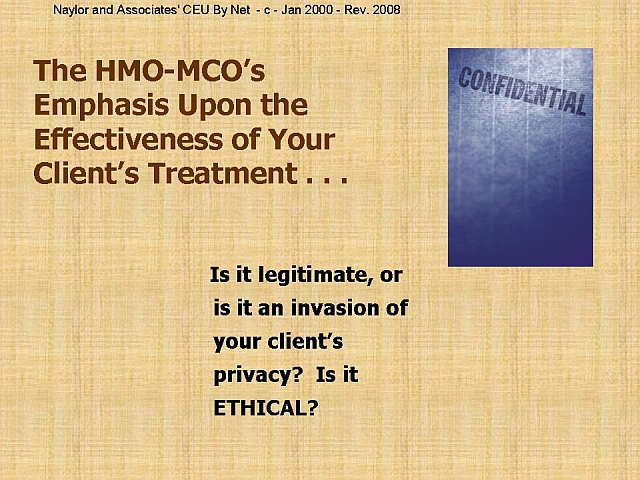
Is such scrutiny legitimate and ethical, or is it an invasion of your (and your client's) privacy? And is it ethical to provide the requested information? Do most states’ licensure standards SUPPORT - or OVERRULE - this type of documentation of a client's treatment information? The answer may surprise you.
GOALS of this course:
1. Understand the ETHICAL AND PRACTICAL impact of CARE MANAGEMENT (a.k.a., Managed Care) upon WHO gets treatment or related services, WHAT treatments and related services they may receive, and HOW MUCH of each intervention is allowed.
2. Identify the ETHICAL ISSUES faced by providers due to the Care Management approach to authorization of behavioral health services - in both the delivery of treatment services AND in the DOCUMENTATION of the Assessment, Diagnosis, and Response to treatment of intervention.
3. Understand the connection between the concept of ‘Medically Necessary Treatment’ and what must be DOCUMENTED in clients’ records, vis-à-vis the professional’s ETHICAL PRECEPTS and LICENSURE REQUIREMENTS.
4. Recognize how these new health care system requirements do in fact mesh and correlate with the longstanding ETHICAL and LEGAL requirements for practicing in the mental health and substance abuse treatment profession.
5. Learn how we can ETHICALLY and LEGALLY accommodate these new service and documentation requirements, while simultaneously meeting the requirements of our Provider Agreements.
6. Learn some creative, alternative treatment options which can lessen the provider's ETHICAL concerns when faced with denial of ‘traditional services’.
To view Study Guide 1 now CLICK HERE
To view Study Guide 2 now CLICK HERE
To view and print QUIZ 1 CLICK HERE
To view and print QUIZ 2 CLICK HERE
|
|
|
|
|
|
|
|
Course 2B - They're Coming to Audit WHEN? a.k.a. 'What Can Go WRONG In That Chart?' |
|
| |

Earn and download a certificate immediately upon completion of this module.
Only $17.50
No charge if you have a subscription
|
|
Course 2B - 'They're Coming to Audit WHEN?' - a.k.a, 'What Can Go WRONG in That Chart?'
This course is copyrighted and published by Marsha Naylor, MA, LPC, CEU By Net, Pendragon Associates LLC. The course earns 2.75 Clock Hours of credit for multiple State Boards including Florida, Texas, and Alabama, TCBAP-TAAP, IC&RC, NAADAC, California CCADE and CADTP, and Florida Certification Board. EACC 2.75 PDHs Domain I expires June 30, 2024 It also awards 1.75 CA BBS Hours and 1.75 NBCC Hours.
Based upon these credentials, the course credits are accepted by most state boards for multiple licenses.
This is a PDF formatted slide show course which addresses the details of effective documentation in client records, within a Managed System of Care. This includes the newly forming ACA Health Plans as well as any other COST-CONTROLLED mental health or addiction funding arrangement or contract. And it applies to both public and private providers, unless their work is strictly private pay.
Want to pass that TREATMENT RECORD AUDIT? Want to avoid RECOUPMENT of claims payments already paid to you, when your records are audited? Want to avoid embarrassment and anxiety when the MCO calls for a client's record, or their auditors show up unannounced at your door? This course tells you how.
Course 2B clearly illustrates 12 problematic 'documentation syndromes' which will sabotage even the best and most experienced clinicians - including the 'POORLY DOCUMENTED LEVEL OF CARE’ Syndrome, the ‘ZOMBIE CLIENT’ Syndrome, the ‘PERPETUAL CARE’ Syndrome, the ‘ANY-PATIENT ITP’ Syndrome, the ‘FAILURE TO MODIFY’ Syndrome, and several more. We tell you how to avoid those 12 deadly documentation problems - no matter which type of assessment, counseling or treatment setting you're in, if you must justify what you do with your clients.
This self-paced slide show describes in plain language what's 'DIFFERENT' about how we must DOCUMENT both ASSESSMENT and TREATMENT in mental health and AOD client records, compared to how we may have been trained, if we are working within a Health Care Reform environment. We give you useful and do-able tips on how to audit your own records - so that you are ready BEFORE the MCO, State auditor, or other contract manager arrives at your door or calls for a record (which is called a 'desk audit').
This popular course also provides a clear explanation about HOW managed care contractors make pre- or post-authorization decisions to approve or deny your requests for treatment OR your submitted claims, based upon your assessment and documentation of the treatment your client needs. We are very clear about the nature of WHAT you must write in the client's record to support that authorization, in an entirely ethical manner.
GOALS of This Course:
1. Know the Goals and Issues Associated With the Conversion to Managed Care (Health Care Reform)
2. Be Aware of the Ethical Issues Which Health Care Reform Brings to Providers When Requesting Authorization, and When Delivering and Documenting Assessment, Treatment and Response to Treatment.
3. Understand the Four CORE PRINCIPLES Which Govern Care Management's 'Medical Necessity' and 'Level of Care' Decisions About the Need for Treatment ..... and How This Meshes with Ethical Requirements for Treatment Professionals
4. Know Specific Approaches to Documentation In Client Records Under a 'Care Managed' Contact, i.e., How to Avoid 12 Problematic 'Documentation Syndromes' Which Can Sabotage Even the Most Experienced Clinicians.
To view Study Guide 1 now CLICK HERE
To view Study Guide 2 now CLICK HERE
To view Study Guide 3 now CLICK HERE
To view and print QUIZ 1 for free, CLICK HERE.
To view and print QUIZ 2 for free, CLICK HERE.
To view and print QUIZ 3 for free, CLICK HERE.
|
|
|
|
|
|
|
|
Course 2C - We Have to Change WHAT? |
|
| |

Earn and download a certificate immediately upon completion of this module.
Only $17.50
No charge if you have a subscription
|
|
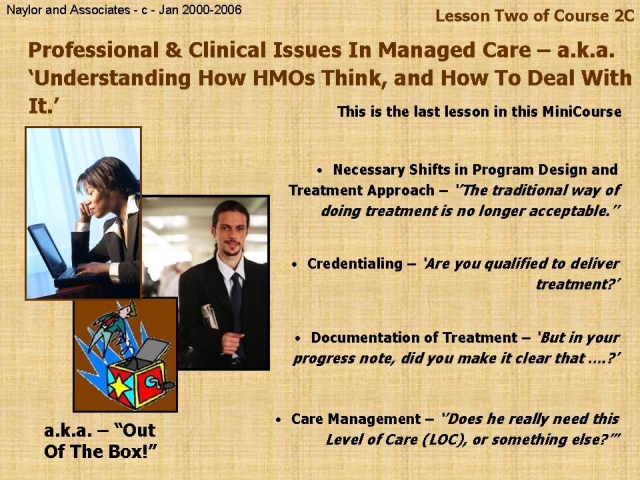
Course 2C - Introduction to Professional & Clinical Issues in Managed Care - Necessary Shifts in Program Design and Treatment Approach
This course is written, copyrighted, and published online by CEU By Net and earns 2 Clock Hours of credit for multiple State Boards including Florida, Texas, and Alabama, TCBAP-TCB-TAAP, IC&RC, NAADAC, California CCADE and CADTP, and Florida Certification Board. EACC 2 PDHs Domain I expires June 30, 2024. Also earns 2 NBCC Hours and 2 CA BBS Hours.
Based upon these credentials, this course is accepted by most state boards for multiple licenses.
This course is appropriate for both Mental Health and Chemical Dependency Treatment Providers - Counselors, Social Workers, LMFTs, etc..
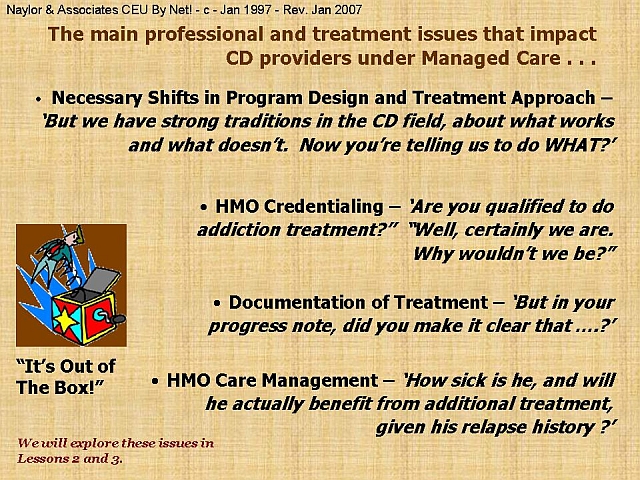
Some of this course's material overlaps Course 2B material (related to managed care goals, how managed care companies THINK, and how we have to change what we write in treatment records) . . . but then the course moves ahead to include professional, clinical, and programmatic CHANGES in store for professionals who are working under a Managed Care Provider Agreement. Of particular importance: We include specific, practical clinical examples of the 4 Core Concepts that guide and direct the Care Management process for approval or denial of treatment requests.
You can VIEW the Study Guides and Quizzes for FREE through the links at the bottom of this course description.
GOALS:
1. Obtain an Overview of the Basic Goals of Health Care Reform (aka, Managed Care), 'Why Are They Doing This To Us?'
2. Understand the Impact of the New Healthcare Industry's Goals Upon Us (The Providers) and Our Clients..
3. Learn To Think Like a Care Manager: Understand the * FOUR CORE CONCEPTS Which Drive Those 'Level Of Care' (LOC) Decisions, and Document Accordingly.
4. Understand How the Insurance Company or Plan Administrator's RISK Affects Providers In Their Professional Operations -- The Positives, The Challenges, and Examples of Creative Service and Treatment Approaches.
5. Review 'Provider Networks' As A Way to Survive the Major Health Care Shifts, Through 'Step-Down' and 'Step-Up' Referrals, and Sharing the Task of Service Delivery
* Note: The 'Four Core Concepts' have been mentioned briefly in other lessons .... but in this lesson we go into more detail about what they are:
1. Medical Necessity – Is the Treatment Needed to Improve, Maintain, or Prevent Deterioration?
2. Current Functionality – Diagnosis is Not Enough!
3. Treatment Goals & Interventions – Do They Match the Diagnosis and Functionality That Is Described in the Assessment and Elsewhere?
4. Progress – Is the Client Responding to Treatment, and Likely to Benefit with More?
Are you interested in this material, but want more credits than this course offers - and more information? Some of this material appears in MiniCourse 3A (3 credit hours total), and in FlexiCourse 5A (5 credit hours).
To view Study Guide 1 now CLICK HERE
To view Study Guide 2 now CLICK HERE
To view Study Guide 3 now CLICK HERE
To view and print QUIZ 1 for free, CLICK HERE
To view and print QUIZ 2 for free, CLICK HERE
To view and print QUIZ 3 for free, CLICK HERE
|
|
|
|
|
|
|
|
Ethics 4D - Ethics of Treatment Documentation and Other Ethical Dilemmas When Insurance and State Contracts Are Paying the Bill |
|
| |

Earn and download a certificate immediately upon completion of this module.
Only $28.00
No charge if you have a subscription
|
|
Ethics 4D - Ethics of Treatment Documentation and Other Ethical Dilemmas When Insurance and State Contracts Are Paying the Bill
This is an Ethics Course copyrighted and published by CEU By Net. This course is sponsored online by CEU By Net and earns 4 Clock Hours of credit for multiple State Boards including Florida and Texas, TCBAP-TAAP, IC&RC, NAADAC, California CCADE and CADTP, and Florida Certification Board. EACC 4 PDHs Domain I, II, III expires June 30, 2024 The course also awards 3.0 CA BBS Hours and 3.0 NBCC Hours. Based upon these credentials, course is accepted by most state boards for multiple licenses.
NOTE: Ethics 4D contains the same core material as the 3 credit-hour Ethics Course 3D, except that 4D includes additional material regarding these ethical issues, plus one additional Credit Hour. And so take either 3D or 4D, but not both.
This course is appropriate for Professional Counselors, LMHCs, LMFTs, Social Workers, Addiction and Substance Abuse Drug and Alcohol Counselors, CEAP providers, and other behavioral health practitioners.
Ethics 4D is a self-paced 3-part online slide show with content that's easy to understand and never boring - regarding the ETHICAL DILEMMAS and PRESSURES encountered on a daily basis by those whose clients' fees-for-service are paid by insurance, managed care, Employee Assistance Programs, self-insured companies, or other closely monitored state or local contracts which have reduction of healthcare cost as a mandate.
Behavioral health care services is now, more than ever before, carefully monitored for clear documented evidence of 'the medical necessity of treatment'. No longer considered to be a 'social service', mental health and addiction treatment is carefully monitored in terms of 'increments of service', 'duration of service', and 'medical necessity' for the type of service being provided. These issues are the basis for approval or denial of treatment requests, and the decisions are based upon what is DOCUMENTED in the client's treatment record - assessments, treatment plans, and progress notes.
This course is a close-up view of that sticky issue ... what to write (and not write) in a client's treatment record, from an ETHICS perspective, in this new era of tightly controlled health care costs. How much do you divulge about your ASSESSMENT of the client's DIAGNOSIS(ES), his prognosis, his functional status, and his response to treatment? What's ETHICAL - when the payor is demanding details? What's NECESSARY?
Is such scrutiny legitimate and ethical, or is it an invasion of your (and your client's) privacy? And is it ethical to provide the requested information? Do most states’ licensure standards SUPPORT - or OVERRULE - this type of documentation of a client's treatment information? The answer may surprise you.
GOALS of this course:
1. Understand the ETHICAL AND PRACTICAL impact of CARE MANAGEMENT (a.k.a., Managed Care) upon WHO gets treatment or related services, WHAT treatments and related services they may receive, and HOW MUCH of each intervention is allowed.
2. Identify the ETHICAL ISSUES faced by providers due to the Care Management approach to authorization of behavioral health services - in both the delivery of treatment services AND in the DOCUMENTATION of the Assessment, Diagnosis, and Response to treatment of intervention.
3. Understand the connection between the concept of ‘Medically Necessary Treatment’ and what must be DOCUMENTED in clients’ records, vis-à-vis the professional’s ETHICAL PRECEPTS and LICENSURE REQUIREMENTS.
4. Recognize how these new health care system requirements do in fact mesh and correlate with the longstanding ETHICAL and LEGAL requirements for practicing in the mental health and substance abuse treatment profession.
5. Learn how we can ETHICALLY and LEGALLY accommodate these new service and documentation requirements, while simultaneously meeting the requirements of our Provider Agreements.
6. Learn some creative, alternative treatment options which can lessen the provider's ETHICAL concerns when faced with denial of ‘traditional services’.
7. Review and understand additional ethics-related issues involved in the treatment of clients under a managed system of care - such as the health care insurers' contractual right to explore the PROVIDER's effectiveness and adherence to best practices in the treatment of individual clients, through review of the OUTCOME of an individual's treatment or intervention.
To view Study Guide 1 now CLICK HERE
To view Study Guide 2 now CLICK HERE
To view Study Guide 3 now CLICK HERE
To view and print QUIZ 1 for free, CLICK HERE
To view and print QUIZ 2 for free, CLICK HERE
To view and print QUIZ 3 for free, CLICK HERE
|
|
|
|
|
|
|
|
FREE Course 1B - It's Not Your Grandpa's Chevy - Intro to Goals, Clinical Concerns, and Opportunities In Behavioral Health Managed Care |
|
| |

Earn and download a certificate immediately upon completion of this module.
Only $0.00
No charge if you have a subscription
|
|
Course 1B - It's Not Your Grandpa's Chevy - Intro to Goals, Clinical Concerns, and Opportunities In Behavioral Health Managed Care
Course 1B is now updated and expanded! The course now addresses the trending and potential impact of the Affordable Care Act upon Behavioral Health providers. This is a FREE COURSE with a FREE CE CERTIFICATE. The course now earns 1.5 clock hours of CE credit for multiple State Boards including Texas, Florida and Alabama, and for TCBAP-TAAP, IC&RC, NAADAC, California CCADE and CADTP, and Florida Certification Board. EACC 1.5 PDHs Domain I, II, III expires June 30, 2024. It also awards 1.5 CA BBS Hours and 1.5 NBCC Credit Hours.
Based upon these credentials, this course is accepted by most state boards for multiple licenses.
This free course is a quick introduction to our online quiz and certificate process. It's also an introduction to the PDF 'SLIDE SHOW' format in which some of our courses are rendered. (Most of our courses are, however, NOT in this slide show format. The majority are text-based professional publications and training manuals. If you want to try an example of that format, sign up for Free Course 1D too!)
NOTE: As with ALL of the courses on this website, you can now READ the Study Guides and Quizzes for this course, for FREE - even before you decide if you want to register on the site or enroll in the course. Just click the links at the bottom of this course description. You may also ENROLL in the course for free, and take the quiz and earn your CE Certificate for free.
This is a 'non-traditional' course that you won't find anywhere else. The course is authored and copyrighted by Marsha Naylor, MA, LPC, CEU By Net, Pendragon Associates LLC.
The course addresses the key client record documentation issues facing providers who are involved in assessment, diagnosis, and treatment of mental health and addiction clients, under the Health Care Reform initiative which is driven by Managed Care, 'narrow networks', and limited funds.
The transition of Mental Health and AOD treatment to a MANAGED SYSTEM OF CARE is not new in some states, but in others it's a recent development. Regardless, the nationwide expansion of ACA Health Care Reform has brought new relevance to the 'Care Management' philosophy.
It's important to understand that Care Management is not only a process; it's a PHILOSOPHY which approaches approval for behavioral health services in a way that is difficult for many practitioners to accommodate.
Treatment within this venue requires new types of justification through WRITTEN CLINICAL DOCUMENTATION which surpasses that which was required in the past
Understanding of the 'Care Management' approach is important for those delivering intensive treatment, as well as to those REFERRING TO intensive treatment - and to most individuals delivering short term counseling [which is usually not considered to be "medical" in nature]. The issue here, is that the APPROACH to AUTHORIZATION of services is essentially one of DOCUMENTATION of "MEDICAL NECESSITY", even if what we are delivering is not "medical".
Our Managed Care series is applicable to all behavioral health providers - those in private practice who are participating in a "panel" or network, as well as those who work for a public or private agency involved in Medicare or Medicaid or Block Grant services or other such contracts - including the EAP provider, whose work is now often done under the auspices of a managed system of care, i.e., a contract manager. It's important to understand that Care Management is a PHILOSOPHY which approaches approval for behavioral health services in a whole new way, and requires WRITTEN JUSTIFICATION from those who deliver services which surpasses that which was required in the past
The first half of this course focuses upon the impact that Health Care Reform and Managed Systems of Care have upon providers and their clients. The second half of this short course focuses upon "Understanding How Managed Care ‘Thinks’ . . . An Introduction to the Clinical, Therapeutic, and Documentation Issues Which Drive the Care Management Process".
GOALS OF COURSE 1B – ‘Intro to Goals, Clinical Concerns, and Opportunities In Behavioral Health Managed Care – It's Not Your Grandpa's Chevy’
1. Obtain a Basic Understanding of the Scope and Impact of the Health Care Reform Movement, in Terms of a 'Managed System of Care', Which Affects 'Who' Gets 'What' Treatment.
2. Know the Current Trends and Potential Shifts In Who Directs and Delivers Treatment Under the Affordable Care Act (ACA).
3. Obtain an Introduction to Clinical Concerns and Requirements for Behavioral Health Professionals under a Managed System of Care - Approach to Client's Diagnosis, Prognosis, Treatment, Response or Lack of Response, and DOCUMENTATION of Same.
4. Understand the Concept of Care Management and Utilization Review – It’s a 'Medical Model' for all of us [even if we are delivering short term counseling which is typically not considered to be "medical" in nature].
5. Identify Clinical Approaches to Documentation of Need for Treatment and the Types of Intervention Programs Which Are Workable and Appropriate Under a Managed System of Care.
To view and print QUIZ 1 for free, CLICK HERE.
To view and print QUIZ 2 for free, CLICK HERE.
To view Study Guide 1 now CLICK HERE
To view Study Guide 2 now CLICK HERE
|
|
|
|
|
|
|
|
Course 3A - Managed Care - Is There Anything GOOD About It? |
|
| |

Earn and download a certificate immediately upon completion of this module.
Only $23.00
No charge if you have a subscription
|
|
Course 3A - Managed Care - Is There Anything GOOD About It? a.k.a., 'The Good, The Bad, and The Ugly of Providing Treatment Under Managed Care - The Perils and The Good Stuff.'
This course is copyrighted and published online by CEU By Net. The course earns 3 Clock Hours of credit for multiple State Boards including Florida, Texas, TCBAP-TCB-TAAP, IC&RC, NAADAC, California CCADE and CADTP, and Florida Certification Board. EACC 3 PDH Domain I, III expires June 30, 2024. Also awards 2.75 CA BBS Hours and 2.75 NBCC Hours.
Based upon these credentials, the course is accepted by most state boards for multiple licenses.
All of the material in 1B and 1C is included in this course, and then we expand on the clinical opportunities and perils for providers. We attempt to put to rest the question, 'So Is there really anything GOOD about Managed Care for Mental Health and Chemical Dependency professionals?' Oh yes indeed, there is!
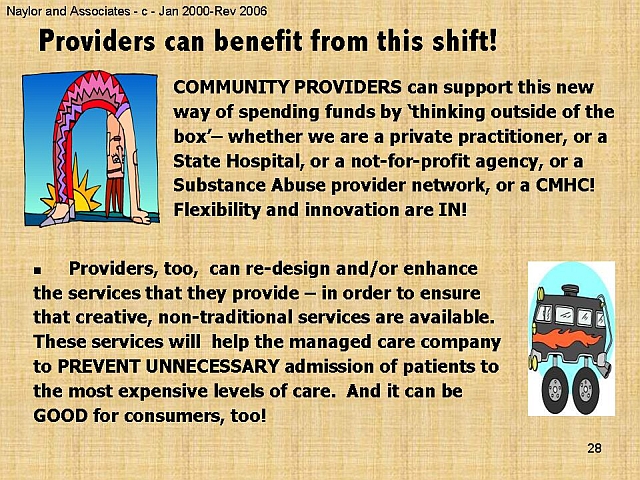
This course emphasizes how innovative, non-traditional counseling, case management, and support services can be provided under the new managed care models, particularly for difficult, recidivistic, high-risk clients - a natural fit for EAPs and AOD providers of Dual Diagnosis services.
Although 'managed care' has become known as an increasingly 'medical' model – necessitating that services be deemed essential to recovery and adaptive functioning – in this course we address the positive changes which this shift has brought to the behavioral health field, as well as the challenges. The 'positives' include flexible home-, job-, and school-based interventions utilizing non-institutional case management and support services for children/adolescents, adults and youth with substance abuse issues, and adults with depression and other mental health problems.
We provide the details of how Care Management departments make decisions to approve or disapprove requested services, and how these decisions must impact the way that you communicate clinical need for services and Level of Care. Such understanding is essential in order for providers to accommodate to this shift in treatment and counseling emphasis.
You can VIEW the Study Guides and Quizzes for FREE through the links at the bottom of this course description. Part of the material in this course is similar to some of the material found in FlexiCourses 4A and 5A.
GOALS:
1. Learn why Managed Care affects the way that we deliver services to clients with mental health and substance use disorders.
2. Understand how 'Managed Care' is designed to work in clinical settings and why adaptation of traditional therapeutic intervention approaches to persons with serious mental health and addiction disorders is essential.
3. Understand the 'Clinical Side' of the Care Manager's decision-making process - 'how Managed Care thinks' about the need for treatment and Level of Care - and how to give them the information they need.
4. Understand the gaps in clinical thinking which are oftentimes reflected in patient records - i.e., twelve 'documentation syndromes' that will result in negative Quality of Treatment reviews.
5. Know the importance of auditing your program's clinical records to identify clinical gaps and approaches that are 'unfriendly' to managed systems of care.
6. Learn about the ways that Managed Care can affect "Access to Treatment" and how providers can adapt the services they offer to offset the impact.
7. Learn creative ways to deliver treatment to persons with serious mental health and addiction disorders -- including non-traditional case management, wrap-around, and support services -- and how to 'sell' these approaches to your funding contractor.
PLEASE NOTE: Part of the material in this course is similar to some of the material found in other managed care courses on this website. For example, you will also find some similar information in Courses 2B and 2C about documentation, but 2B and 2C go into greater detail about audit issues and self-audit of your clients’ records.
To view and print QUIZ 1 for free, CLICK HERE
To view and print QUIZ 2 for free, CLICK HERE
To view and print QUIZ 3 for free, CLICK HERE
To view and print QUIZ 4 for free, CLICK HERE
To view Study Guide 1 now CLICK HERE
To view Study Guide 2 now CLICK HERE
To view Study Guide 3 now CLICK HERE
To view Study Guide 4 now CLICK HERE
|
|
|
|
|
|
|
|
Course 5A - Welcome to Care Management! Do They REALLY Need Treatment? |
|
| |
|
Course 5A - Welcome to Care Management! Do They REALLY Need Treatment?
|
This course is copyrighted and published online by Marsha Naylor, MA, LPC, CEU By Net - Pendragon Online LLC. The course incorporates information about the ongoing impact of the Affordable Care Act (ACA - a.k.a.ObamaCare) on treatment design and reimbursement and the effect on mental health and SUD clients. The concept of INTEGRATED Medical Care is now an inherent part of Managed Health Care philosophy, although most such integration still occurs in health care programs which are 'treatment models under study.'
There are THREE 'chapters' or 'modules' in this course - MC101, MC201, and MC301 - each of which earns a certificate.
The course earns a TOTAL OF 8 Clock Hours of credit for multiple State Boards including Texas Mental Health Boards, TCBAP-TCB-TAAP, IC&RC, NAADAC, California CCADE and CADTP, and Florida Certification Board. The three modules also award a total of 5.25 CA BBS Hours and 5.25 NBCC Hours.
EACC has approved it for a TOTAL of 8 PDHs in Domains 1, 3 - Renewed July 1, 2022. [Module 101 earns Domain I, III - 3.5 PDHs; Module 201 earns Domains I, III - 2.75 PDH; Module 301 earns 1.75 PDHs in Domains I, III.]
NOTE: For FLORIDA Mental Health, effective 3/29/2021 we are pulling this course out of our Florida CE Broker course listing until we can combine the 3 modules into a single certificate, for better uploading to CEBroker.
Based upon these credentials, this course is accepted by most state boards for multiple licenses.
You should NOT take both Managed Care Course 4A and Managed Care Course 5A. The content and goals for Modules 101 and 201 are the SAME in both courses. Course 5A has one additional module - Module 301, with additional credit.
Also if you'd rather study this material in smaller pieces, both 4A and 5A contain some material also found within a few of our smaller courses, e.g., 1B, 1C.
To view Study Guide 1 now CLICK HERE
To view Study Guide 2 now CLICK HERE
To view Study Guide 3 now CLICK HERE
To view and print QUIZ 1 which you take after Study Guide 2, CLICK HERE.
To view and print QUIZ 2 which you take after Study Guide 3, CLICK HERE.
To view Study Guide 1 now CLICK HERE
To view Study Guide 2 now CLICK HERE
To view Study Guide 3 now CLICK HERE
To view and print QUIZ 1 for free, CLICK HERE
.
To view and print QUIZ 2 for free, CLICK HERE.
To view and print QUIZ 3 for free, CLICK HERE.
To view Study Guide 1 now CLICK HERE
To view Study Guide 2 now CLICK HERE
To view Study Guide 3 now CLICK HERE
To view and print QUIZ 1 for free, CLICK HERE.
To view and print QUIZ 2 for free, CLICK HERE.
GOALS of Module 101:
1. Obtain an introduction to Goals and Objectives of Behavioral Health Managed Care [Health Care Reform] - 'Why Are They Doing This to Us?'
2. Understand the Concept of RISK BASED MANAGED CARE, including 'Capitation' [the Most Common Design of the Federal and State Managed Care Arrangements, Including Medicaid and Medicare.
3. Understand How This New Health Care Reform System Impacts Providers In Both Clinical And Financial Ways.
4. Know What Can Go Wrong in a Health Care Reform Environment - At Both the Insurance Company End and the Service Provider End, and Within The Delivery System
GOALS of Module 201:
1. Obtain Additional Understanding of the Impact of the New Healthcare System (Managed Behavioral Health Care, or Health Care Reform), Upon Providers and Their Clients
2. Know How to 'Adapt' in Your Program Design and Practices, When Providing Services Under a Managed Care Provider Arrangement
3. Learn About Several Creative Service Delivery Options For Treatment Providers Which Will Allow More Autonomy In Programming for MH and CD Clients Under a Care Management System.
4. Obtain a Basic Understanding of The Four Core Elements Which Determine Approval for Treatment, During the Care Management Process (i.e., what determines 'Medical Necessity' for treatment?)
GOALS of Module 301:
1. Understand How Health Care Reform Requires Out-of-the-Box, Flexible Thinking, Within Organizations and Provider Networks and EAP Programs, and As a Major Part of Discussions with MCOs
2. Obtain Additional Awareness of How the 'Care Management' Process and Its Four Core Principles Affect the Way That We Deliver and Document the Need for Treatment for Mental Health and Chemical Dependency Clients.
3. Understand How Program Design Must Make Room for Alternative Treatments and Interventions if It Is to Be Successful.
8.0 (or 0.8) CE credits for $28.00
|
|
|

|
Module 101 - from Courses 4A and 5A - Welcome to Care Management - and It's Not Your Grandpa's Chevy!
|
Earn and download a certificate immediately upon completion of this module.
|
|
|
|
|

|
Module 201 - from Courses 4A and 5A - The Good, the Bad, and the Ugly in Managed Health Care
|
Earn and download a certificate immediately upon completion of this module.
|
|
|
|
|

|
Module 301 - from Course 5A - Professional and Clinical Issues in Managed Care
|
Earn and download a certificate immediately upon completion of this module.
|
|
|
|
|
|
|
|
|
|
|
|
Managed Care Course 4A - This Is Managed Behavioral Health Care - and It's Not Your Grandpa's Chevy! |
|
| |
|
Managed Care Course 4A - This Is Managed Behavioral Health Care - and It's Not Your Grandpa's Chevy
|
This course is copyrighted and published online by Marsha Naylor, MA, LPC, CEU By Net - Pendragon Online LLC. The course incorporates information about the ongoing impact of the Affordable Care Act and the movement toward INTEGRATED MEDICAL CARE upon treatment design and reimbursement and upon mental health and SUD clients. Many states continue to advocate for maintaining this health care program, and the program is supported by populations in most states regardless of party affiliation.
There are TWO 'chapters' or 'modules' in this course - MC101 and MC201- each of which earns a certificate. You may take one or both.
The course earns a TOTAL OF 6.25 Clock Hours of credit for multiple State Boards including Texas Mental Health Boards, TCBAP-TCB-TAAP, IC&RC, NAADAC, California CCADE and CADTP, and Florida Certification Board for CAPs. The two modules also award a total of 6.25 for EACC in Domains I and III, for the two certificates. Earns 4.25 CA BBS Hours and 4.25 NBCC Hours.
EACC has approved the course for a TOTAL of 6.25 PDHs in Domains 1, 3 - Renewed July 1, 2022. [Module 101 earns Domain I, III - 3.5 PDHs, and Module 201 earns Domains I, III - 2.75 PDH.]
NOTE: For FLORIDA Mental Health, effective 3/29/2021 we are pulling this course out of our Florida CE Broker course listing until we can combine the 2 modules into a single certificate, for better uploading to CEB. Do NOT enroll in this course for Florida CE Broker credit as it will be rejected.
Based upon these credentials, this course is accepted by most state boards for multiple licenses.
NOTE FOR FLORIDA Mental Health licensees: Effective 3/29/2021 we have pulled this course out of our Florida CE Broker course listing until we can combine the 3 modules into a single certificate, for better uploading to CEB.
What's in this course? It's a straight-forward, no nonsense view of WHAT HAS CHANGED for Mental Health and AOD service providers with the arrival of health care reform around the country (aka, managed care, or managed systems of care) which has now moved beyond the impact of the ACA. We discuss what can go wrong in a State's or the Feds' design of its plans from the perspective of service delivery and its impact upon consumers and providers. We also discuss the impact of 'narrow networks' and 'Integrated Care' upon providers, which now affects EAP programs and private providers contracting with commercial insurance as well as public providers delivering Medicaid services.
Of great significance to treatment providers, is the issue of HOW the insurance companies make DECISIONS ABOUT APPROVAL OR DENIAL of care, i.e., Care Management. There are FOUR CORE PRINCIPLES that impact CARE MANAGEMENT decisions, and this course explains these clearly. Understanding these Core Principles of Care Management is crucial to how effectively we communicate our clients' need for treatment (verbally AND in the client's written record of treatment) including what type of treatment is needed, how much and for how long, their response to treatment, and the need for continued treatment.
DO NOT take both Managed Care Course 4A and 5A.
Course 4A contains the first two modules found in Managed Care Course 5A (101 and 201). Course 5A has one additional module - MC301.
To view Study Guide 1 now CLICK HERE
.
To view Study Guide 2 now CLICK HERE
To view Study Guide 3 now CLICK HERE
To view and print QUIZ 1 which you take after Study Guide 2, CLICK HERE.
To view and print QUIZ 2 which you take after Study Guide 3, CLICK HERE.
VIEW THE COURSE MATERIALS AND THE QUIZZES FOR MC201 BEFORE YOU ENROLL, IF YOU WISH.
To view Study Guide 1 now CLICK HERE
To view Study Guide 2 now CLICK HERE
To view Study Guide 3 now CLICK HERE
To view and print QUIZ 1 for free, CLICK HERE
.
To view and print QUIZ 2 for free, CLICK HERE.
To view and print QUIZ 3 for free, CLICK HERE.
Note: You will receive a separate certificate for each of the modules in the course.
GOALS of Module 101:
1. Obtain an introduction to Goals and Objectives of Behavioral Health Managed Care [Health Care Reform] - 'Why Are They Doing This to Us?'
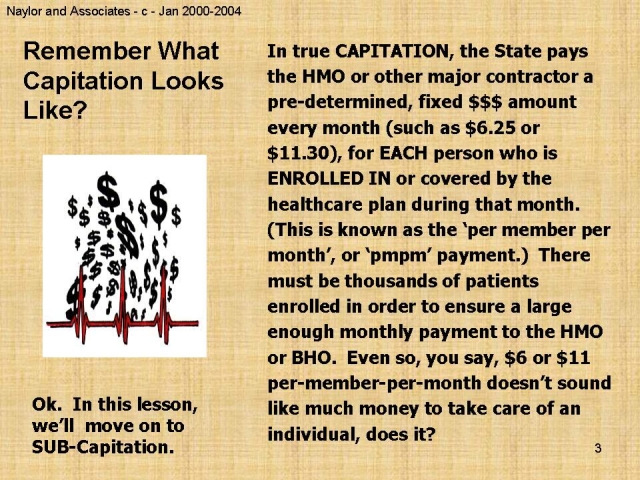
2. Understand the Concept of RISK BASED MANAGED CARE, including 'Capitation' [the Most Common Design of the Federal and State Managed Care Arrangements, Including Medicaid and Medicare.
3. Understand How This New Health Care Reform System Impacts Providers In Both Clinical And Financial Ways.
4. Know What Can Go Wrong in a Health Care Reform Environment - At Both the Insurance Company End and the Service Provider End, and Within The Delivery System
GOALS of Module 201:
1. Obtain Additional Understanding of the Impact of the New Healthcare System (Managed Behavioral Health Care, or Health Care Reform), Upon Providers and Their Clients
2. Know How to 'Adapt' in Your Program Design and Practices, When Providing Services Under a Managed Care Provider Arrangement
3. Learn About Several Creative Service Delivery Options For Treatment Providers Which Will Allow More Autonomy In Programming for MH and CD Clients Under a Care Management System.
4. Obtain a Basic Understanding of The Four Core Elements Which Determine Approval for Treatment, During the Care Management Process (i.e., what determines 'Medical Necessity' for treatment?)
6.25 (or 0.625) CE credits for $26.00
|
|
|

|
MC101 - from Managed Care Courses 4A and 5A - It's Not Your Grandpa's Chevy!
|
Earn and download a certificate immediately upon completion of this module.
|
|
|
|
|

|
MC201 - from Managed Care Courses 4A and 5A - The Good, the Bad, and the Ugly in Health Care Reform
|
Earn and download a certificate immediately upon completion of this module.
|
|
|
|
|
|
|
|
|
|
|
|
Course 1C - Capitation (Cost Containment) and You! How It Affects Referral and Treatment Services |
|
| |

Earn and download a certificate immediately upon completion of this module.
Only $10.00
No charge if you have a subscription
|
|
Course 1C - 'Capitation (Cost Containment) and You!' How It Affects the Way That We Deliver Referral and Treatment Services
This course is copyrighted and published by CEU by Net and awards 2 Clock Hours of CE Credit approved by multiple State Mental Health Boards including Texas, Florida, California CCADE and CADTP, Florida Certification Board, TCBAP-TCB-TAAP, NAADAC, and IC&RC. EACC 2 PDH Domain I expires June 30, 2024 The Course also awards 1.25 CA BBS Hours and 1.25 NBCC Hours.
Based upon these credentials, our courses are accepted by most states for multiple licenses.
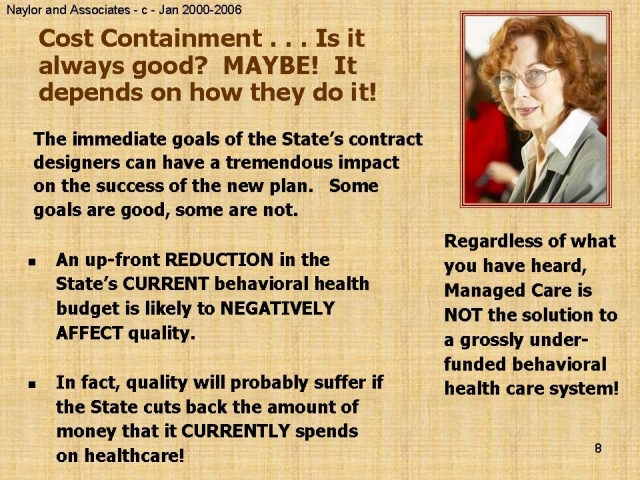
This course contains some of the same introductory material as in 1B, but it also provides additional information about how the idea of 'Cost Containment' actually works in practice - within the ACA or ObamaCare and in other Managed Care plans. How will it impact the work we do? Can mental health and AOD treatment providers and provider organizations (networks, agencies) succeed in these 'narrow network' arrangements? Can they have any autonomy? Can they use creativity in their service programs? (Answer: Yes, and we tell you 'how')
Also, you will learn 'which' programmatic designs have 'which' major implications for providers and their clients.
You can VIEW the Study Guides and Quizzes for FREE through the links at the bottom of this course description.
GOALS:
1. Understand the Impact of the Managed Care Approach within the ACA, Upon Providers and Clients - 'Narrow Networks', Vertical Integration of Healthcare, and 'Care Management'.
2. Understand the Risk Based Contracts That Are the Core of the ACA - and How Providers Can Adjust Their Referral and Treatment Approaches Constructively within This Cost Containment Framework.
3. Know Several Creative Service Delivery Approaches Which Promote Greater Autonomy In Programming For Mental Health And CD/SA Clients’ Providers.
IMPORTANT NOTE: If you buy this course 1C, please be aware that the material is also present in FlexiCourses 4A, 5A, and 10A. What's the difference? The FlexiCourses have a lot more material and more credits!
To view Study Guide 1 now CLICK HERE
To view Study Guide 2 now CLICK HERE
To view and print QUIZ 1 for free, CLICK HERE.
To view and print QUIZ 2 for free, CLICK HERE.
|
|
|