Earn Unlimited FREE CEUs from CEU By Net for an entire year with our Unlimited CEUs Subscription, only $49. Choose courses that are relevant to practice in a traumatized national milieu and within a changing system of behavioral health treatment.
View and print courses and quizzes for free, without registering on the site. Take two courses for FREE.
Earn Unlimited CE Credits in on our website for only $49 per year with no restrictions - approved by NBCC, EACC, NAADAC, IC&RC and most State Boards for Behavioral Health.
Courses include both 'traditional' and 'hot' topics
Ethics, TeleHealth, Models of Clinical Supervision, Trauma-Informed Care, Human Tafficking of Adolescents, Risk Management in the operation of mental health and addiction treatment programs.
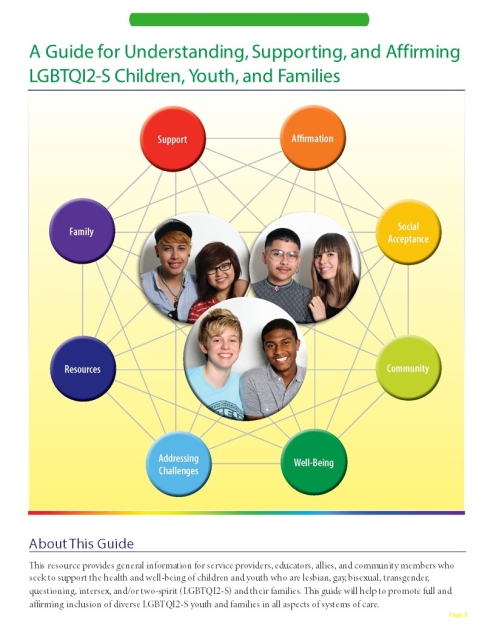
LGBTQ youth, families and children in Crisis, adult and adolescent Substance Use Disorders (SUD), Suicide Prevention with adolescents
Anger Management, PTSD, Cultural Awareness, Veterans with SUD, PTSD, and TBI
Identification and prevention of Medical Errors in Behavioral Health, and Clinical Supervision of behavioral health programs.
LINKS TO POPULAR COURSES
HOW TO FIND COURSES YOU WANT TO TAKE
CEU By Net offers more than 185 Clock Hours of CE Credit on this website. Go to the bottom of this page for a list of ALL the course titles we currently offer. If you are looking for a specific topic, click 'COURSES' on the menu bar above to find topics which interest you.
![]() ![]()
Please NOTE: You cannot actually take quizzes in the catalog. You are viewing a COPY of the quiz in the catalog. To actually take the quiz, you must log into your account, ENROLL IN THE COURSE, and take the quiz from INSIDE your account.
Here are specific instructions for enrolling in courses and taking quizzes.
(1) REGISTER to get a password and username
(2) Make sure you are LOGGED IN to your account when you are ready to enroll in a course
(3) CLICK the 'COURSES' tab on the menu bar to locate COURSE CATALOGS which interest you.
(4) In the course catalogs, click the + signs in front of course names to read the COURSE DESCRIPTIONS and ENROLL IN COURSES.
You can READ the course materials and the quizzes for FREE if you choose. You will find links to the course materials (a.k.a., 'Study Guides') and the quizzes by clicking the second + sign, at the BOTTOM OF EVERY COURSE DESCRIPTION.
You cannot actually take the quizzes from the links in the catalog; these catalog links are only for viewing the course materials and the quizzes. You must ENROLL in the course to take the quizzes.
(5) How to enroll? While logged in to your account with your username and password, you can ENROLL in a course by clicking 'SIGN UP NOW' to the left of the course description - and you can ignore the price tags below the 'Sign Up Now' button, IF you have an Annual Subscription
(6) After you click SIGN UP NOW, follow the prompts to PAY for the course - UNLESS you have an Annual Subscription, in which case you pay nothing to enroll
(7) To take the quiz(zes) for your course: While logged in, CLICK 'STUDENT HOME' on the menu bar to go to your 'My Home Page'. There you will see the titles of all the courses in which you have enrolled thus far. Each course title is an active link that will take you to the 'Study Guides and Quizzes' page for the course. CLICK THE NAME OF THE COURSE for which you want to take or print the quiz(zes).
(8) You will now be on the 'Study Guides and Quizzes' page for that course. You will see LINKS to download the course materials to your computer and to take the quiz(zes) online to earn your certificate.
You can also PRINT the quiz(zes) here before beginning to read the course. Mark quiz answers on your paper copy of the quiz, and then transfer your answers to the online quiz screen when you are ready to do that.
- Most of our courses have only one Study Guide (like a 'chapter') and one quiz. Some courses have more than one Study Guide (more than one 'chapter') and there will be a quiz for each Study Guide. For example: If there are three Study Guides in the course, you will take three quizzes.
- You will be able to see how many Study Guides and Quizzes there are in a course by either
(1) going to the bottom of the course description in the catalog where you can view all the study guides and quizzes for each course for free, or
(2) going to your My Home Page and CLICKING THE TITLE of a course in which you have enrolled. You will immediately see a link to each Study Guide and each Quiz in the course.
If you see three quiz links there, you will know that you have to pass three quizzes to get your certificate. If you see only one quiz link, you know that you have to pass only one quiz.
Remember that after you pass ALL the quizzes in a course (whether that's one or more than one), you must complete and submit the Feedback Form to get your certificate.
WHERE IS THE FEEDBACK FORM? When you have passed all the quizzes for a course (one or more than one) you will see a big blue link that says "Congratulations! You are almost done! Please complete the feedback form, to get your certificate."
If you need to find the Feedback Form or something else later (like your certificate), go to your My Home Page and click the name of the course. We will take you there. Think of your 'My Home Page' as 'home base' for all of the courses in which you have enrolled.
|
| |
CLICK THE + IN FRONT OF ANY COURSE TITLE, BELOW
TO LOOK FOR A SPECIFIC TOPIC, CLICK 'COURSES' ON THE MENU BAR ABOVE
AND SCROLL DOWN THE DROP-DOWN LIST
![]()
|
|
|

|
|
Course 6TBI—TBI Toolkit for Counselors |
|
| |
Earn and download a certificate immediately upon completion of this module.

Only $22.00
No charge if you have a subscription
|
|
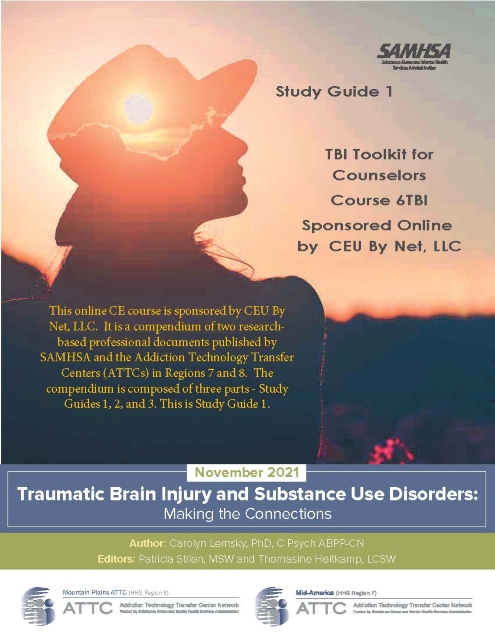
Course 6TBI—TBI Toolkit for Counselors
This Course 6TBI—TBI Toolkit for Counselors—trains mental health and addiction professionals in the medical definition and implications of Traumatic Brain Injury (TBI) from mild brain damage to coma, and from infant to adult. Understand the significant difference in the therapeutic approach needed for assessing and counseling clients with both TBI and substance abuse issues compared to traditional assessment and counseling approaches with SUD and MI clients who do not have a Traumatic Brain Injury.
The course awards 6 CEUS. For NBCC and California, earns 4 Credit Hours
Goals of the Course:
1. Know the medical definition and implications of Traumatic Brain Injury (TBI) within the various lobes of the brain—from mild brain damage to coma, and from infant to adult.
2. Know the causes and varying levels of mental impairment sustained in Traumatic Brain Injury—caused by the impact of hard objects against the skull or by hypoxia and anoxia when the brain is deprived of oxygen, such as occurs in drug overdoses or choking during intimate partner violence.
3. Understand the vital function of the frontal lobe—including how TBI, drugs, and alcohol impact the function of this critical area of the brain; know what occurs when a client with TBI chooses to use alcohol and other substances during and after recovery.
4. Learn the adaptations needed for individual and group counseling of clients with co-occurring TBI and substance abuse issues, compared to traditional counseling approaches with clients who do not have a Traumatic Brain Injury.
5. As a behavioral health provider, understand the difficulty of the recovery process for clients with TBI to prevent misattribution of behaviors as uncooperative or passive.
6. Understand how and why confusion and memory deficits inherent in TBI complicate follow-through with plans and new routines, and learn the strategic way to address these issues.
7. Know research-validated approaches to working with adults and children with TBI with varying levels of cognitive impairment and those with co-occurring behavioral health issues that complicate the treatment of the physical aspects of the injury.
Published and authored by: Author Carolyn Lemsky, PhD, C Psych ABPP-CN, Mountain Plains Addiction Technology Transfer Center; Mid-America Addiction Technology Transfer Center; Editors Patricia Stilen, MSW and Thomasine Heitkamp, LCSW; SAMHSA
Note: You are free to read, download, save, and print the Study Guide(s) and Quiz(zes) for this Course, before deciding to enroll in the course. These course materials are public domain, and CEU By Net is sponsoring the course for CE Credit. You may STUDY THIS COURSE and the quiz AT NO CHARGE. You may enroll in the course at any time. You must take the quiz ONLINE, by logging into your
My Home Page
, clicking on the course you want to complete, completing the quiz or quizzes required, and submitting the Feedback Form. You will then instantly receive your course completion certificate! For more information on this course - and to see a COPY of the online quiz - click the '+' symbols, below:
|
|
|
Course 6TBI - ToolKit for TBI - Guide 1 |
|
| |
Click here
to view this study material.
Click here
to view and print the quiz you will take for this material.
|
|
|
|
|
Course 6TBI - ToolKit for TBI - Guide 2 |
|
| |
Click here
to view this study material.
Click here
to view and print the quiz you will take for this material.
|
|
|
|
|
Course 6TBI - ToolKit for TBI - Guide 3 |
|
| |
Click here
to view this study material.
Click here
to view and print the quiz you will take for this material.
|
|
|
|
|
|
|
|
|
|
Course 4SUD - Surviving the Overdose—But Now What |
|
| |

Earn and download a certificate immediately upon completion of this module.
Only $21.00
No charge if you have a subscription
|
|
Course 4SUD - Surviving the Overdose—But Now What
This Course 4SUD — 'Surviving the Overdose—But Now What?' is sponsored online by CEU By Net. The course earns 4 Clock Hours of credit for multiple National and State Mental Health and Addiction Licensing and Certification Boards including NAADAC, IC&RC, Texas Mental Health Boards, Texas' TCBAP-TCB-TAAP, Florida CE Broker, and Florida Certification Board for CAP. The course also awards 2.5 Credit Hours for NBCC and California BBS.
Based on these credentials, the course is an acceptable source of continuing education for most state mental health and addiction licensing boards.
The course material in this sponsored course is newly revised and published in 2024 by the Substance Abuse and Mental Health Services Administration (SAMHSA). The training document contains two sections, both of which are published by SAMHSA—'Now What? The Role of Prevention Following a Nonfatal Opioid Overdose' and 'The Overdose Prevention and Response TOOLKIT.'
The publication focuses on the essential discharge activity and the immediate follow-up actions that are necessary when individuals and their family or friends leave the ER following survival of a near-fatal overdose. The goal is to prevent the risk of a repeated overdose and fatality.
The discharge protocol may or may not include a plan for abstinence or connection to a SUD treatment program. The intervention is a HARM REDUCTION model, which emphasizes that the path to recovery must be determined by the individual. After a near-fatal overdose, the individual may not choose abstinence and may not be ready for SUD treatment interventions despite their near-death experience. The role of the Recovery Specialist is to support the individual in their goals and assist in development of a plan to keep the individual SAFE despite continued use of drugs.
The second section of the course—the SAMHSA 'Toolkit'—provides enlightening information about Opioids including Fentanyl that are causing thousands of deaths annually, and other drugs and lethal combinations such as cocaine and methamphetamines that are also increasingly responsible for fatal overdoses.
The information in this course addresses the physical impact of the various drugs and the critical signs (including cessation of breathing) of impending fatal overdose, plus the steps to take when witnessing and responding to an overdose, including restoration of breathing and the administration of Opioid Overdose Reversal Medications (OORM) such as naloxone. The inevitable physical experience of acute withdrawal and some ways to safely reduce the impact are also addressed.
GOALS OF THIS COURSE:
1. Know the immediate and subsequent actions that are necessary when individuals and their family or friends leave the ER after a near-death overdose—including connecting them to people and practices that reduce the risk of re-overdose and fatality.
2.Learn how to support and keep overdose survivors SAFE with Harm Reduction planning—however that is defined by the individual, which may or may not include abstinence or participation in a SUD treatment program.
3. Understand the nature of the physical impact on the body of the various opioid and stimulant drugs and the critical signs (including cessation of breathing) of an impending fatal overdose.
4. Know how to use a lifesaving Opioid Overdose Reversal Medication (OORM) kit, including when and how to administer the medication (by injection or nasal spray), when to repeat a dose, and what to do after breath is restored.
5. Learn the physical impact on the body associated with the various lifesaving Opioid Overdose Reversal Medications (OORMs), and ways to possibly reduce the severity of the associated withdrawal experience.
6. Know why a 'community approach' to post-overdose recovery is essential, and how to facilitate it.
7. Learn the unique issues associated with Prescription Opioids and how to help patients develop a personal plan to maintain safety—including the response to changes in pain levels due to medication tolerance.
8. Have immediate access to multiple resources recommended by SAMHSA, via active links.
Note: You are free to read, download, save, and print the Study Guide(s) and Quiz(zes) for this Course, before deciding to enroll in the course. These course materials are public domain, and CEU By Net is sponsoring the course for CE Credit. You may STUDY THIS COURSE and the quiz AT NO CHARGE. You may enroll in the course at any time. You must take the quiz ONLINE, by logging into your
My Home Page
, clicking on the course you want to complete, completing the quiz or quizzes required, and submitting the Feedback Form. You will then instantly receive your course completion certificate! For more information on this course - and to see a COPY of the online quiz - click the '+' symbols, below:
|
|
|
Guide 1 - Course SUD |
|
| |
Click here
to view this study material.
Click here
to view and print the quiz you will take for this material.
|
|
|
|
|
Guide 2 - Course 4SD |
|
| |
Click here
to view this study material.
Click here
to view and print the quiz you will take for this material.
|
|
|
|
|
|
|
|
|
|
Course 4V - Public Mass Shootings - Predictive Factors, Challenges, & Prevention |
|
| |
Earn and download a certificate immediately upon completion of this module.
Only $21.00
No charge if you have a subscription
|
|
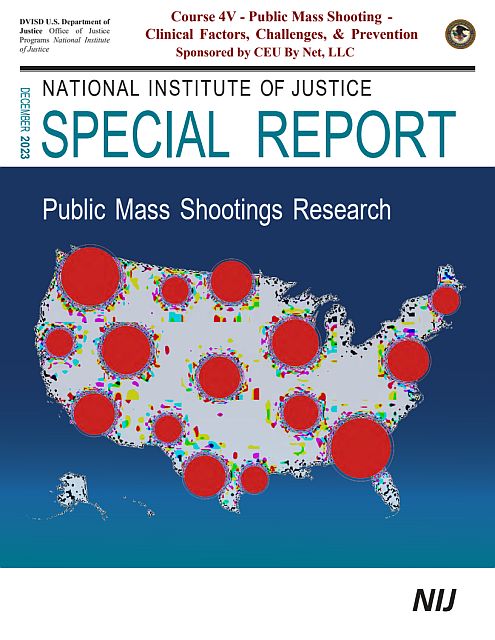
Public Mass Shootings — Predictive Factors, Challenges, & Prevention
This Course 4V, Public Mass Shootings — Predictive Factors, Challenges, & Prevention — is sponsored online by CEU By Net. The course earns 4 Clock Hours of credit for multiple State Mental Health and Addiction Boards including Texas Mental Health Boards, Florida CE Broker, Texas' TCBAP-TCB-TAAP, Florida Certification Board for CAP, IC&RC, and NAADAC. The course also awards 2.5 Credit Hours for California BBS and NBCC.
Based on these credentials, the course is an acceptable source of continuing education for most state mental health and addiction licensing boards.
This Special Report was published in December 2023 by the U.S. Department of Justice, Office of Justice Programs, National Institute of Justice, Nancy La Vigne, Ph.D., Director.
Say the authors, “This Special [Dec 2023] Report of the National Institute of Justice (NIJ) presents a synthesis of select findings from over 60 publications on 18 NIL-supported research projects on public mass shootings, including school mass shootings, since 2014. It also identifies areas of need and interest for future research and recommendations."
Goals of this course:
1. Learn to recognize patterns of behavior that may foreshadow mass shootings — specifically public mass shootings.
2. Understand some of the mental well-being challenges faced by people who plan and commit mass public shootings—such as the trauma of being bullied or friendless—and the strategic responses that may avert tragedy when indicators appear.
3. Learn key factors and challenges that currently serve as barriers to the advance detection and prevention of public mass shootings, particularly in K-12 schools.
4. Understand the widespread CULTURAL impact of public mass shooting in America — including the impact on the American POLITICAL environment and the significance of SOCIAL MEDIA as a key to recognizing impending mass shootings.
5. Understand why indicators of planned shootings, including leaking of plans online and verbally to peers, are often not pursued — particularly in K-12 schools — and specific activities to overcome this 'culture of silence' obstacle.
6. Learn the recommendations of the National Institute of Justice for interventions to use when shooting plans are detected and recommendations of actions to avoid after a shooting occurs.
7. Understand the impact of media coverage that currently distorts public and cultural perceptions about those who commit mass public shootings, and therein discourages accurate prediction and prevention of such events.
8. Know the varying functions of different types of firearms, the preferences of mass shooters, and the implications for legislative action at the State and local levels.
Note: You are free to read, download, save, and print the Study Guide(s) and Quiz(zes) for this Course, before deciding to enroll in the course. These course materials are public domain, and CEU By Net is sponsoring the course for CE Credit. You may STUDY THIS COURSE and the quiz AT NO CHARGE. You may enroll in the course at any time. You must take the quiz ONLINE, by logging into your
My Home Page
, clicking on the course you want to complete, completing the quiz or quizzes required, and submitting the Feedback Form. You will then instantly receive your course completion certificate! For more information on this course - and to see a COPY of the online quiz - click the '+' symbols, below:
|
|
|
Course 4V - Public Mass Shootings - Guide 1 |
|
| |
Click here
to view this study material.
Click here
to view and print the quiz you will take for this material.
|
|
|
|
|
Course 4V - Public Mass Shootings - Guide 2 |
|
| |
Click here
to view this study material.
Click here
to view and print the quiz you will take for this material.
|
|
|
|
|
|
|
|
|
|
Course 8T - Human Trafficking of Adolescents in America - Ethics, Culture, Identification, Assessment, and Rescue |
|
| |

Earn and download a certificate immediately upon completion of this module.
Only $22.00
No charge if you have a subscription
|
|
Course 8T - Human Trafficking of Adolescents in America—Ethics, Culture, Identification, Assessment, and Rescue
CEU By Net, LLC sponsors this online course, 'Course 8T - Human Trafficking of Adolescents in America — Ethics, Culture, Identification, Assessment, and Rescue'
Spread these 8 hours of CE credit to apply to several CE categories including General, Cultural Competence, Abuse and Neglect, LGBTQ, Trauma, Assessment, etc.. Approved by NBCC, NAADAC, IC&RC, and most other states.The course earns 8 credit hours (CEUs) that you can apply to multiple continuing education categories including SUD and mental health Assessment, Cultural Awareness; Federal and State Laws and Rules; Ethics, Crisis Intervention and Trauma-Informed Care; LGBTQ youth; interagency and community coordination; abuse, neglect, exploitation, and more.
The course earns 8 CEUs for Texas and most other states nationwide for mental health and addiction licenses and certifications, and 8 hours for NAADAC and IC&RC. Earns 6 credit hours for NBCC and California BBS (and applies to your required 6 hours of Laws and Ethics for BBS).
This course presents an ethical, sensitive, and culturally appropriate approach to identifying, assessing, and assisting minors who are victims of Human Trafficking, including coordination with local and Federal Law Enforcement in the prosecution of trafficking perpetrators.
The course material includes a printable, downloadable prototype assessment for use with trafficking victims, which is important in securing interagency services for survivors and successful prosecution of perpetrators. The course also explains the Federal laws applying to the trafficking of minors vs. adults and clarifies common misunderstandings about what constitutes 'trafficking.'
The GOALS of this course:
1. Learn the focus, approach, and achievements of the US Department of Justice and its partner organizations in the National Strategy to Combat Human Trafficking.
2. Understand the Federal laws and legal definitions of Human Trafficking for both minors and adults as defined in the Trafficking Victims Protection Act (TVPA); know how to recognize the various forms of sex and labor trafficking to which victims are submitted which violate their Human Rights; and understand the volitional difference between Human Trafficking and Prostitution in Adults.
3. Learn a research-based ETHICAL and CULTURALLY AWARE approach to assisting adolescent victims of Human Trafficking with the development of personal SAFETY strategies and methods of escape from the perpetrator.
4. Become familiar with the ETHICALLY formulated Trafficking ASSESSMENT content that is required for the successful prosecution of human trafficking perpetrators. Includes victim-centered language and questions, awareness of trauma-sensitive dynamics, sensitivity to safety issues, and respect for the victim's right to PRIVACY and CONFIDENTIALITY.
5. Understand the ETHICAL ISSUES and PROFESSIONAL CHALLENGES involved when working with the law enforcement team—i.e., the inherent limitations placed on CLIENT CONFIDENTIALITY, to successfully prosecute the perpetrator; and the need for both the credentialed staff and the unlicensed staff to maintain compliance with the rules for SCOPE of PRACTICE.
6. Know the characteristics and methods of Human Trafficking perpetrators and the diverse settings in which they operate, violating the FEDERAL LAW in the United States and the HUMAN RIGHTS of the victim.
7. Understand the typical etiology of how Human Trafficking exploitation and abuse occur in the lives of homeless and runaway youth, and the reasons why escape is difficult or impossible without TRAUMA Informed assistance and INTERAGENCY COORDINATION between LAW enforcement, SOCIAL SERVICES, and behavioral health professionals.
8. Understand the role of drugs, alcohol, homelessness, and survival sex in the deprivation of human rights which is characteristic of Human Trafficking.
9. Know an ethical way to work with trafficking victims to develop a safety plan at various stages in the human trafficking situation – while a victim is in the situation, during the process of leaving, and once the victim has left – and how to ensure safety for staff within the program.
10. Recognize the impact of the COVID-19 Pandemic upon resources for homeless and runaway adolescents who are targets of Human Trafficking perpetrators.
AUTHORS, PUBLISHERS: The material in this manual is published and copyrighted in the public domain by the U.S. Department of Justice, U.S. Department of Health and Human Services, SAMHSA, U.S. Office of Victims of Crime, Homeland Security, The Polaris Project, and Family & Youth Services Bureau - Runaway and Homeless Youth Training & Technical Assistance Center - National Safe Place Network.
APPROVALS:
NBCC, California BBS (including Laws and Ethics), Texas Mental Health licensing boards, Texas TCBAP-TCB-TAAP, NAADAC, IC&RC, Florida Certification Board (FCB), Florida Board of Clinical Social Work, Marriage and Family Therapy and Mental Health Counseling. Based on these approvals, the course is approved by most mental health and addiction licensing boards.
Note: You are free to read, download, save, and print the Study Guide(s) and Quiz(zes) for this Course, before deciding to enroll in the course. These course materials are public domain, and CEU By Net is sponsoring the course for CE Credit. You may STUDY THIS COURSE and the quiz AT NO CHARGE. You may enroll in the course at any time. You must take the quiz ONLINE, by logging into your
My Home Page
, clicking on the course you want to complete, completing the quiz or quizzes required, and submitting the Feedback Form. You will then instantly receive your course completion certificate! For more information on this course - and to see a COPY of the online quiz - click the '+' symbols, below:
|
|
|
Guide 1_Course 8T_Human Trafficking of Adolescents in America |
|
| |
Click here
to view this study material.
Click here
to view and print the quiz you will take for this material.
|
|
|
|
|
Guide 2_Course 8T_Human Trafficking of Adolescents in America |
|
| |
Click here
to view this study material.
Click here
to view and print the quiz you will take for this material.
|
|
|
|
|
Guide 3_Course 8T_Human Trafficking of Adolescents in America |
|
| |
Click here
to view this study material.
Click here
to view and print the quiz you will take for this material.
|
|
|
|
|
|
|
|
|
|
Course 8K - Harm Reduction Strategies & Challenges with Co-Occurring HIV, SUD, & Mental Disorders |
|
| |
Earn and download a certificate immediately upon completion of this module.
Only $23.00
No charge if you have a subscription
|
|
Course 8K - Harm Reduction Strategies & Challenges with Co-Occurring HIV, SUD, and Mental Disorders
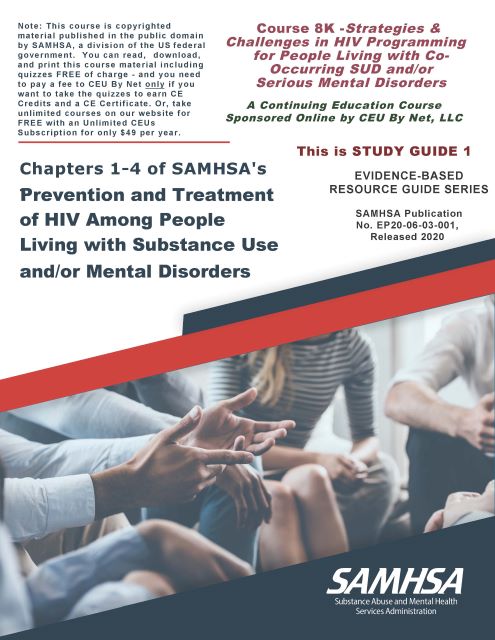
This Continuing Education course is sponsored online by CEU By Net, LLC. The course is an expansion of the shorter Course 1K, to which we have added Chapters 1, 2, and 3 extracted from the larger document written and copyrighted by SAMHSA, published in the public domain in 2020 with a forward updated in May 2021 by the U.S. Department of Health and Human Services,
This continuing education course earns 8 CEUs for TCBAP-TCB-TAAP, California CAADE and CADTP, NAADAC, IC&RC, Florida Certification Board (FCB), Florida and Texas Mental Health Boards, and CE Broker. Also earns 6 credit hours for NBCC and California BBS. EACC Approval for 8 PDHs in Domains I, II, III - expired June 30, 2024.
Based upon these credentials, 8 course credits are accepted by MOST MENTAL HEALTH and ADDICTION licensing boards nationwide.
This CE course contains 4 of the 5 chapters of the SAMHSA document entitled 'Prevention and Treatment of HIV Among People Living with Substance Use and/or Mental Disorders' -- published by SAMHSA in the public domain in 2020 with a May 2021 forward by Elinore F. McCance-Katz, MD, Ph.D., Assistant Secretary for Mental Health and Substance Use, U.S. Department of Health and Human Services.
The course document is the result of a collaboration of expert panels of federal, state, and non-governmental participants who provided input for each of the chapters in the document. Panel members include accomplished scientists, researchers, service providers, community administrators, federal and state policymakers, and people with lived experience.
Compared to Course 1K, this Course 8K presents a more extensive examination of current approaches and challenges encountered in the prevention and treatment of HIV in people living with co-occurring SUD and/or SMI or SED. The course also presents current evidence of the effectiveness of programs and strategies used to treat and prevent HIV among people with co-occurring behavioral health disorders.
The course includes practical information from currently operating treatment and prevention models to consider when selecting and implementing your own programs and practices.
The emphasis in the design of the three research-validated programs is upon PREVENTION and TREATMENT of HIV and HARM REDUCTION in people who use and inject drugs and may engage in unprotected sex. The models encourage the improvement of overall mental and physical health in clients with HIV and co-occurring disorders through psychosocial programming.
The three model programs feature practices to increase adherence and uptake of viral suppression and preventative drugs, including pre-exposure prophylaxis (PrEP), post-exposure prophylaxis (PEP), syringe exchange programs (SEP), Contingency Management (CM), Patient Navigation (PN), and linkage and retention.
We have extracted the extensive list of references for all of these chapters, and placed them at the end of the course as attachments with active links to the referenced documents. You can review and download any of this reference material for use now and in the future. You will not be tested on the reference documents but they provide valuable added perspective to the course material and resources which you can use in your program or practice now and in the future.
The document is the result of a collaboration of expert panels of federal, state, and non-governmental participants who provided input for each of the chapters in the document. Panel members include accomplished scientists, researchers, service providers, community administrators, federal and state policymakers, and people with lived experience
.
The Goals of This Course:
1. Learn the details of three research-validated service delivery models in diverse settings in which HIV can be effectively prevented and treated in persons living with HIV and concurrent SUD and/ or Mental Illness, including those who may engage in unprotected sex.
2. Learn effective approaches with varying CULTURAL populations to encourage uptake and consistent compliance with (a) Pre-Exposure Prophylaxis (PrEP - prevention of HIV when exposed to the virus), and (b) Post-Exposure Prophylaxis (PEP), and (c) suppression of the HIV virus in those who have contracted HIV (ART - Antiretroviral Therapy)..
3. Understand the roles of Biomedical Intervention, Psychosocial Intervention, and awareness of cultural characteristics in the prevention and treatment of HIV and other Sexually Transmitted Diseases in persons with concurrent behavioral health disorders (SUD and mental illness).
4. Learn how Syringe Exchange programs are successfully integrated within communities and the most effective approach to implementation with persons with concurrent behavioral health disorders.
5. Learn the role of Peer Health Navigation (PHN) and Contingency Management (CM) in achieving behavioral and biomedical targets, including transgender women of color who are at risk for or have HIV and concurrent behavioral health disorders.
6. Know why it is critical that programs primarily serving people with serious mental illness and SUD (a) assess their clients for HIV risk, (b) conduct HIV testing, and (c) provide medically and behaviorally integrated HIV prevention and treatment services to address their complex needs.
7. Understand the errors in the design of HIV programs which result in unsuccessful or reduced HIV viral suppression -- particularly with those living with a concurrent diagnosis of SUD and/or Mental Illness.
8. Understand that the model HIV treatment and prevention programs presented in this course must be modified as needed, to meet the needs, living circumstances, and cultural characteristics of the local population.
Note: You are free to read, download, save, and print the Study Guide(s) and Quiz(zes) for this Course, before deciding to enroll in the course. These course materials are public domain, and CEU By Net is sponsoring the course for CE Credit. You may STUDY THIS COURSE and the quiz AT NO CHARGE. You may enroll in the course at any time. You must take the quiz ONLINE, by logging into your
My Home Page
, clicking on the course you want to complete, completing the quiz or quizzes required, and submitting the Feedback Form. You will then instantly receive your course completion certificate! For more information on this course - and to see a COPY of the online quiz - click the '+' symbols, below:
|
|
|
Guide 1 - Course 8K |
|
| |
Click here
to view this study material.
Click here
to view and print the quiz you will take for this material.
|
|
|
|
|
Guide 2 - Course 8K |
|
| |
Click here
to view this study material.
Click here
to view and print the quiz you will take for this material.
|
|
|
|
|
Guide 3 - Course 8K |
|
| |
Click here
to view this study material.
Click here
to view and print the quiz you will take for this material.
|
|
|
|
|
|
|
|
|
|
Course 1K - Introduction to Effective Harm-Reduction Strategies for Prevention and Treatment of HIV in Persons with Co-Occurring Behavioral Health Disorders |
|
| |
Earn and download a certificate immediately upon completion of this module.
Only $18.00
No charge if you have a subscription
|
|
Course 1K - Introduction to Effective Harm-Reduction Strategies for Prevention and Treatment of HIV in Persons with Co-Occurring Behavioral Health Disorders
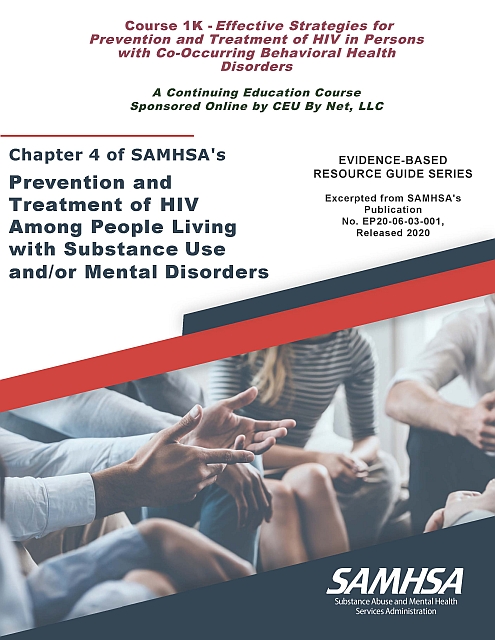
This short Continuing Education course is sponsored online by CEU By Net, LLC. The course content is written and copyrighted by SAMHSA, published in the public domain in 2020 with a forward updated in May 2021. SAMHSA presents current, research-validated strategies for the prevention and treatment of persons who are living with HIV concurrent with SUD and/or Mental Disorders, with an emphasis on HARM REDUCTION. The course materials examine three currently operating community-based programs that utilize emerging and best practices for working with this population and identify the challenges and strategies for implementation.
The three model programs utilize client-centered, harm-reduction approaches in diverse settings that have demonstrated effectiveness in treating persons with concurrent HIV and Substance Use and/or Mental Disorders, as well as prevention of HIV in this vulnerable behavioral health population. The strategies described are part of a comprehensive HIV program.
The programs feature practices to increase uptake and improve adherence to pre-exposure prophylaxis (PrEP), post-exposure prophylaxis (PEP), syringe exchange programs (SEP), Contingency Management (CM), Patient Navigation (PN), and linkage and retention.
This continuing education course earns 2 CEUs for TCBAP-TCB-TAAP and Texas BHEC, NAADAC, IC&RC, and Florida Certification Board (FCB), Florida Mental Health Board, CE Broker and most states. Earns 1.75 for Florida Mental Health licenses, and 1.25 credit hours for NBCC and California BBS. EACC 2 PDHs Domain I, II, III expires June 13, 2025
Based upon these credentials, the course credits are accepted by MOST MENTAL HEALTH and ADDICTION licensing boards nationwide.
This CE course contains Chapter 4 of the larger SAMHSA document entitled 'Prevention and Treatment of HIV Among People Living with Substance Use and/or Mental Disorders' -- published by SAMHSA in the public domain in 2020 with a May 2021 forward by Elinore F. McCance-Katz, MD, Ph.D., Assistant Secretary for Mental Health and Substance Use, U.S. Department of Health and Human Services.
The document is the result of a collaboration of expert panels of federal, state, and non-governmental participants who provided input for each of the chapters in the document. Panel members include accomplished scientists, researchers, service providers, community administrators, federal and state policymakers, and people with lived experience
The Goals of This Course:
1. Learn the details of three research-validated service delivery models in diverse settings in which HIV can be effectively prevented and treated in persons living with HIV and concurrent SUD and/ or Mental Illness, including those who may engage in unprotected sex.
2. Learn the effective approach to encouraging uptake and consistent compliance with Pre-Exposure Prophylaxis (PrEP) and post-exposure prophylaxis (PEP) in various CULTURAL populations, including transsexual women and gay men.
3. Understand the roles of Biomedical Intervention, Psychosocial Intervention, and awareness of cultural characteristics in the prevention and treatment of HIV in persons with concurrent behavioral health disorders (SUD and mental illness).
4. Learn how Syringe Exchange programs are successfully integrated within communities and the most effective approach to implementation with persons with concurrent behavioral health disorders.
5. Learn the role of Peer Health Navigation (PHN) and Contingency Management (CM) in achieving behavioral and biomedical targets in transgender women of color who are at risk for or have HIV and concurrent behavioral health disorders.
6. Know why it is critical that programs primarily serving people with serious behavioral health disorders assess their clients for HIV risk, conduct HIV testing, and provide integrated HIV prevention and treatment services to address their complex needs.
Note: You are free to read, download, save, and print the Study Guide(s) and Quiz(zes) for this Course, before deciding to enroll in the course. These course materials are public domain, and CEU By Net is sponsoring the course for CE Credit. You may STUDY THIS COURSE and the quiz AT NO CHARGE. You may enroll in the course at any time. You must take the quiz ONLINE, by logging into your
My Home Page
, clicking on the course you want to complete, completing the quiz or quizzes required, and submitting the Feedback Form. You will then instantly receive your course completion certificate! For more information on this course - and to see a COPY of the online quiz - click the '+' symbols, below:
|
|
|
Guide for Course 1K |
|
| |
Click here
to view this study material.
Click here
to view and print the quiz you will take for this material.
|
|
|
|
|
|
|
|
|
|
2025 Update of Course 2G_Ethics & Scope of Practice for Texas LPC |
|
| |

Earn and download a certificate immediately upon completion of this module.
Only $10.00
No charge if you have a subscription
|
|
2025 Update of Course 2G_Ethics & Scope of Practice for Texas LPC
This course is the 2025 Update of Course 2G — Ethics & Scope of Practice for Texas LPCs. The course is presented online by CEU By Net, LLC, and is downloadable in a PDF format for studying offline if desired. The quiz must be taken online and certificates are available immediately.
The course earns 2.5 Ethics CEUs for Texas LPCs and meets the re-licensure requirement for a course in Texas-Specific Ethics. The course also earns 1.75 NBCC Credit Hours for NCCs who are licensed in Texas.
In December 2024, the Texas Secretary of State, the Behavioral Health Executive Council, and the Board of Examiners of Licensed Professional Counselors re-published RULES for LPCs with some modifications from the previous year. The updated Rules are made available in the new LPC Rule Book dated November 2024. The updated Rules are also published on the TX Secretary of State (SOS) website, where you will always find the MOST CURRENT and OFFICIAL version of any Rule.
NOTE: There is NO NEED to consult the SOS website to take this course. To prepare for the course quiz, enroll in the course, open or download the Study Guide and the quiz, and study online or offline. Quiz questions are drawn from the Study Guide for this course.
On page 7 of the Study Guide, we have included active LINKS to take you directly to specific Rules of Practice categories on the SOS site, at any time in the future.
In this course, we have also included a section on the meaning and implications of Scope of Practice and a brief review of the changes in 42 CFR, Part 2 — the Federal law pertaining to the release of confidential information about the treatment of individuals with Substance Use Disorders.
Goals for Learning:
1. Obtain an understanding of (1) the meaning of 'Scope of Practice,' (2) its importance in the retention of your Texas LPC license, and (3) its importance in the event of a lawsuit alleging unacceptable or unethical practice.
2. Know the meaning and the use of the term 'Prevailing Standard of Professional Care,' its relevance to compliance with the LPC Rules of Practice, and its significance to the outcome of civil suits alleging inappropriate treatment of a client.
3. Reinforce the LPC Rules of Practice, Title 22, PART 30, Chapter 681, SUBCHAPTER B, including some specific rules often overlooked or misunderstood.
4. Understand that the version of any Rule that is published on the website of the Texas Secretary of State shall control, in the event of a conflict with the published LPC Rule Book.
5. Know how to readily access and use ACTIVE LINKS to the most current Rules of Practice on the Texas Secretary of State (SOS) website, which are replicated on page 7 of the course document.
6. Become aware of the finalized changes in Federal regulation 42 CFR, Part 2 that facilitate the exchange of SUD treatment information between healthcare providers, including LPCs.
Note: You are free to read, download, save, and print the Study Guide(s) and Quiz(zes) for this Course, before deciding to enroll in the course. These course materials are public domain, and CEU By Net is sponsoring the course for CE Credit. You may STUDY THIS COURSE and the quiz AT NO CHARGE. You may enroll in the course at any time. You must take the quiz ONLINE, by logging into your
My Home Page
, clicking on the course you want to complete, completing the quiz or quizzes required, and submitting the Feedback Form. You will then instantly receive your course completion certificate! For more information on this course - and to see a COPY of the online quiz - click the '+' symbols, below:
|
|
|
2025 Update 2G_Ethics & Scope of Practice Texas LPC |
|
| |
Click here
to view this study material.
Click here
to view and print the quiz you will take for this material.
|
|
|
|
|
|
|
|
|
|
Course 2M - Risk Management of Medical Error in Behavioral Health Programs and Clinical Supervision |
|
| |

Earn and download a certificate immediately upon completion of this module.
Only $20.00
No charge if you have a subscription
|
|
Course 2M - Risk Management of Medical Error in Behavioral Health Programs and Clinical Supervision
This Course 2M - Risk Management of Medical Error in Behavioral Health Programs and Clinical Supervision - is sponsored online by CEU By Net and is now APPROVED in FLORIDA for 2 CEUs in Medical Errors, effective March 16, 2021. The course earns 2 Credit Hours for Texas LPCs, LMFTs, and LCSWs, TxCBAP-TCB-TAAP, NAADAC, IC&RC, Florida Certification Board (FCB) for CAPs, and most State mental health and addiction boards for multiple licenses. EACC awards 2 PDHs in Domain I, II, III expires June 13, 2025. The course also awards 1.5 Credit Hours for California BBS and NBCC.
The course is a compendium of published and copyrighted material, including definitions and excerpts from Joint Commission's 2021 Accreditation Manual for Behavioral Health; the Agency for Healthcare Research and Quality's Systems Approach to Medical Errors (AHRQ - a division of the US Department of Health and Human Service); the British Journal of Pharmacology published by the National Center for Biotechnology Information, U.S. National Library of Medicine; and Marsha Watson Naylor, MA, LPC, owner of CEU By Net LLC.
It is well-known that working within the mental health and addiction fields and supervising professional staff entails a significant risk of legal and civil liability when something 'goes wrong.' This course explores the risk and repercussions forthcoming from HUMAN MISTAKES (i.e., MEDICAL ERRORS) made by managers, supervisors, supervisees, contractors, and other employees in the delivery of services. The course explains how PROGRAM DESIGN and SYSTEM FLAWS are responsible or play a major role in most human errors which occur in behavioral health programs and other medical settings. In the process of Programmatic and Clinical Supervision, when mistakes are made by supervisees. the Supervisor must not assume that the fault lies exclusively with the supervisee. Issues presented by the program design and functionality of the system must also be explored. The course contributes to the effective development and operation of a comprehensive RISK MANAGEMENT PROGRAM.
Effective prevention of Medical Errors extends beyond mistakes in prescribing and administering medication, to include ANY human mistake made within a treatment program that has harmed, or could have harmed, a patient or employee. The course makes the point that most such errors are committed by otherwise competent behavioral health managers and other professionals in the process of interacting with clients and each other—and that most such errors are precipitated by flaws in the system and design of program components.
The most effective approach, therefore, is to identify systemic and programmatic flaws, develop a remedial plan to correct the identified issues, and closely monitor the results – rather than punish.
GOALS of this course:
1. Understand that 'Medical Error' is an inclusive concept that extends beyond mistakes in prescribing and administering medication, to include any human mistake made within a treatment program that has harmed, or could have harmed, a patient or employee.
2. Know the types of Medical Error that occur in behavioral health programs, the difference between Sentinel (Critical) Incidents and Adverse Incidents, and ways to integrate these concepts into the CLINICAL SUPERVISION and DEVELOPMENT of professional staff.
3. Understand the reasons why Medical Errors occur, including the fact that most human mistakes occur because of flaws in program DESIGN and SYSTEMIC complications.
4. Learn how to establish a Risk Management Program to address Medical Errors, including How to Identify, Evaluate, Correct, Monitor, and Prevent Recurrence.
5. In the prevention and correction of Medical Errors, know the difference between PROSPECTIVE Risk Management Review and RETROSPECTIVE Risk Management Review, and the application of each.
6. Understand the importance of identifying and addressing the INHERENT RISK which is associated with your type of program operation, and how to incorporate the concept of 'inherent risk' into CLINICAL SUPERVISION and DEVELOPMENT of professional staff.
7. Learn the significant difference between 'active errors' and 'latent errors' and the different approaches to RISK MANAGEMENT of each.
8. Understand the critical role of Systems Analysis in the correction of Medical Errors, and incorporate ongoing Systems Analysis into daily program operation and clinical supervision.
9. Learn and teach a classification system for four types of Medication Errors based on psychological theory and how to prevent them: knowledge-based errors, rule-based errors, action-based errors (including technical errors), and memory-based errors (‘lapses’).
Note: You are free to read, download, save, and print the Study Guide(s) and Quiz(zes) for this Course, before deciding to enroll in the course. These course materials are public domain, and CEU By Net is sponsoring the course for CE Credit. You may STUDY THIS COURSE and the quiz AT NO CHARGE. You may enroll in the course at any time. You must take the quiz ONLINE, by logging into your
My Home Page
, clicking on the course you want to complete, completing the quiz or quizzes required, and submitting the Feedback Form. You will then instantly receive your course completion certificate! For more information on this course - and to see a COPY of the online quiz - click the '+' symbols, below:
|
|
|
Course 2M -Study Guide 1 |
|
| |
Click here
to view this study material.
Click here
to view and print the quiz you will take for this material.
|
|
|
|
|
Course 2M - Study Guide 2 |
|
| |
Click here
to view this study material.
Click here
to view and print the quiz you will take for this material.
|
|
|
|
|
|
|
|
|
|
Course 4S - Developmental Model of Clinical Supervision in Behavioral Health |
|
| |
Earn and download a certificate immediately upon completion of this module.
Only $24.00
No charge if you have a subscription
|
|
Course 4S - Developmental Model of Clinical Supervision in Behavioral Health
Course 4S - 'The Developmental Model of Clinical Supervision in Behavioral Health' - is sponsored online by CEU By Net. The course earns 4.5 Credit Hours in Clinical Supervision [also valid for Ethics credit and Risk Management credit]. For social workers, mental health and addiction counselors, LMFTs, NAADAC, IC&RC, TCBAP-TCB-TAAP, Florida Certification Board for CAP. General Credit for Florida Mental Health. Re-approved by EACC for 4 PDHs, Domains I, II, III expires June 13, 2025. For NBCC and California BBS, the course awards 3.0 Credit Hours in Clinical Supervision.
Based om these credentials, the course is accepted by most state boards for behavioral health CE credit. Some boards may require formal review and approval of the course for purposes of Supervisor Training credit.
This sponsored course presents the Blended or Integrated Developmental Model of Supervision, first articulated and published by Stoltenberg, McNeill, and Delworth (1998), in which both the Supervisee and the Supervisor progress through specific DEVELOPMENTAL LEVELS or STAGES of professional identity and functionality. Originally published by SAMHSA-CSAT (2009 - Rockville Maryland) as part of ‘Treatment Improvement Protocol (TIP) No. 52’, it was revised and updated by SAMHSA-CSAT in 2014 and was subsequently indexed and is currently published online by National Center for Biotechnology Information, U.S. National Library of Medicine, National Institutes of Health (NIH) 8600 Rockville Pike, Bethesda MD, 20894 USA as ‘Part 1, Chapter 1, Clinical Supervision and Professional Development of the Substance Abuse Counselor: Information You Need to Know.’ Mental Healh Clinical Supervision content, references, and bibliographical notations are included within the text from NBCC, AAMFT, NASW, and numerous recognized mental health research publications.
The course addresses in detail the purposes, principles, ETHICS, METHODS, and TECHNIQUES of CLINICAL SUPERVISION of Behavioral Health SUPERVISEES by licensed Supervisors, including the LEGAL necessity of written documentation of all supervisory interactions, observations, and assessments including formative and summative performance evaluations.
The course further addresses the legal issues and vulnerabilities (Risk Management) involved in the supervision of mental health and SUD professionals by licensed supervisors, and the need for ethical and legal DIRECT OBSERVATION of the supervisee's work with clients. The benefits and disadvantages of each of the OBSERVATION METHODS is described.
The course explains the nature of the collaborative relationship between Supervisors and Supervisees, and the Supervisor's function as role model and mentor for Supervisees, as well as the role of GATEKEEPER for licensure in the profession.
GOALS of THIS COURSE:
1. Understand the purpose and essential functions of the supervisory relationship and process -- teacher, consultant, coach, mentor/role model, and guardian of the welfare of the organization's clients.
2. Understand the Supervisor's role as 'Gatekeeper' for the behavioral health professions.
3. Know the central principles and guidelines of Clinical Supervision and Risk Management pertaining to ethical and legal vulnerability of both the supervisor and the supervisee, dual relationships and boundary issues, informed consent, confidentiality, and supervisor-specific responsibilities including prevention of supervisee burnout and compassion fatigue.
4. Understand the legal distinction between 'direct liability' and 'vicarious liability' (respondeat superior), and how these apply to the ethical and legal need for DIRECT OBSERVATION of supervisees' work and DOCUMENTATION of supervisory actions and interactions.
5. Know how to implement the steps in a 'decision tree' to effectively manage a situation in which the supervisor is concerned about a possible ETHICAL or LEGAL violation by a supervisee.
6. According to the Developmental Model of Supervision, know and be able to recognize the levels/stages of development of Behavioral Health Supervisees, and the levels/stages of Supervisor development.
7. Know the various methods and techniques of MONITORING and EVALUATING the development and clinical performance of supervisees, including DIRECT and INDIRECT methods of observation and the benefits and limitations which apply to each.
8. Understand the difference between clinical and administrative supervision, and learn approaches to balancing both responsibilities when necessary.
9. Know how to integrate CULTURAL COMPETENCE into supervision and how to prevent, recognize and address issues of problematic cultural competence between the supervisee and the client, and between the supervisor and the supervisee.
10. Learn about the June 2020 changes in Federal statute ‘42 CFR, Part 2,’ pertaining to confidentiality for persons receiving treatment for SUD, and the revision of NBCC's ETHICS policy for Online Counseling, which was expanded to include Provision of Distance Professional Services in multiple distance media formats.
Note: You are free to read, download, save, and print the Study Guide(s) and Quiz(zes) for this Course, before deciding to enroll in the course. These course materials are public domain, and CEU By Net is sponsoring the course for CE Credit. You may STUDY THIS COURSE and the quiz AT NO CHARGE. You may enroll in the course at any time. You must take the quiz ONLINE, by logging into your
My Home Page
, clicking on the course you want to complete, completing the quiz or quizzes required, and submitting the Feedback Form. You will then instantly receive your course completion certificate! For more information on this course - and to see a COPY of the online quiz - click the '+' symbols, below:
|
|
|
Guide 1_Course 4S |
|
| |
Click here
to view this study material.
Click here
to view and print the quiz you will take for this material.
|
|
|
|
|
Guide 2_Course_4S |
|
| |
Click here
to view this study material.
Click here
to view and print the quiz you will take for this material.
|
|
|
|
|
|
|
|
|
|
Course 3TMH - Ethics and Practice of Telehealth Treatment of PTSD |
|
| |
Earn and download a certificate immediately upon completion of this module.
Only $20.00
No charge if you have a subscription
|
|
Course 3TMH - Ethics and Practice of Telehealth Treatment of PTSD
This Course 3TMH - 'Course 3TMH - Ethics and Practice of Telehealth Treatment of PTSD' - is sponsored online by CEU By Net. The course earns 4.0 Credit Hours in TELEHEALTH credit for FLORIDA MENTAL HEALTH LICENSEES. Earns 4 CEUs for Texas LCSWs, LPCs, and LMFTs, and 4 CEUs for NAADAC, IC&RC, TCBAP-TCB-TAAP, the Florida Certification Board for CAP. Based upon these credentials, the course is accepted by most state boards for 4 hours of mental health and SUD credit. The course awards 2.75 credit hours for California BBS and NBCC. The course was re-approved by EACC for 3.75 PDHs Domain I, II & III, effective May 6, 2024. Expires May 5, 2025.
The course is a compendium of documents primarily created and published by multiple branches of the US Government's mental health and addiction treatment delivery system. The research described in this course focuses primarily upon Telehealth treatment of PTSD through remote Video Teleconferencing. However, the core premises, consents, provider-client interaction, documentation techniques, follow-up, and training methods also apply to other TMH modalities and diagnoses.
The materials in this course are public domain and are written and published by the US Department of Veteran Affairs' National Center for PTSD, the US Department of Health and Human Services' Substance Abuse and Mental Health Services Administration (SAMHSA), and the Addiction Technology Transfer Center Network (ATTC) - South Southwest ATTC located at the University of Texas School of Social Work, and the National Frontier and Rural ATTC.
The course is divided into two sections, with a quiz for each section - both of which must be passed to download the certificate. The first part of this course is the research-based document written by the VA's National Center for PTSD, focusing on the ethical and therapeutic approach to delivery of Telemental Health assessment and treatment of Military Veterans with PTSD. The materials provide a description of how to implement telemental health through Clinical Video Teleconferencing (CVT) in which clients are not in the same location as the service provider.
The interaction between client and provider can be transmitted via a tablet, phone, computer, and/or video camera. The publication presents research-based data that demonstrate that remote Video Telemental Health is as effective as in-person, in-office treatment of PTSD, and is sometime more effective. Further, providers and clients are able to remotely accomplish all the essential clinical functions required for successful treatment, including:
• clinical assessment
• trauma-focused psychotherapy including CPT for individuals and groups, Prolonged Exposure (PE), and CBT-I for trauma-based insomnia
• psychoeducational interventions
• cognitive testing
• general psychiatry and medication management
Other areas in this first publication include:
• Alliance, Dropout, and Patient Preferences in CVT Treatment
• Clinical and Practical Considerations for CVT
• Pros and Cons of Telemental Health for PTSD
• Considerations for Risk Assessment
• Additional Resources and activity pertaining to informed consent.
Beyond this first publication on the subject of CVT in the treatment of PTSD, the balance of the course contains planning and documentation checklists and guidance for use in setting up a Telemental Health program regardless of the diagnosis of clients served, including activity needed to ensure ethical practice and confidentiality. Topics addressed include:
• Obtaining Informed Consent for Telemental Health Services
• The use and documentation of the Teach-Back method to promote and ensure the client's understanding of information, homework assignments, and medication protocols provided during the tele-session, including checklists for documentation of interventions and response.
• Guidelines, formats, and checklists for assessing the organization's capacity to deliver telemental health services from a technical and manpower perspective.
GOALS of the course:
1. Recognize the prevalence of untreated PTSD in tribal reservations, rural areas, post-deployment veteran populations, and nationwide due to the Covid-19 pandemic and other situational trauma, and the role that Telemental Health can play in the remote treatment of affected individuals.
2. Know how to remotely implement technical precautions, documentation including informed consent, and intervention approaches which are necessary to ensure the safety, confidentiality, and ethical treatment of clients who receive treatment through remote electronic communication,
3. Learn that the use of Evidence Based Practices (EBPs) in conjunction with home-based Clinical Video Teleconferencing (CVT) is empirically demonstrated to be as effective as - and sometimes more effective than - in-person, in-office treatment of PTSD.
4. Review current 2020 research which demonstrates that all EBP modalities for treatment of PTSD can be effectively delivered through remote home-based video teleconferencing, including Cognitive Processing Therapy (CPT) for individuals and groups, and Prolonged Exposure (PE) and Cognitive Behavioral Therapy for Insomnia (CBT-I) for individuals.
5. Learn the use and documentation of the Teach-Back method to promote and ensure the client's understanding of instructions, homework assignments, and medication protocols provided during the telehealth session, including checklists for documentation of interventions and client response.
6. With structured checklists and recommended actions, providers learn that essential clinical functions can be effectively performed remotely, including clinical assessment, trauma-focused psychotherapy with individuals and groups, psychoeducational interventions, cognitive testing, general psychiatry, and medication management.
7. Learn the details of what has and has not been changed by SAMHSA in its significant modification of 42 CFR Part 2 in July 2020, pertaining to confidentiality and exchange of clinical information.
8. Learn the step-by-step process of evaluating and putting into place the technical requirements and IT hardware and software systems needed for trouble-free Telemental Health sessions.
Note: You are free to read, download, save, and print the Study Guide(s) and Quiz(zes) for this Course, before deciding to enroll in the course. These course materials are public domain, and CEU By Net is sponsoring the course for CE Credit. You may STUDY THIS COURSE and the quiz AT NO CHARGE. You may enroll in the course at any time. You must take the quiz ONLINE, by logging into your
My Home Page
, clicking on the course you want to complete, completing the quiz or quizzes required, and submitting the Feedback Form. You will then instantly receive your course completion certificate! For more information on this course - and to see a COPY of the online quiz - click the '+' symbols, below:
|
|
|
Course 3TMH - Guide 1 |
|
| |
Click here
to view this study material.
Click here
to view and print the quiz you will take for this material.
|
|
|
|
|
Course 3TMH - Guide 2 |
|
| |
Click here
to view this study material.
Click here
to view and print the quiz you will take for this material.
|
|
|
|
|
|
|
|
|
|
Course 4J - Anger Management: A Cognitive Behavioral Therapy Manual |
|
| |

Earn and download a certificate immediately upon completion of this module.
Only $22.00
No charge if you have a subscription
|
|
Course 4J - Anger Management for Substance Abuse and Mental Health Clients: A Cognitive Behavioral Therapy Manual
The course is a research-based TRAINING MANUAL which is appropriate for Addiction and Mental Health Professionals, school counselors and school psychologists, and others who work with Anger Management, Domestic Violence, and Dual Diagnoses.
The course earns 4 Clock Hours of Continuing Education credit for multiple Mental Health and Addiction Licensing and Certification Boards including the Texas and Florida Mental Health Boards, TxCBAP-TAAP, IC&RC, NAADAC, and Florida FCB. EACC 4 PDHs Domain I, II, III expires June 13, 2025. Earns 3 Credit Hours for NBCC and California BBS. Based upon these credentials, the course is accepted by most other states for multiple licenses including Social Workers, Mental Health Counselors, MFTs, CEAPs, and School Counselors.
This course is specifically approved for 4 credit hours in DOMESTIC VIOLENCE by Florida Board of Clinical Social Work, Marriage and Family Therapy and Mental Health Counseling.
The treatment approach is ideal for ongoing programmatic operations in clinics, treatment centers, schools, and in criminal justice and deferred adjudication programs. EAP providers working in industry may wish to utilize this program on a short-term basis as an intervention in the workplace – whether the employees are the perpetrator or the receiver of uncontrolled anger or abuse. In EAP situations, referral on to longer term treatment may be indicated, particularly where SUD is a diagnostic issue.
The course is published in the public domain by the U.S. DEPARTMENT OF HEALTH AND HUMAN SERVICES Substance Abuse and Mental Health Services Administration (SAMHSA), Center for Substance Abuse Treatment (CSAT). The publication is authored by Patrick M. Reilly, Ph.D. and Michael S. Shopshire, Ph.D. of the San Francisco Treatment Research Center, Department of Psychiatry, University of California, San Francisco. Sharon Hall, Ph.D., was the Treatment Research Center’s Principal Investigator.
IMPORTANT NOTE: There is a free, supplemental CLIENT WORKBOOK ('Participant Workbook') for use by group members which is published in three languages (ENGLISH, KOREAN, AND SPANISH). The workbook provides group members with a summary of the information presented in each session, which they can notate and review on their own between sessions. The Client Workbook is NOT a part of the course material upon which you will be tested, but you may wish to save and print it for use by your clients in the treatment process. You can print the workbooks for free, for use by you and/or your clients, even if you don't want to take the quiz on the course material. Just click the links below for the language of your choice.
ENGLISH VERSION:
GO HERE.
SPANISH VERSION: GO HERE.
KOREAN VERSION: GO HERE.
INTRODUCTION FROM THE PUBLISHERS: 'Despite the connection of anger and violence to substance abuse, few treatments have been developed to address anger and violence problems among people who abuse substances. To provide clinicians with tools to help deal with this important issue, [we are] pleased to present Anger Management for Substance Abuse and Mental Health Clients: A Cognitive Behavioral Therapy Manual ..... The anger management treatment design in this manual, which has been delivered to hundreds of clients over the past 8 years, has been popular with both clinicians and clients. This treatment design can be used in a variety of clinical settings and will be beneficial to the field.'
GOALS AND FOCUS OF THIS COURSE:
The approach used in the intervention model described in this manual is a combined CBT approach that employs relaxation, cognitive, and communication skills interventions.
Readers learn the four types of Cognitive Behavioral Therapy (CBT) interventions most often used when working with ANGER and DOMESTIC VIOLENCE and ABUSE DISORDERS, and how to implement them ..... particularly in the context of anger which becomes abusive and violent toward spouses and other family members, co-workers, and friends.
EAP providers may wish to utilize these interventions for clients on a short term basis in order to help affected individuals - whether they be the perpetrator or the receiver of uncontrolled anger or abuse. In EAP situations, referral on to longer term treatment may be needed, as indicated. Goals for learning:
1. Learn specific relaxation interventions to be taught to clients in a CBT group therapy context, which target emotional and physiological components of verbal and physical expression of anger.
2. Learn specific cognitive interventions (CBT) which target negative cognitive processes, such as assigning hostile appraisals and attributions to others, irrational beliefs, and inflammatory thinking.
3. Know how to teach specific communication skills which target deficits in conflict resolution and constructive assertiveness.
4. Understand that use of cognitive techniques to control anger is a STRENGTH-BASED approach which can be employed in multiple situations - on the job, within the family, with colleagues, within the community to avoid legal repercussions, and in situations in which the use of alcohol had been previously utilized in response to anger.
5. Know how to present clients with MULTIPLE anger control TECHNIQUES that encourage development of INDIVIDUALIZED ANGER CONTROL PLANS, using as many of the techniques as possible
6. Learn how to teach the use of COMBINED techniques which integrate two or more strategies for control of multiple RESPONSE DOMAINS. (verbal, physical, and use of alcohol).
This is a 'QUIZ ONLY' COURSE! Read and print the study material and the quiz for FREE. Save it to your computer, and study the publication off-line if you choose. YOU PAY ONLY TO TAKE THE ONLINE QUIZ and to obtain your INSTANTLY DOWNLOADED CEU CERTIFICATE. If you have an Annual Subscription, you can enroll in this and all other courses on this website for FREE.
Note: You are free to read, download, save, and print the Study Guide(s) and Quiz(zes) for this Course, before deciding to enroll in the course. These course materials are public domain, and CEU By Net is sponsoring the course for CE Credit. You may STUDY THIS COURSE and the quiz AT NO CHARGE. You may enroll in the course at any time. You must take the quiz ONLINE, by logging into your
My Home Page
, clicking on the course you want to complete, completing the quiz or quizzes required, and submitting the Feedback Form. You will then instantly receive your course completion certificate! For more information on this course - and to see a COPY of the online quiz - click the '+' symbols, below:
|
|
|
Course 4J - Anger Management: A Cognitive Behavioral Therapy Manual |
|
| |
This is a 4-credit hour course on 'Anger Management for Substance Abuse and Mental Health Clients: A Cognitive Behavioral Therapy Manual'. It's a 'QUIZ ONLY' COURSE! This means that you can read and print the study material AND the quiz for FREE, before you decide to enroll in the course.
The course material is accessed free of charge on the website of the U.S. DEPARTMENT OF HEALTH AND HUMAN SERVICES Substance Abuse and Mental Health Services Administration, Center for Substance Abuse Treatment. This is DHHS Publication No. 07-4008, originally printed in 2002, and revised in 2007, reviewed annually, and currently featured by SAMHSA in its Professional Publications section.
NOTE: This is an online PDF document, which can be opened and read with Adobe Reader and possibly other pdf readers. You may need to download (save) this document to your computer in order to open it, depending upon your operating system and browser settings. To do that, with your browser window showing the URL for the document, click FILE, and then SAVE AS, and place the document in the desired directory or sub-directory folder of your computer or laptop or an external device (e.g., a memory stick), etc..
Click here
to view this study material.
Click here
to view and print the quiz you will take for this material.
|
|
|
|
|
|
|
|
|
|
Course 7R - Essentials of Risk Management |
|
| |

Earn and download a certificate immediately upon completion of this module.
Only $28.00
No charge if you have a subscription
|
|
Course 7R - The Essentials of Risk Management
This Course 7R—The Essentials of Risk Management—is written and published online by CEU By Net. The course earns 7.5 Clock Hours of credit for multiple State Mental Health and Addiction Boards including Texas and Florida Mental Health Licensing Boards, Texas Certification Board (TCB -TCBAP-TAAP), NAADAC, IC&RC, Florida CE Broker, California CCAPP, CADTP, and CCADE; Florida Certification Board. Approved by EACC for 7.5 PDHs—Domains I & II, effective May 1, 2023. Also awards 5 Credit Hours for California BBS Hours and 5 NBCC Hours. Based upon these credentials, the course is accepted by most state boards for multiple licenses.
This course presents a comprehensive approach to establishing an in-house Risk Management program for the Corporate and Military clients of EAPs, and for the DESIGN and SUPERVISION of Behavioral Health treatment programs and their professional staff (social work, counseling, marriage and family therapy, and addiction professionals).
The course presents the essential processes involved in Risk Management within the workplace—up-front Prospective Prevention Planning and after-the-fact Retrospective Review and Correction. The emphasis is upon identification of the HUMAN FACTORS and the SYSTEMIC and PROGRAM DESIGN ISSUES which potentially contribute(d) to Critical and Adverse Incidents in the workplace, and the development of a PREVENTION or CORRECTION plan.
The course includes numerous vignettes which graphically demonstrate the necessity of Risk Management and the problems which organizations create and face when they fail to establish Risk Management Prevention and Correction Plans. The course also includes a deidentified Internal Risk Management Death Review, which demonstrates the principle of 'leaving no stone unturned' when seeking the Contributing Factors in Critical Incidents.
This course also demonstrates a core philosophy which is derived from the teaching of the Joint Commission—'Your worst day is an Opportunity for Improvement.' Examples of this philosophy are provided through a detailed case study of a suicide in a highly-respected Dual Diagnosis Supported Housing Program, which was followed by an intensive internal Retrospective Risk Management Review. The Review, although at times emotionally painful to both management and staff, identified and corrected several program design and staff management issues which had been heretofore unrecognized. The ultimate result was a significant positive impact upon the quality and safety of program operation.
This course provides practical tools for EAPs and Behavioral Health Managers to use in the process of Risk Management Prevention and Correction of Adverse and Critical Incidents, including a detailed checklist-based approach to uncovering the Human Factors in Critical and Adverse Incidents. Specific examples of both types of Incidents are provided.
In addition to Critical Incidents, we include how to prevent and correct Adverse Incidents—those negative Performance and Outcome indicators and Compliance Violations that can 'sink the ship.' Monitoring of these indicators is essential in the retention of contracts and funding sources in any work organization—whether that be a Detox Unit or a Community MHMR Center or an IT or Social Media giant, or the US Military, or a carpet manufacturer, or a Purina Cat Food Factory.
The Goals for Learning:
1. Learn the definition, the working philosophy, and the process of Risk Management in Employee Assistance Programs (EAPs) and in DESIGN and SUPERVISION of Mental Health and Addiction Treatment programs and their staff.
2. Obtain a clear perspective of establishing and conducting an ongoing Risk Management program, from the review of multiple case studies and examples of Critical and Adverse Incidents in the EAP workplace and in Mental Health and Addiction Treatment Programs.
3. Understand that when Critical and Adverse Incidents occur, we must look beyond the errors committed by individuals, to include an unbiased assessment of systemic and program design flaws which contributed to the Critical or Adverse event.
4. Learn how to set up and operate the Risk Management Committees from the first step -- identification of the 'INHERENT RISKS' of operating the business.
5. Understand the need for and the process of PROSPECTIVE RISK MANAGEMENT when contemplating PENDING changes in the workplace
6. Understand the details of performing a Retrospective Review and analysis of Critical and Adverse Incidents which have occurred in the workplace, focusing upon the identification of the HUMAN FACTORS and the SYSTEM DESIGN FACTORS which have caused or contributed to the Incident.
7. From specific examples, learn how to establish Contingency Response Programs to address unpreventable catastrophic and seriously disruptive events WITHIN organizations, with the goal of reducing the IMPACT and speeding the RECOVERY from the incident.
8. From specific examples, learn how to establish Community-Wide Contingency Response Plans to address unpreventable catastrophic events within the community-- with the goal of reducing the IMPACT, speeding the RECOVERY, improving the community's RESPONSE to given catastrophes, and moving forward with an improved Contingency Response Plan.
9. From specific examples, learn about the collaborative partnership between EAPs, the Department of Defense, and the Department of Veterans Affairs from a Risk Management perspective, as well as the role of EAPs in consultation and coaching with organizational management—a sound model for Risk Management in all Behavioral Health programs.
Author and Publisher:
This course is written, published, and copyrighted by Marsha Watson Naylor, MA, LPC, CEU By Net—Pendragon Online LLC, Austin, TX. Ms. Naylor is a former Assistant Deputy Commissioner for the Texas Department of MHMR and has seventeen years experience as a national level consultant to multiple organizations including Behavioral Health Provider Networks, the Managed Care Industry, State Legislators and Advocacy groups, the Annie E Casey Foundation, the Center for Health Care Strategies, and other mental health and addiction organizations. She also has twenty years' experience in program administration and consultation in the mental health and addiction fields, for inpatient and outpatient Mental Health and Addiction services at the state and local level.
Note: You are free to read, download, save, and print the Study Guide(s) and Quiz(zes) for this Course, before deciding to enroll in the course. These course materials are public domain, and CEU By Net is sponsoring the course for CE Credit. You may STUDY THIS COURSE and the quiz AT NO CHARGE. You may enroll in the course at any time. You must take the quiz ONLINE, by logging into your
My Home Page
, clicking on the course you want to complete, completing the quiz or quizzes required, and submitting the Feedback Form. You will then instantly receive your course completion certificate! For more information on this course - and to see a COPY of the online quiz - click the '+' symbols, below:
|
|
|
Course 7R_Essentials of Risk Management - Study Guide |
|
| |
Click here
to view this study material.
Click here
to view and print the quiz you will take for this material.
|
|
|
|
|
|
|
|
|
|
Course 5P_A - Part I - Preventing Suicide Tool Kit for High Schools |
|
| |

Earn and download a certificate immediately upon completion of this module.
Only $24.00
No charge if you have a subscription
|
|
Course 5P_A - Part I - Preventing Suicide Tool Kit for High Schools
This Course 5P_A -- Part I of Preventing Suicide, a Tool Kit for High Schools -- presents a comprehensive Risk Management and culturally sensitive approach to PREVENTING primary suicides of students in High Schools as well as a POSTVENTION approach to preventing 'copy cat' or 'contagion' suicides in the surviving student population. The document was originally published in 2012 but is reviewed annually by SAMHSA, and it's currently a featured manual on the SAMHSA website.
This course is sponsored online by CEU By Net. The course earns 5.75 Clock Hours of credit for multiple State Mental Health and Addiction Boards including Texas Mental Health Boards, TCBAP-TCB-TAAP, Florida Certification Board, Florida CE Broker, IC&RC, and NAADAC; EACC for 6.0 PDHs, Domains I, II, III expires June 13, 2025. The course also awards 4 Credit Hours for California BBS and 4 NBCC Hours. Based upon these credentials, the course is accepted by most state boards for multiple licenses.
The document for this course is published by the Substance Abuse and Mental Health Services Administration (SAMHSA) and was prepared by the National Association of State Mental Health Program Directors (NASMHPD) in collaboration with Education Development Center, Inc. (EDC), and NASMHPD Research Institute, under contract with SAMHSA, U.S. Department of Health and Human Services (HHS), Rosalyn Blogier, LCSW-C and Dr. Tarsha Wilson, Government Project Officers.
The course has two Study Guides and a quiz for each Study Guide. Each of the steps involved in developing a comprehensive Suicide Prevention Plan for High Schools includes one or more TOOLS which guide the implementation of the given step, including forms, worksheets, fact sheets, guidelines, and handouts for use in training staff and educating parents.
Study Guide 1 focuses upon identifying the legal issues and necessary steps involved in the development of a Suicide Prevention Plan which can meet the needs of students -- including cultural factors and characteristics of families. Each plan must accommodate the staffing and community resources which are available to play specific roles in the plan. The first Study Guide also introduces the Risk Factors, the Protective Factors, and the Warning Signs of the potential for suicide among students, which should be communicated to school administrators, staff, and parents.
The second Study Guide describes the steps and tools necessary to IMPLEMENT the components of school-based suicide prevention plans, including the details of Suicide Risk Assessment and determining the Level of Suicide Risk.
The GOALS of the Course:
1. Access an empirically based Suicide Prevention toolkit with step-by-step tools to implement a multifaceted suicide prevention and postvention program addressing the Risk Management needs and cultures of high school students and their families.
2. Know the characteristics of adolescents who are most at risk for suicidal behavior, including depressed and anxious youth, LGBTQ youth, the victims and perpetrators of bullying, those who are using alcohol and drugs, and those with a familial lifestyle or history which includes violence, SUDs, suicide, and poor parental support of children.
3. Understand the steps and the sequence which are necessary to implement the components of a comprehensive school-based suicide prevention and postvention program, including specific tools to implement these steps -- guidelines, forms, checklists, worksheets, documentation formats and procedures, and fact sheets for program planning, training of staff, and education of parents.
4. Know research-based strategies that can help prevent suicide of students in high schools, including a SUICIDE RISK ASSESSMENT format for evaluating the level of risk of an adolescent student and the approach to working with the student's family -- including parents who are resistant, confused, traumatized, in denial, or impacted by cultural bias and/or the LGBTQ status of their child.
5. Know the indicators which correlate with low, moderate, and high Levels of Risk for Suicide among high school students, and the correlation between SUDs, mental health disorders, family dynamics, cultural elements, and suicidal behavior.
6. Understand how to prioritize and select Suicide Prevention programs and activities that will be effective in individual schools, considering the cultural, ethnic and familial characteristics of the school population.
7. Obtain guidance in how to identify school staff and community partners to play specific roles, necessary Risk Management protocols, and effective ways to generate support for the plan in the school system, among families, and within the community.
8. Learn how to integrate suicide prevention and Risk Management into activities that fulfill other aspects of the school’s mission, such as preventing the abuse of alcohol and other drugs and bullying.
A similar course is offered on this website (Course 6B, After a Suicide: A Tool Kit for Schools -- also published by SAMHSA) which primarily addresses Risk Management RESPONSE following a suicide in a school, including response to younger children in the primary and middle school age group. This Course 5P_A has a different structural format than Course 6B, with more attention to the details of stepwise implementation of a Suicide Prevention and Response Plan -- including working with traumatized and resistant parents -- with an eye to Risk Management.
COMING SOON! Parts II and III of Suicide Prevention: A Tool Kit for Schools.
Note: You are free to read, download, save, and print the Study Guide(s) and Quiz(zes) for this Course, before deciding to enroll in the course. These course materials are public domain, and CEU By Net is sponsoring the course for CE Credit. You may STUDY THIS COURSE and the quiz AT NO CHARGE. You may enroll in the course at any time. You must take the quiz ONLINE, by logging into your
My Home Page
, clicking on the course you want to complete, completing the quiz or quizzes required, and submitting the Feedback Form. You will then instantly receive your course completion certificate! For more information on this course - and to see a COPY of the online quiz - click the '+' symbols, below:
|
|
|
Course 5P_A - Guide 1- Preventing Suicide Tool Kit for High Schools |
|
| |
Click here
to view this study material.
Click here
to view and print the quiz you will take for this material.
|
|
|
|
|
Course 5P_A - Guide 2 - Preventing Suicide Tool Kit for High Schools |
|
| |
Click here
to view this study material.
Click here
to view and print the quiz you will take for this material.
|
|
|
|
|
|
|
|
|
|
Course 5T - Traumatic Grief in Childhood |
|
| |

Earn and download a certificate immediately upon completion of this module.
Only $22.00
No charge if you have a subscription
|
|
Course 5T – 'Traumatic Grief in Childhood'
This Course 5T – 'Traumatic Grief in Childhood' - is an online continuing education course sponsored by CEU By Net. This Course 5T earns 5 Clock Hours of CE credit for multiple mental health and addiction licensing and certification boards including Mental Health Boards in Texas and Florida (automatic upload to CE Broker), TCBAP-TCB-TAAP, Florida Certification Board for CAP, Alabama, California CCADE and CADTP, NAADAC and IC&RC. EACC 5 PDHs Domain III Expires June 30, 2024. Also, earns 3.5 Credit Hours for NBCC and California BBS. Based upon these credentials, the course is accepted by most state boards for multiple licenses.
The seven documents which comprise the study materials of this Course 5T are authored and published in the public domain by the National Child Traumatic Stress Network (NCTSN) and funded by the federal Substance Abuse and Mental Health Services Administration (SAMHSA). There is also a survey-based research study by the New York Life Foundation on the retrospective impact of the death of a parent on a child prior to the age of 20.
Each of the seven sections of this course focuses upon a different circumstance or aspect of Childhood Grief following the death of a family member or other caretaker, or the witnessing of a horrific situation in which people are killed or injured [such as a school or mall shooting or terrorist attack]. These studies also describe the grief process which children and adolescents normally experience following such events, as well as the nature of Childhood Traumatic Grief and how we can identify and treat it.
Traumatic Grief requires different professional and parental interventions and approaches than those ordinarily required to help a child adjust to a death of a loved one or the witnessing of a horrific event. Most children and adolescents do not experience Traumatic Grief after such deaths or events, and are able to adjust with normal targeted support. With Traumatic Grief, the child or adolescent does not adjust with the normal amount of support, and he or she experiences lingering effects, trauma, and symptomatology which can seriously affect their lives. This course addresses multiple such circumstances including military deaths, deaths of parents before the age of 20, deaths of siblings, and sexual health as it pertains to Traumatic Grief.
There are seven relatively short Study Guides (chapters or sections) in this course, and each Study Guide has a different primary focus. These include:
Part 1. Overview - Childhood Traumatic Grief: Information for Mental Health Providers
Part 2. About Child Trauma: Examples of Traumatic Grief, the Risks, and the Protective Factors
Part 3. The Twelve Core Concepts: Concepts for Understanding Traumatic Stress Responses in Children and Families
Part 4. Traumatic Grief in Military Children
Part 5. Sexual Health and Trauma
Part 6. Sibling Death and Childhood Traumatic Grief
Part 7. A Research Report Looks Back at Childhood Experiences with Parental Death
The GOALS of this course:
1. Know the difference between the normal grieving process experienced by children and adolescents when someone close to them dies, vs. Childhood Traumatic Grief requiring professional intervention.
2. Understand the range of behavioral and emotional symptomatology (grief reactions) which become evident with Traumatic Grief, and how these reactions interfere with the child’s daily life and ability to function and interact with others.
3. Know the clinical approach to assessing the presence and severity of Childhood Traumatic Grief at various stages of childhood development (young children, pre-adolescents, adolescents, and young adults).
4. Understand how Traumatic Grief Reactions interfere with the child’s daily life and ability to function and interact with others, as well as his neurophysiological development.
5. Know the '12 Core Concepts' for understanding the complexity of traumatic stress responses in childhood, including familial, cultural, experiential, and physiological issues.
6. Know the specific 'Risk' and 'Protective Factors' which apply to youth with who experience a severe trauma - including those factors which primarily emanate from the home and the reactions of its residents, from the community and its culture, and from the child's personal background and history with trauma.
7. Know the unique features of Military Deaths and Traumatic Grief in children and adolescents.
8. Understand the connection between severe trauma and sexual behaviors in youth, as well as using the traumatic experience to positively shape sexual experiences in the future.
9. Know the unique features of Sibling Death and its impact upon surviving siblings, and specific approaches to recommend to parents and other caretakers in their interactions with sibling survivors.
10. Review and understand a recent research study of now-adult individuals, reporting their experiences and reactions to the death of a parent prior to age 20.
The course materials and the quizzes are free to read, download, and print without registering on the CEU By Net website. You pay only to take the CEU By Net quizzes and earn continuing education credits from the licensing and certification entities by whom CEU By Net is approved or pre-approved.
TO VIEW THE ENTIRE COURSE IN ONE DOCUMENT, FOR EASIER PRINTING, GO HERE.
Note: You are free to read, download, save, and print the Study Guide(s) and Quiz(zes) for this Course, before deciding to enroll in the course. These course materials are public domain, and CEU By Net is sponsoring the course for CE Credit. You may STUDY THIS COURSE and the quiz AT NO CHARGE. You may enroll in the course at any time. You must take the quiz ONLINE, by logging into your
My Home Page
, clicking on the course you want to complete, completing the quiz or quizzes required, and submitting the Feedback Form. You will then instantly receive your course completion certificate! For more information on this course - and to see a COPY of the online quiz - click the '+' symbols, below:
|
|
|
Course 5T - Guide 1 |
|
| |
Click here
to view this study material.
Click here
to view and print the quiz you will take for this material.
|
|
|
|
|
Course 5T - Guide 2 |
|
| |
Click here
to view this study material.
Click here
to view and print the quiz you will take for this material.
|
|
|
|
|
Course 5T - Guide 3 |
|
| |
Click here
to view this study material.
Click here
to view and print the quiz you will take for this material.
|
|
|
|
|
Course 5T - Guide 4 |
|
| |
Click here
to view this study material.
Click here
to view and print the quiz you will take for this material.
|
|
|
|
|
Course 5T - Guide 5 |
|
| |
Click here
to view this study material.
Click here
to view and print the quiz you will take for this material.
|
|
|
|
|
Course 5T - Guide 6 |
|
| |
Click here
to view this study material.
Click here
to view and print the quiz you will take for this material.
|
|
|
|
|
Course 5T - Guide 7 |
|
| |
Click here
to view this study material.
Click here
to view and print the quiz you will take for this material.
|
|
|
|
|
|
|
|
|
|
Course 3T - Trauma-Informed Care in Behavioral Health |
|
| |

Earn and download a certificate immediately upon completion of this module.
Only $18.00
No charge if you have a subscription
|
|
Course 3T - Trauma-Informed Care in Behavioral Health
This Course 3T - Trauma-Informed Care in Behavioral Health Services - is sponsored and presented online by CEU By Net. The course earns 3.0 Clock Hours of credit for multiple State Mental Health and Addiction Boards including Texas BHEC, Florida CE Broker, Texas' TCBAP-TCB-TAAP, California CADTP and CAADE, Florida Certification Board, IC&RC, and NAADAC. Re-approved May 6, 2024 by EACC for 3 PDHs Domains I, II & III. Expires May 5, 2025. The course also awards 2 Credit Hours for California BBS and 2 NBCC Hours. Based upon these credentials, the course is accepted by most state boards for multiple licenses.
This material was first published in 2014-2015 by the US Department of Health and Human Services, SAMHSA, and CSAT, as the Quick Guide to Trauma-Informed Care, from TIP 57 in the TIP series for training of behavioral health treatment providers. Per SAMHSA, this publication is based upon the most current research pertaining to Trauma-Informed Care.
The document addresses the primary principles and approaches to the treatment of traumatic stress reactions in persons with Substance Use Disorders and Mental Health issues which were present either before or after the traumatic event or circumstance. Understanding of cultural factors, including the traditional expression of grief within the culture, are essential to effectively respond.
The material describes the multiple TRIGGERS which produce traumatic stress reactions (symptoms) in Trauma Survivors, and provides the correct terminology and clinical understanding for each symptom. Specific strategies and supportive interventions for each type of stress reaction are presented - perhaps the most significant of which is the recognition that the individual's trauma-related symptoms are ADAPTIVE, rather than pathological. The reason why the client must retain control of his or her own recovery process is demonstrated throughout the document.
The Goals of Learning:
1. Understand the impact of the individual's CULTURE and/or the nature of the CULTURAL TRAUMA upon the level of trust, the expression of traumatization, the perception of the traumatic experience, and the CULTURAL APPROACH to recovery.
2. Learn the terminology which is native to Trauma-Informed Care (TIC), as it pertains to the client, the cause and function of traumatic stress reactions, and the NORMALIZATION of those reactions.
3. Learn to identify the multiple types and symptoms of traumatic stress reaction experienced by clients, with a clinical understanding of the adaptive function for each symptom.
4. Learn the basic principle that trauma-related symptoms are ADAPTIVE mechanisms rather than pathological, and that choosing and developing new ways to manage trauma-related TRIGGERS are the client's choice to make.
5. Learn the trauma-informed treatment principles and the effective strategies for working with Trauma Survivors vs. strategies and practices which are not effective.
6. Understand the phenomenon of RETRAUMATIZATION which occurs within a treatment situation as a result of treatment strategies, program procedures, and organizational policies which inadvertently replicate the dynamics of the traumatic event or situation.
7. Know the need to specifically identify recovery from trauma as a primary goal for Trauma Survivors who have entered treatment to address their Substance Use Disorder or Mental Health problems.
This course material is HHS Publication No. (SMA) 15-4912, first printed in 2015, and published by the U.S. DEPARTMENT OF HEALTH AND HUMAN SERVICES, Substance Abuse and Mental Health Services Administration, Center for Substance Abuse Treatment
Note: You are free to read, download, save, and print the Study Guide(s) and Quiz(zes) for this Course, before deciding to enroll in the course. These course materials are public domain, and CEU By Net is sponsoring the course for CE Credit. You may STUDY THIS COURSE and the quiz AT NO CHARGE. You may enroll in the course at any time. You must take the quiz ONLINE, by logging into your
My Home Page
, clicking on the course you want to complete, completing the quiz or quizzes required, and submitting the Feedback Form. You will then instantly receive your course completion certificate! For more information on this course - and to see a COPY of the online quiz - click the '+' symbols, below:
|
|
|
Course 3T - Trauma-Informed Care in Behavioral Health - Study Guide |
|
| |
Click here
to view this study material.
Click here
to view and print the quiz you will take for this material.
|
|
|
|
|
|
|
|
|
|
Course 6B - After a Suicide: Toolkit for Schools |
|
| |

Earn and download a certificate immediately upon completion of this module.
Only $24.00
No charge if you have a subscription
|
|
Course 6B - After a Suicide: Toolkit for Schools
This Course 6B - After a Suicide: Toolkit for Schools - is sponsored online by CEU By Net. The course earns 6 Clock Hours of credit for multiple State Mental Health and Addiction Boards including Texas Mental Health Boards, Florida CE Broker, the Alabama Board for Social Work, Texas' TCBAP-TCB-TAAP, Florida Certification Board, IC&RC, and NAADAC. Re-approved May 6, 2024 by EACC for 6 PDHs Domains I, II & III, expiring May 5, 2025. The course also awards 4 Credit Hours for California BBS and 4 NBCC Hours. Based upon these credentials, the course is accepted by most state boards for multiple licenses.
This course is the new, 2nd Edition of the original document created in 2011 by the American Foundation for Suicide Prevention (AFSP) and the Suicide Prevention Resource Center (SPRC). The purpose is to assist schools in the aftermath of a suicide in the school community. This second edition includes updated information and new material.
The material in this course reflects consensus recommendations developed in consultation with national experts, including school-based administrators and staff, clinicians, researchers, and crisis response professionals. It provides guidance and an array of tools for school administrators and mental health managers for development of a POSTVENTION approach to student or employee suicide.
In this course, POSTVENTION is strategically implemented by middle and high school administrators and key Crisis Intervention staff, after the death of a student or school employee by suicide, in coordination with community entities including the Coroner or Medical Examiner, Police, Funeral Director, and the Faith Community. The purpose of Postvention is to alleviate the distress of suicidally bereaved individuals – in this case, both students and employees - and to reduce the risk of imitative suicidal behavior (SUICIDE CONTAGION), and to promote the healthy recovery of the affected community.
This resource was originally developed for Administrators and Crisis Team staff in middle and high schools, but it is also valuable for Mental Health and Addiction Treatment Programs - particularly inpatient, residential and Intensive Outpatient programs. Although some of the guidance can also be used to serve other academic groups, the developmental differences between students in elementary, middle, and high school, and college must be taken into account when using the toolkit to respond to a death in a school or treatment program. Likewise, age differences in other workplaces must be taken into consideration.
These materials are useful for Employee Assistance Program (EAP) professionals who are providing management consultation to school districts. The strategic interventions and tools presented in this course apply to both District students and District employees. The essential approach to communication about the death and POSTVENTION procedures which follow a death are also applicable to workplaces other than schools.
Ideally, schools and other organizations should have a crisis response and postvention plan in place before a suicide occurs. That will enable staff to respond in an organized and effective manner. But whether or not a plan is in place, this toolkit contains information to initiate a coordinated response within the facility and the community.
Goals for Learning:
1. Know the Crisis Response Steps that should be taken immediately, internally within the organization and within the community, when a school learns that a student or employee has died by suicide.
2. Know the do's and don'ts of reducing the emotional trauma of a student or employee suicide for all students and staff, including specific approaches to obtaining and communicating information about the death.
3. Understand the concept and process of POSTVENTION within an organization -- i.e., strategic communication and activity implemented by administrators and key staff to alleviate the distress of suicidally bereaved individuals -- with intent to reduce the risk of imitative suicidal behavior (SUICIDE CONTAGION) and promote the healthy recovery of the affected community.
4. Know the approaches to sharing information and coordinating activities with organizations outside the school, including the police department, the coroner or medical examiner, the faith community, the funeral home director, and mental health providers.
5. Know how to effectively work with the Media – helping journalists to ensure that the public gets the information it needs without causing undue emotional stress, and without increasing the risk of suicide contagion to other students or violation of privacy.
6. Know how to appropriately use and guide Social Media to inform, while working to limit the spread of online rumors and the type of media content that can increase the risk of vulnerable students.
7. Understand the dynamics and risks involved in Memorialization – how to establish policies and procedures which guide students toward appropriately remembering and honoring a student who died without contributing to additional emotional trauma or suicide risk among other students.
8. Have direct access to an extensive array of tools and templates including sample guidelines for policy development, letter content, and procedures to be used in the aftermath of a suicide.
9. Direct access to an extensive collection of online resources for the design and implementation of effective POSTVENTION programs in the aftermath of tragedies including student suicide.
This course is published and copyrighted by American Foundation for Suicide Prevention, & Suicide Prevention Resource Center. (2018). After a Suicide: A Toolkit for Schools (2nd edition). Waltham, MA: Education Development Center. Funded by the American Foundation for Suicide Prevention (AFSP) and the Suicide Prevention Resource Center (SPRC), supported by a grant from the U.S. Department of Health and Human Services (HHS), Substance Abuse and Mental Health Services Administration (SAMHSA), Center for Mental Health Services (CMHS), (Grant No. 5U79SM062297).
Note: You are free to read, download, save, and print the Study Guide(s) and Quiz(zes) for this Course, before deciding to enroll in the course. These course materials are public domain, and CEU By Net is sponsoring the course for CE Credit. You may STUDY THIS COURSE and the quiz AT NO CHARGE. You may enroll in the course at any time. You must take the quiz ONLINE, by logging into your
My Home Page
, clicking on the course you want to complete, completing the quiz or quizzes required, and submitting the Feedback Form. You will then instantly receive your course completion certificate! For more information on this course - and to see a COPY of the online quiz - click the '+' symbols, below:
|
|
|
Course 6B - After a Suicide: Toolkit for Schools - Study Guide |
|
| |
Click here
to view this study material.
Click here
to view and print the quiz you will take for this material.
|
|
|
|
|
|
|
|
|
|
Course 6J - The Ethics of Working with LGBTQ Youth - Ending Conversion Therapy |
|
| |

Earn and download a certificate immediately upon completion of this module.
Only $24.00
No charge if you have a subscription
|
|
Course 6J - The Ethics of Working with LGBTQ Youth - Ending Conversion Therapy
This course – 'Course 6J - The Ethics of Working with LGBTQ Youth - Ending Conversion Therapy' – is sponsored online by CEU By Net and earns 6.75 Clock Hours of credit for multiple State Mental Health and Addiction Boards and Associations including Texas Mental Health Boards, TCB-TCBAP-TAAP, Florida mental health boards and Florida Certification Board. The course is pre-approved by IC&RC and NAADAC for 6.75 Clock Hours through our TCB-TCBAP-TAAP, and Florida Board Approvals. EACC approves 6 PDH Domain I, II, III which expires June 13, 2025. The course awards 4.5 NBCC Hours.
Based upon our national credentials, the course is accepted by most state boards for multiple licenses.
To read and download this course for FREE, click links that you will find at the end of this course description.
CEU By Net sponsors this research-based course online for Continuing Education credit - as an ETHICS course, a CULTURAL AWARENESS course, and a COUNSELING intervention course. The training document was prepared and published in the public domain in October 2015 by Substance Abuse and Mental Health Services Administration (SAMHSA - Rockville, MD). The Expert Panel consisted of a panel of researchers and practitioners in child and adolescent behavioral health with a strong background in gender development, gender identity, and sexual orientation in children and adolescents. The panel included, among others, Sheri Berenbaum, PhD; Celia B. Fisher, PhD; Laura Edwards-Leeper, PhD; Marco A. Hidalgo, PhD; David Huebner, PhD; Colton L. Keo-Meier, PhD; Scott Leibowitz, MD; Robin Lin Miller, PhD; Caitlin Ryan, PhD, ACSW; Josh Wolff, PhD; and Mark A. Yarhouse, PsyD. The APA activities were coordinated by Clinton W. Anderson, PhD (Associate Executive Director, Public Interest Directorate, Director LGBT Office) and Judith Glassgold, PsyD (Associate Executive Director, Government Relations, Public Interest Directorate).
We at CEU By Net are sponsoring this course because it represents a critical 'sea change' in the mental health and addiction field and in American social thinking. This course should be enlightening for all professionals who are not familiar with the inherent physiological and genetic basis for LGBTQ IDENTITY including TRANSGENDER IDENTITY in very young children, and the developmental process as it unfolds over time. The course is clinically appropriate for Professional Counselors, Social Workers, LMFTs, CEAPs, and Addiction Professionals who are working with or who may work with adolescents and children who are or may be questioning their sexual orientation or gender identity, and their parents.
The course is clear about the impact of understanding and accepting LGBTQ identity and sexual orientation upon achievement of treatment goals. The course provides specific approaches to forming a healthy accepting professional relationship with LGBTQ youth and their families.
The authors/publishers describe the purpose well:
"Ending Conversion Therapy: Supporting and Affirming LGBTQ Youth, is [published] to provide mental health and addiction professionals with accurate information about effective and ineffective therapeutic practices related to children’s and adolescent’s sexual orientation and gender identity. Specifically, this report addresses the issue of CONVERSION THERAPY for minors. .....The conclusions in this report are based on professional consensus statements arrived at by experts in the field. Conversion Therapy - the effort to change an individual’s sexual orientation, gender identity, or gender expression - is a practice that is not supported by credible evidence and has been disavowed by behavioral health experts and associations.
"..... Conversion therapy perpetuates outdated views of gender roles and identities as well as the negative stereotype that being a sexual or gender minority or identifying as LGBTQ is an abnormal aspect of human development. Most importantly, it may put young people at risk of serious harm."
This publication is abundantly clear that "scientists now recognize that a wide spectrum of gender identities and gender expressions exist (and have always existed), including people who identify as either man or woman, neither man nor woman, a blend of man and woman, or a unique gender identity (Harrison, Grant, & Herman, 2012; Kuper, Nussbaum, & Mustanski, 2012)" Further, "Same-gender sexual identity, behavior, and attraction are not mental disorders. Same-gender sexual attractions are part of the normal spectrum of sexual orientation. Sexual orientation change in
children and adolescents should not be a
goal of mental health and behavioral interventions".
The authors are clear that the inherent gender orientation, gender identity, and gender expression of each individual child CANNOT be changed through behavioral health interventions or social pressure - a conclusion that is now supported by virtually all professional behavioral health and medical associations as well as the DSM and the ICD. This Federal publication presents and supports GENDER as a fluid developmental construct that is experienced individually by children and adolescents from age 2 through puberty.
The AFFIRMATIVE CARE process is presented as a parent-child-professional team effort which allows children and adolescents who identify as TRANSGENDER to explore their identity and cross sex transition at their own pace, in whatever form it may take. Medical interventions (cross sex hormone treatment and gender affirmative surgery) as well as social gender transition are explored by the child and family with the assistance of a medical and behavioral health team, when the youth is ready for such considerations.
Professionals taking this course will know the meaning of Sexual Minority, Gender Minority, Sexual Orientation, Gender Identity, Gender Expression, Transgender, Cisgender, Intersex, and Gender Diverse as these terms apply to LGBTQ children and youth, and the possible developmental trajectories of each.
THE GOALS OF THIS COURSE
1. Based upon the extensive research which produced this SAMHSA document, understand the new ETHICAL REQUIREMENT for mental health, SUD, and physical healthcare professionals to cease the practice of CONVERSION THERAPY with LGBTQ youth.
2. Recognize the negative impact of failing to acknowledge LGBTQ identity and sexual orientation as an important ETHICAL ISSUE in both mental health and substance abuse programs -- considering the vulnerability of LGBTQ children and adolescents to substance use disorders (SUD) and suicidal behaviors as a function of family rejection and homelessness, anxiety and depression, and submission to CONVERSION THERAPY.
3. Know the various forms of CONVERSION THERAPY to which LGBTQ children and youth have been historically submitted, and the approved alternatives to Conversion Therapy that are appropriate at various stages of LGBTQ identity development.
3. Know the difference between Sexual Orientation, Gender Identity, and Gender Expression in children, adolescents, and young adults, and the possible blending of these gender attributes.
4. Gain a clear understanding of the difference between GENDER vs. Sex Assigned at Birth, as it pertains to the normal spectrum of sexual expression and development of gender identity in humans.
5. Recognize the negative impact of failing to acknowledge LGBTQ identity and sexual orientation, and the vulnerability of LGBTQ children and adolescents to substance abuse, homelessness, anxiety, depression, and suicidal behaviors when submitted to CONVERSION THERAPY.
6. Know the meaning of Sexual Minority, Gender Minority, Sexual Orientation, Gender Identity, Gender Expression, Transgender, Cisgender, Intersex, and Gender Diverse as these terms apply to LGBTQ children and youth, and the possible developmental trajectories of each.
7. Learn effective, ETHICAL approaches to forming a healthy counseling relationship with LGBTQ youth and their families, including families who are not comfortable with their child's LGBTQ identity.
8. Know how to present the LGBTQ status of the child or adolescent to the parent, including (1) the inherent neurological and biochemical basis for LGBTQ identity and (2) the physical and emotional development process from childhood to adulthood.
9. Know the most effective approach to assisting parents in forming a healthy relationship with the child or adolescent despite their difficulty in accepting the child's LGBTQ status.
10. Know and understand the appropriate AFFIRMATIVE CARE for TRANSGENDER and Intersex youth which facilitates timely social and medical transition (including surgery and sex-affirmative hormonal regimen), based upon an understanding of the developmental trajectories from very early childhood through young adulthood.
Note: You are free to read, download, save, and print the Study Guide(s) and Quiz(zes) for this Course, before deciding to enroll in the course. These course materials are public domain, and CEU By Net is sponsoring the course for CE Credit. You may STUDY THIS COURSE and the quiz AT NO CHARGE. You may enroll in the course at any time. You must take the quiz ONLINE, by logging into your
My Home Page
, clicking on the course you want to complete, completing the quiz or quizzes required, and submitting the Feedback Form. You will then instantly receive your course completion certificate! For more information on this course - and to see a COPY of the online quiz - click the '+' symbols, below:
|
|
|
Course 6J - The Ethics of Working with LGBTQ Youth - Ending Conversion Therapy |
|
| |
Click here
to view this study material.
Click here
to view and print the quiz you will take for this material.
|
|
|
|
|
|
|
|
|
|
Course 5K - Part 1 of Finding Balance After the War Zone |
|
| |

Earn and download a certificate immediately upon completion of this module.
Only $24.00
No charge if you have a subscription
|
|
Course 5K - Part 1 of 'Finding Balance
After the War Zone - Considerations in the Treatment of Post-Deployment Stress Effects - A Guide for Clinicians'
Course 5K - Part 1 of 'Finding Balance
After the War Zone - Considerations in the Treatment of Post-Deployment Stress Effects - A Guide for Clinicians'. This course is sponsored online by CEU By Net and earns 5 Clock Hours of credit for multiple State Boards including Florida and Texas Mental Health, TCBAP-TCB-TAAP, IC&RC, NAADAC, California CCAPP, CADTP, and CCADE, Florida Certification Board, and 5 PDHs Domains I, II and III for EACC effective May 6, 2024 and expires May 5, 2025. It also awards 4 CA BBS Hours and 4 NBCC Hours. Based upon these credentials, the course is accepted by most state boards for multiple licenses.
NOTE: This Course 5K has two study guides. and two quizzes. You may view, save, and print them for FREE at the bottom of the course description.
This sponsored course is the first half (Chapters 1, 2, 3, and 4) of a Federally funded and published training manual for clinicians entitled 'Finding Balance After the War Zone - Considerations in the Treatment of Post-Deployment Stress Effects - A Guide for Clinicians'. 'Stress Effects' are the mental, emotional, and physiological injuries which result from unrelenting trauma on the battlefields of Iraq and Afghanistan, which include PTSD, AOD Substance Use Disorders (SUDs), and Traumatic Brain Injury (TBI) - which frequently involves anger control issues, domestic violence, anxiety and depression.
This course addresses the ASSESSMENT and TREATMENT of War Zone Stress Injuries, and also presents an excellent explanation of the unique CULTURE of Military Service Units in the War Zone - both while there, and after they are re-deployed to home. This course explores the reason why most War Zone veterans feel that the hard part of the war is 'coming home.'
The OTHER HALF of this federally published manual (Chapters 5, 6, 7, and 8) is seen on our website as Course 5L, which also earns 5 Clock Hours of CE Credit and 5 PDHs. 5L goes into more detail about the interaction between the provider and the veteran, with specific intervention and treatment approaches for specific issues. Want a quick preview of Course 5L? Go Here. For more details about Course 5L, view the description in this catalog.
This course is authored and copyrighted by Pamela Woll, MA, CADP - 2013 Award as 'Professional of the Year' from the Illinois Certification Board (IAODAPCA, the credentialing body for addiction prevention and treatment professionals in Illinois), published in the public domain by Great Lakes ATTC (Addiction Technology Transfer Center), Human Priorities, CSAT and the federal Substance Abuse and Mental Health Services Administration.
This manual is written from the perspective of the emotional and physical STRESS INJURIES incurred during deployment to war zones in the Middle East. The publication recognizes that those who are deployed in these wars face some unique challenges when they return to home - challenges that require enhanced professional awareness if behavioral health clinicians, counselors and therapists are to work effectively with this generation of Service Members and veterans. Although the military continues to evolve in development of approaches to War Zone veterans, this publication covers the essential aspects of working with these traumatized individuals in ways that oftentimes differ from approaches used with the typical SUDs and mental health patient.
Says the author of this publication: 'No matter how many words this chapter might contain, or how carefully they were chosen, they would not be enough to convey the experience of war. The single most important tool for the civilian preparing to help veterans is a sense of humility, an appreciation for the enormity of what we cannot know if we have never experienced combat. And our most important task is to listen.'
This course is intended to provide a BACKGROUND of knowledge about the unique trauma experienced by this decade's war zone combatants and the lingering effects of same - knowledge which civilian clinicians can utilize in the assessment, intervention and treatment process. Specifically, this course explains WHY the stress of deployments to the Iraq and Afghanistan war zones are particularly TRAUMATIC and UNRELENTING - mentally, physically, and biochemically. The emotional and physical TRAUMA that is experienced in these conflicts is particularly brutal, with an extra measure of persistent impact upon the neurological and biochemical systems of those who return. It is this unseen damage that causes the most difficulty when these men and women return home.
Understanding the ingrained CULTURE of the Military Services, particularly in Units deployed to war zones, is also critical to successful therapeutic interaction.
This Clinicians' Guide is appropriate for all civilian counselors and other clinicians who want to work more effectively within the military culture - licensed and certified professionals who are (or plan to be) delivering Mental Health, AOD/SUD, and EAP services to post-deployment Veterans and active Military Personnel with PTSD, Traumatic Brain Injury (TBI), Substance Use Disorders (SUDs), Depression, Anger Management Issues, Domestic Violence, and other results of STRESS INJURIES.
THE GOALS OF THIS COURSE:
• Understand the unique complexity of Dual Diagnosis STRESS INJURIES which are incurred in the war zones of Iraq and Afghanistan – from the neurological effects of traumatic brain injury (TBI) to the psychological and spiritual effects, including DUAL DIAGNOSIS Substance Use Disorders (SUDs), anxiety, depression, post-traumatic stress disorder (PTSD), anger, rage, paranoia, severe interpersonal conflict, domestic violence, etc..
• Based upon the extensive research which produced this document, learn to recognize the embodied stress reactions and protective mechanisms that are common in military personnel returning from deployment in a war zone - including the chemical imbalances that result from intense or unrelenting threat, stress, and trauma - all of which continue to impact the ability of the human organism to recognize when the danger is past.
• Know what it is that drives the disruptive and frightening symptoms accompanying post-deployment PTSD - such as flashbacks, the 'freeze reaction', runaway heart rate, dissociative reactions, 'shut down', and failure to distinguish 'then' from 'now'. Think 'amygdala' and 'stress chemicals' - and 'fight or flight'.
• Recognize (1) that individuals may instinctively seek to remedy their combat stress effects through SELF-MEDICATING with alcohol, street drugs, and misuse of prescription medications, and (2) that cessation of AOD use may trigger the emergence of a persistently traumatized (frozen) biochemical status.
• Obtain an understanding of the mechanism through which unconscious stored memories and other symptoms of trauma begin to emerge at higher levels of intensity, when alcohol and drugs leave the system.
• Become aware of some basic misconceptions about military personnel and veterans who present with Stress Injuries incurred in a war zone, which can result in misguided and ineffective counseling interventions for marital conflict, domestic violence, workplace dysfunction, SUDs, anxiety and depression, and other post-deployment dysfunction.
• Develop introductory knowledge about the factors and situations which contribute to resilience vs. vulnerability to trauma and stress in a war zone -- including the MILITARY CULTURE, which promotes resilience but makes 'going home' particularly difficult.
• Become aware of some basic misconceptions about military personnel and veterans who present with Stress Injuries which have been incurred in a war zone, which can result in misguided counseling interventions.
• Know some basic clinical and therapeutic things to do and not do when working with significant war zone Stress Injuries.
• Learn that a CBT approach to Veterans' neurological, emotional, and relationship dysfunction is an effective way for the individual to find his own path to peace and the quieting of stress-related chemicals.
Read and print the study material and quizzes for FREE before you decide to enroll in the course. Save the study material to your computer, and study off-line if you choose. [NOTE: If you have an active Annual Subscription for $54.95, you pay nothing to enroll in the course and take the quiz.]
For additional information about the study materials - and for links to READ and PRINT them - please CLICK the + SIGN BELOW.
Note: You are free to read, download, save, and print the Study Guide(s) and Quiz(zes) for this Course, before deciding to enroll in the course. These course materials are public domain, and CEU By Net is sponsoring the course for CE Credit. You may STUDY THIS COURSE and the quiz AT NO CHARGE. You may enroll in the course at any time. You must take the quiz ONLINE, by logging into your
My Home Page
, clicking on the course you want to complete, completing the quiz or quizzes required, and submitting the Feedback Form. You will then instantly receive your course completion certificate! For more information on this course - and to see a COPY of the online quiz - click the '+' symbols, below:
|
|
|
Course 5K - Guide 1 |
|
| |
This Study Guide 1 contains the first two chapters of this well documented, highly informative federally funded publication, with the focus of each chapter as follows:
Chapter 1
This chapter presents an overview of some of the critical issues which have tended to differentiate the wars in Iraq and Afghanistan from previous wars in modern times, from a deployment and survivorship perspective. The primary sections of focus are these:
- The expanded role of SUD (Substance Use Disorder) treatment and recovery upon re-deployment to home.
- An overview of the clinical challenges associated with counseling of post-deployment military personnel.
- The prevailing stigma and reluctance to seek help
- The need for veteran-specific education and training of professionals prior to entering into a therapeutic relationship with war zone survivors.
- An overview of the effective treatment responses which we seek to bring about reduction in the neurological impact of traumatic brain injury (TBI) to the psychological and spiritual effects including DUAL DIAGNOSIS Substance Use Disorders (SUDs), post-traumatic stress disorder (PTSD), anger, rage, paranoia, conflict leading to domestic violence, etc..
Chapter 2
This chapter examines the nature of the body's response to unrelenting stress and threat to safety, in the context of the Iraq and Afghanistan wars:
- The human stress and survival system:
- How the body naturally responds to stress and threat
- How we first develop our ability to respond to stress in balanced ways
- How our stress response systems become more vulnerable to being off balance and to persisting in 'overdrive' even when the danger is past.
- What causes the stress response system to fail to recognize safety.
- Using a CBT approach, the therapist or counselor helps the individual find his own path to peace and the quieting of stress-related chemicals which produce the frightening images and flashbacks.
Click here
to view this study material.
Click here
to view and print the quiz you will take for this material.
|
|
|
|
|
Course 5K - Guide 2 |
|
| |
In Study Guide 2 of Course 5K, the following is addressed:
Chapter 3 has five areas of focus:
- Resilience and Vulnerability in the War Zone
- Service Members’ Experiences in Iraq and Afghanistan
- Positive Experiences in the Theater of War
- Military Care for War-Zone Stress
- Challenges in Demobilization, Homecoming, and Reintegration
Chapter 4 expands upon some of the ways in which the human stress and survival system responds to life in the war zone, and the persistent physiological, emotional, and functional effects experienced by men and women who have served in Iraq and Afghanistan.
This chapter also addresses, with extensive quotations from actual War Zone survivors, some basic misconceptions about military personnel and veterans who present with Stress Injuries which have been incurred in a war zone. If such misconceptions are not clarified for the service provider, the result is likely to be, at best, misguided counseling interventions - and at worst, iatrogenic illness in the client.
Click here
to view this study material.
Click here
to view and print the quiz you will take for this material.
|
|
|
|
|
|
|
|
|
|
Course 5L - Part 2 of Finding Balance After the War Zone |
|
| |

Earn and download a certificate immediately upon completion of this module.
Only $24.00
No charge if you have a subscription
|
|
Course 5L - Part 2 of 'Finding Balance
After the War Zone - Considerations in the Treatment of Post-Deployment Stress Effects - A Guide for Clinicians'
Course 5L—Part 2 of 'Finding Balance After the War Zone—Considerations in the Treatment of Post-Deployment Stress Effects—A Guide for Clinicians'. This course is sponsored online by CEU By Net and earns 5 Clock Hours of credit for multiple State Boards including Florida and Texas Mental Health Boards, CE Broker, Alabama, TCBAP-TCB-TAAP, IC&RC, NAADAC, Florida Certification Board, California CADTP, and CCADE, and 5 PDHs Domains I & II for EACC effective May 6, 2024, expires May 5, 2025. It also awards 4.0 CA BBS Hours and 4.0 NBCC Hours. Based upon these credentials, this course is accepted by most state boards for multiple licenses.
PLEASE NOTE: Course 5L has two study guides (sections) and two quizzes. You must pass both quizzes in this course to earn a certificate.
The course is appropriate for licensed and certified professionals who are (or plan to be) delivering Mental Health, Addiction, and EAP services to military personnel and veterans who are experiencing PTSD, TRAUMATIC BRAIN INJURY, SUBSTANCE USE DISORDERS (SUDs), DEPRESSION, and other STRESS INJURIES upon return from War Zone deployment.
Course 5L on our site is PART 2 of the Federal research-based publication entitled 'Finding Balance After the War Zone .....' The course encompasses Chapters 5, 6, 7, and 8 of that Federally funded training manual, and is an expansion of our site's Course 5K [which is Part I of the Federal training manual].
The document is authored and copyrighted by Pamela Woll, MA, CADP - 2013 Award as 'Professional of the Year' from the Illinois Certification Board (IAODAPCA), the credentialing body for addiction prevention and treatment professionals in Illinois; published in the public domain by Great Lakes ATTC (Addiction Technology Transfer Center), Human Priorities, CSAT and the federal Substance Abuse and Mental Health Services Administration (SAMHSA).
As an expansion of Course 5K, this course moves further into the treatment process and the interaction of the clinician with the Service Member or Veteran who has been redeployed to home from the War Zone, and their families.
This course seeks to correct many of the MISCONCEPTIONS that civilians carry about the Military Culture and how Service Members and Veterans actually perceive the military role that they have been filling in the war zone, and how they react to the major challenge of 'Coming Home'.
A significant proportion of War Zone veterans who return to home from Iraq or Afghanistan are returning with severe TRAUMA and STRESS EFFECTS incurred on a battlefield that is very different from in previous wars. These 'stress effects' often include SUBSTANCE USE DISORDER (SUDs), ANGER, RAGE, SEVERE INTERPERSONAL CONFLICT, ANXIETY, DEPRESSION, and DOMESTIC VIOLENCE. But how to treat it—especially when these traumatized individuals are returning to marriage or a cohabitation relationship and/or the need to become employed in a different line of work?
Do we use the same approaches that work well with non-military clients? OR, is there a DIFFERENT CULTURE that we must consider throughout the treatment process? Is there a DIFFERENT APPROACH that we must take to everything we do with post-deployment clients, if we are to be successful? The answer is YES. The author is clear that when we work with War Zone veterans, we are working with a very different and clearly defined culture, about which many civilians have little or no knowledge or experience.
This training manual addresses specific, unique issues encountered in the ASSESSMENT and TREATMENT of the trauma-induced emotional, physical, biopsychological, and biochemical STRESS INJURIES incurred during deployment to war zones in Iraq and Afghanistan. These stress injuries include but are not limited to Dual Diagnosis SUDs, PTSD, Traumatic Brain Injury (TBI), Anxiety and Depression, and significant difficulty with flashbacks and mistrust of situations which can produce terror and rage reactions.
Because of the unique nature of the injuries, the assessment and intervention process with Military Service Members and Veterans must be characterized by cultural humility, cultural openness, and the willingness to suspend one’s usual assumptions and ways of doing things. Without such a cultural awareness, many errors in intervention approach may be made, potentially resulting in IATROGENIC ILLNESS in our military patients and clients.
Unlike many courses which address post-deployment treatment for veterans, this course is clear that there are PREFERRED ALTERNATIVES to the traditional approaches often utilized in PTSD and trauma resolution, such as desensitization and immersion therapy. This author also describes preferred alternatives to some of the time-honored, traditional AOD-SUD treatment approaches—alternatives which are better suited to the experiences, mindset, and culture of War Zone veterans. Using these alternative interventions reduces the risk of premature termination of treatment and/or worsening of the post-deployment emotional condition. This course teaches how to purposefully EMPOWER War Zone veterans with a number of cognitive and skills-based approaches which help the veteran to STRUCTURE his or her OWN RECOVERY PROCESS.
Perhaps the second most important message in these chapters for civilian professionals is this: The most difficult challenge faced by War Zone military survivors is not the trauma of the battlefield itself, but rather the process of 'COMING HOME.' Why is that the case? Does it have to do with the uniqueness of the military CULTURE and the DEPLOYMENT MINDSET? And how, as professionals, can we use this knowledge? Says the author, “Civilians need to learn more about the heart and soul of a warrior. They need to stop asking, What was the hardest part about being over there? and start asking, What’s the hardest part about being home?”
The materials also emphasize the importance of recognizing that battlefield-related Stress Injuries may not appear for weeks, months or years after re-deployment to home. Family members and the war zone survivors themselves oftentimes have little understanding of the actual cause of their Stress Injury symptoms—i.e., chemical imbalances within the body, resulting from the intense and unrelenting threat, stress, trauma, and physical demands of the terrain. They are more inclined to see this biochemical impact as a sign of mental illness or incompetence or moral weakness.
This course incorporates a CBT approach to educating the war veteran about the biochemical cause of post-deployment Stress Injuries, and a CBT approach to helping the veteran find his or her own path to peace and the quieting of stress-related chemical disturbance.
In summary . . . what do we need to do differently in the ASSESSMENT and TREATMENT of these individuals, including how SUDs and PTSD services are provided? That is what this course—'Part 2 of Finding Balance After the War Zone'—is about.
THE GOALS OF THIS COURSE:
1. Obtain an understanding of the MILITARY CULTURE of those who have been deployed to a War Zone—and how this affects their return to home and family, and their response to ASSESSMENT and TREATMENT for SUDs, PTSD, and other stress injuries sustained on the battlefield.
2. Learn the nuances of effective personal and therapeutic interaction between civilian professionals and Military clients—including the aspects of the ASSESSMENT and TREATMENT PROCESS which are different from those typically experienced with a civilian population.
3. Based upon the extensive research which produced this document, obtain a more detailed understanding about the unique emotional and biochemical STRESS INJURIES incurred during deployment to war zones in Iraq and Afghanistan, which result in Dual Diagnosis SUDs (Substance Use Disorders), PTSD, Traumatic Brain Injury (TBI), depression, anxiety, and disruption of relationships within the family and community..
4. Understand the impact of the trauma- and stress-induced biochemical imbalances which produce many of the symptoms and protective mechanisms common to those returning from deployment in a war zone—and learn some of the practical interventions to address them in an intervention or treatment setting.
5. Learn a skills-based approach to working with war zone veterans, to facilitate resilience and re-balancing skills, including those treatment modalities to avoid.
6. In order to REDUCE instances of iatrogenic illness in War Zone military survivors, develop a better awareness of the misconceptions and lack of knowledge that civilian providers oftentimes have about the MILITARY CULTURE—including how Service Members and Veterans actually perceive their roles and experiences in the war zone.
7. Understand how and why post-deployed War Zone veterans oftentimes utilize alcohol and drugs to suppress the disturbing symptoms caused by unrelenting danger and stress—and some of the ways that traditional AOD counseling approaches MUST BE ADAPTED to SAFELY treat these individuals.
To READ and PRINT the two Study Guides in this course and to preview and print a copy of the two quizzes you will take online, JUST CLICK THE + SIGN BELOW.
Note: You are free to read, download, save, and print the Study Guide(s) and Quiz(zes) for this Course, before deciding to enroll in the course. These course materials are public domain, and CEU By Net is sponsoring the course for CE Credit. You may STUDY THIS COURSE and the quiz AT NO CHARGE. You may enroll in the course at any time. You must take the quiz ONLINE, by logging into your
My Home Page
, clicking on the course you want to complete, completing the quiz or quizzes required, and submitting the Feedback Form. You will then instantly receive your course completion certificate! For more information on this course - and to see a COPY of the online quiz - click the '+' symbols, below:
|
|
|
Course 5L - Guide 1 |
|
| |
Click here
to view this study material.
Click here
to view and print the quiz you will take for this material.
|
|
|
|
|
Course 5L - Guide 2 |
|
| |
Click here
to view this study material.
Click here
to view and print the quiz you will take for this material.
|
|
|
|
|
|
|
|
|
|
Course 3H - Principles of Adolescent SUD Assessment and Treatment - A Research-Based Practical Guide |
|
| |

Earn and download a certificate immediately upon completion of this module.
Only $20.00
No charge if you have a subscription
|
|
Principles of Adolescent SUD Assessment and Treatment - A Research-Based Practical Guide
This practical research-based publication is sponsored by CEU By Net and is approved and/or pre-approved for 3.5 Clock Hours of continuing education credit by multiple State Boards including Texas BHEC and Florida, and by TCBAP-TAAP, NAADAC, IC&RC, Florida CE Broker and Florida Certification Board,, and California CADTP and CCADE, Approved for 3.5 PDHs Domain I, II & III by EACC Reapproved May 6, 2024. Expires May 5, 2025. It also awards 2.5 CA BBS Credit Hours and 2.5 NBCC Credit Hours.
In addition to a clear research-based description of the impact of both illicit and misused prescription drugs on the developing adolescent brain (including marijuana), the course includes an extensive analysis of the intervention approaches which work – including several types of short-term counseling with the entire family. This course is therefore quite appropriate for all Addiction and Mental Health service providers working with adolescents who are experiencing or at risk for the entire spectrum of Substance Use Disorder (SUD)—from early experimentation to addiction. .
This sponsored course is authored, published and copyrighted in the public domain by the National Institute of Drug Abuse (NIDA), Nora D. Volkow, M.D., NIDA Director. Dr. Volkow says, about the core issue addressed in this well-researched study,
“Historically, the focus with adolescents has tended to be on steering young people clear of drugs before problems arise. But the reality is that different interventions are needed for adolescents at different places along the substance use spectrum, and some require treatment, not just prevention.
Fortunately, scientific research has now established the efficacy of several treatment approaches that can address substance use during the teen years. This guide describes those approaches, as well as presents a set of guiding principles and frequently asked questions about substance abuse and treatment in this age group.”
THE GOALS OF THIS COURSE:
1. Recognize the realities of adolescent drug use, including the SOCIAL and CULTURAL issues which inherently complicate treatment for adolescent SUDs.
2. Know the principles to consider in assessing, diagnosing, and treating adolescent substance use disorders and the therapeutic components to be included—including intensive involvement of the family.
3. Understand the unique status of the developing adolescent brain, and the biochemical connection between this stage of NEUROLOGICAL development and DRUG-SEEKING, RISK-TAKING BEHAVIORS.
4. Know and understand why there is a physiologically detrimental impact of substance use upon adolescent brain structures and critical neural pathways.
5. Understand why abusing drugs during adolescence can interfere with effectively meeting crucial SOCIAL, CULTURAL, and DEVELOPMENTAL milestones, and can also compromise cognitive development.
6. By category of drug, know the specific dangers, attractions, and potential for adolescent addiction—including the personality, social, and familial characteristics which affect vulnerability.
7. Considering the special treatment needs for youth ages 12 to 17 and the intrinsic role of family dynamics in the process: Know the most effective evidence-based approaches to adolescent SUD assessment and treatment - including the most effective forms of family-based treatment.
Aside from Nora D. Volkow, MD, these additional professionals are cited for their contribution to the development of this publication: Tina Burrell, M.A., Washington State Department of Social and Health Services, Connie Cahalan, Missouri Department of Mental Health, Barbara Cimaglio, Vermont Department of Health, Michael L. Dennis, Ph.D., Chestnut Health Systems, Rochelle Head-Dunham, M.D., Louisiana Department of Health and Hospitals, Scott W. Henggeler, Ph.D., Medical University of South Carolina, Sharon Levy, M.D., M.P.H., Children’s Hospital Boston, Kenneth J. Martz, Psy.D., CAS, Pennsylvania Department of Drug and Alcohol Programs, Kathy Paxton, M.S., West Virginia Bureau for Behavioral Health and Health Facilities, Paula D. Riggs, M.D., University of Colorado School of Medicine.
This is a self-paced course. Although you must access it online, you may save and print the course document and a copy of the quiz for FREE, before making a decision to enroll in the course. You may print and study the materials offline, if you prefer, although the interactive quiz MUST be taken online, logged into your account.
To view and print the study materials and the quiz for FREE, CLICK ON THE + SIGN BELOW, and click the links for a preview. When you have enrolled in the course, you will find these same links inside your account, to re-access the course materials and to print and TAKE THE ONLINE QUIZ.
Note: You are free to read, download, save, and print the Study Guide(s) and Quiz(zes) for this Course, before deciding to enroll in the course. These course materials are public domain, and CEU By Net is sponsoring the course for CE Credit. You may STUDY THIS COURSE and the quiz AT NO CHARGE. You may enroll in the course at any time. You must take the quiz ONLINE, by logging into your
My Home Page
, clicking on the course you want to complete, completing the quiz or quizzes required, and submitting the Feedback Form. You will then instantly receive your course completion certificate! For more information on this course - and to see a COPY of the online quiz - click the '+' symbols, below:
|
|
|
Course 3H - Principles of Adolescent SUD Treatment - Study Guide |
|
| |
As required by some of our certification boards, this is an open-access website. That means that you may read all of the course materials presented on this website and the quizzes for FREE - whether you decide to register and enroll in courses, or not. You may also download and print 85% of the courses on the site for free before registering or enrolling.
You pay only if you wish to enroll in courses and take quizzes to earn certificates. You may buy an Annual Subscription for $54.95 and take unlimited courses on this website at no additional charge, for an entire year.
This course material is comprised of one online downloadable text document (i.e., the study guide) in a PDF format, and one online quiz. As an unscored 'pre-test' or practice quiz, we recommend that you print a COPY of the quiz before beginning to read the document, and mark answers to our questions on the paper copy as you work through the course. When you are ready to take the quiz, be sure that you are logged into your account, and take the quiz online.
If you fail to get 75% of the answers correct, you can retake the quiz. When you have passed it, we give you immediate FEEDBACK (on your screen) as to which questions you missed, and the correct answer to the question(s) you missed, and the answer(s) which you gave. It's INTERACTIVE!!
We hope you enjoy this course!
Click here
to view this study material.
Click here
to view and print the quiz you will take for this material.
|
|
|
|
|
|
|
|
|
|
Course 2J_Basic Guide to Traumatic Stress, Complex Trauma, and Resilience |
|
| |

Earn and download a certificate immediately upon completion of this module.
Only $18.00
No charge if you have a subscription
|
|
Course 2J_Basic Guide to Traumatic Stress, Complex Trauma, and Resilience
This course – 'Basic Guide to Traumatic Stress, Complex Trauma, and Resilience' – is sponsored online by CEU By Net and earns 2.5 Clock Hours of credit for multiple State Mental Health and Addiction Boards including Florida CE Broker, Texas BHEC, TCBAP-TCB-TAAP, IC&RC and NAADAC pre-approval, and Florida Certification Board, California CADTP, and CCADE, 3.0 PDHs are re-approved by EACC for Domains I, II and III, effective May 6, 2024 and expires May 5, 2025. The course also awards 1.5 California BBS Hours and 1.5 NBCC Hours. Based upon these credentials, the course is accepted by most state boards for multiple licenses.
The training document was prepared and published in 2017 in the public domain by the Center for Child Traumatic Stress on behalf of the National Child Traumatic Stress Network. This work was funded by the Substance Abuse and Mental Health Services Administration (SAMHSA), US Department of Health and Human Services (HHS).
This course document serves as a basic clinical guide which assists clinicians in identifying strengths and functionality patterns which can contribute to the development of resiliency and emotional survival of trauma—including, specifically, Complex Trauma. The Study Guide has three sections, each of which focuses upon a different aspect of trauma and resilience.
The first section of the Study Guide—'Family Resilience and Traumatic Stress'—focuses upon the family as a unit and the factors which impact their reaction to the traumatic event or ongoing traumatic circumstances, and the development of resilience in the face of trauma.
The second section of the document -- 'RESILIENCE and CHILD TRAUMATIC STRESS' -- focuses specifically on the CHILDREN within the family: What does resilience look like in children? What factors might enhance resilience in children after traumatic events? What are some initial steps to enhance recovery during treatment or service delivery?
The third section of this document focuses on the specific topic of 'What is COMPLEX TRAUMA?' in youth, and how it differs from the trauma experienced in single, time-limited events such as natural disasters, terrorist attacks, seeing someone hurt or killed, a major car accident, etc. Complex Trauma occurs in situations of CHRONIC or ONGOING mistreatment or abuse, chronic instability in living conditions and parental support, ongoing or unrelenting uncertainty and insecurity, and potentially in those traumas which ‘don’t end’ following mass tragedy and the aftermath of natural disasters [such as Hurricane Katrina and the disappearance of Malaysian Flight 370].
The authors indicate that this 'workbook' format pertaining to Complex Trauma can be used by clinicians 'to have conversations—sometimes hard, but often freeing—with young adults, teens, pre-teens (and even some …. 7-9 year olds).' CEU By Net sees the third section of the course as perhaps the most compelling, in that it places the understanding and resolution of Complex Trauma into an unusual and workable framework which can serve as a step-by-step guide for mental health and addiction counselors, social workers, family therapists, CEAPs, and their clients.
This course can be of assistance with the delayed aftermath of mass casualty and traumatic occurrences which does not begin to resolve in a timely manner with the initial post-trauma interventions – particularly in situations in which many questions or disruptive circumstances are left hanging and unresolved for the families involved in the traumatic event, such as Malaysian Flight 370 and the socioeconomic impact of the Katrina hurricane.
• In such situations, Complex Trauma reactions may come into play, which presents a potential for long-term disruption of family and individual functionality in the workplace, school, and family life. CEAPs and other therapists can then play a role in helping employers to identify employees in which Complex Trauma has begun to exert an extended impact upon individuals and their families, and to develop a plan for intervention with those so affected.
Goals of this course:
1. Within the context of TRAUMA and COMPLEX TRAUMA, learn to identify family strengths, functionality patterns, and other factors which can contribute to development of resilience and emotional survival of trauma, vs. those factors and characteristics which inhibit resilience and recovery.
2. Learn some initial STRENGTH-BASED steps which providers can take with families to enhance their resilience and resumption of functioning following a traumatic event.
3. Understand the nature of 'child traumatic stress' and 'resilience' in children, as individuals, and what factors and clinical interventions can enhance resilience following a traumatic event.
4. Learn the meaning of 'Complex Trauma' and how it differs from the trauma experienced in events such as natural disasters, terrorist attacks, seeing someone hurt or killed, a major car accident, etc…
5. Learn a specific therapeutic intervention to use with young adults, adolescents and pre-teens who are experiencing Complex Trauma.
Note: You are free to read, download, save, and print the Study Guide(s) and Quiz(zes) for this Course, before deciding to enroll in the course. These course materials are public domain, and CEU By Net is sponsoring the course for CE Credit. You may STUDY THIS COURSE and the quiz AT NO CHARGE. You may enroll in the course at any time. You must take the quiz ONLINE, by logging into your
My Home Page
, clicking on the course you want to complete, completing the quiz or quizzes required, and submitting the Feedback Form. You will then instantly receive your course completion certificate! For more information on this course - and to see a COPY of the online quiz - click the '+' symbols, below:
|
|
|
Course 2J_Basic Guide to Traumatic Stress and Resilience - Study Guide |
|
| |
This course is published in the public domain and is therefore FREE to read, download, and copy prior to deciding if you want to enroll in the course, and even before deciding to register on the site. This document has three brief sections which pertain to children and families who have experienced a traumatic event or who suffer from an overwhelming accumulation of traumatic events in their day to day life circumstances. There is one quiz to take following the study of the three sections of the Study Guide.
Click here
to view this study material.
Click here
to view and print the quiz you will take for this material.
|
|
|
|
|
|
|
|
|
|
Ethics Course 4B_Rights of Persons Living with Serious Mental Illness and Co-Occurring Substance Use Disorders - Our Ethical and Practical Responsibilities |
|
| |

Earn and download a certificate immediately upon completion of this module.
Only $24.00
No charge if you have a subscription
|
|
Ethics Course 4B_Rights of Persons Living with Serious Mental Illness and Co-Occurring Substance Use Disorders - Our Ethical and Practical Responsibilities
This course, Ethics Course 4B: 'Rights of Persons Living with Serious Mental Illness and Co-Occurring Substance Use Disorders—Our Ethical and Practical Responsibilities', is sponsored online by CEU By Net and earns 4.25 Clock Hours of credit for multiple State Boards for Mental Health and Addiction, including Florida, Texas, and Alabama, TCBAP-TCB-TAAP, NAADAC, IC&RC, Florida Certification Board. The course also awards 3.0 California BBS Hours and 3.0 NBCC Hours. Based upon these credentials, the course is accepted by most state boards for multiple licenses. See our Addiction Course Catalog for our IC&RC and NAADAC approved Status. [Course is no longer offered for EACC PDHs.]
CEU By Net sponsors this course online for Continuing Education credit. The training document is authored by the National Alliance on Mental Illness (NAMI).
The platform addresses the ETHICAL and PRACTICAL RESPONSIBILITY of licensed, certified, and allied professionals to help individuals with serious mental disorders including SUDs to achieve recovery and resiliency in their lives, and to be assured the SAME RIGHTS that are accorded to persons without mental disorders. These materials clearly reflect NAMI's commitment to the principles of recovery and resilience, and the RIGHT of individuals to be intrinsically involved in the planning and review of their own treatment, including medication.
The ethical and professional responsibility to protect the individual's rights in the treatment process—and to reduce the stigma and discrimination associated with mental illness and co-occurring SUDs—are addressed throughout the document. CEU By Net has included the substantial majority of the document as it is published by NAMI, for purposes of this online CE course.
The situational content addresses the circumstances of adults, children, and families who are in crisis or involved in active treatment, as well as those involved with the judicial system, or in a formal educational environment. The oftentimes discriminatory use of seclusion, restraint, solitary confinement, and weapons of force are addressed, including the appropriate use and the negatives of each.
The NAMI platform also addresses the rights and circumstances of underserved populations who are living with mental illness, e.g., people who are difficult to engage in treatment, the homeless, those involved in the criminal justice system and/or veterans or military personnel.
NAMI repeatedly asserts that individuals with serious disorders have the right to INTEGRATED mental health, addiction, and physical health treatment. This approach to treatment is consistent with the requirements of the Affordable Care Act (ACA). Assuring integrated health care for one's clients with serious mental disorders is in keeping with the ETHICAL responsibility to act in the BEST INTEREST of the client.
Issues of the handling of mental illness and co-occurring addiction in the judicial system are also addressed in some detail—including the varying positions of the States in the application of the death penalty vis-à-vis individuals with mental illness. NAMI is clear that when viewing the rights that should be accorded to persons with serious mental illness and co-occurring disorders within the judicial system, mental illness must not be confused with sociopathic behavior.
The course is appropriate for Social Workers, Mental Health and AOD Counselors and Therapists, LMFTs, School Counselors, Psychologists, EAP counselors, teachers, law enforcement professionals, and all allied professionals who serve children, adolescents, and adults with serious mental illness and co-occurring substance use disorders.
THE GOALS of THIS COURSE:
1. Know the ETHICAL and practical responsibilities of licensed, certified, and allied professionals in specific treatment, crisis, educational, and law enforcement situations involving individuals with serious mental illness including co-occurring substance use disorder.
2. Become aware of core principles of PROFESSIONAL RESPONSIBILITY, including protection of individuals from stigma and discrimination, the support of their right to recovery and resiliency in their daily lives, and their right to be intrinsically involved in planning and review of their mental health and/or SUDs treatment including medication.
3.. Understand what is meant by the INTEGRATION of physical health, mental health and addiction treatment, and know how it is best implemented with people living with serious mental illness and co-occurring SUDs.
4. Understand how Integration of Treatment Services relates to our ETHICAL requirement to act in the BEST INTEREST of the client.
5. Become aware of the inappropriate and discriminatory use of certain interventions used to 'control' individuals with mental illness and co-occurring SUDs—including restraint, seclusion, and solitary confinement—and the effective, acceptable, and ETHICAL alternative interventions.
6. Learn NAMI's view of the rights and accommodations that should be accorded to persons with serious mental illness and co-occurring Substance Use Disorders within the judicial system, vs. the handling of individuals with sociopathic behavior.
7. Understand the differing ways that States handle mental illness and co-occurring addiction in the judicial system, including the varying positions of the States in the application of the death penalty to people with mental illness.
Note: You are free to read, download, save, and print the Study Guide(s) and Quiz(zes) for this Course, before deciding to enroll in the course. These course materials are public domain, and CEU By Net is sponsoring the course for CE Credit. You may STUDY THIS COURSE and the quiz AT NO CHARGE. You may enroll in the course at any time. You must take the quiz ONLINE, by logging into your
My Home Page
, clicking on the course you want to complete, completing the quiz or quizzes required, and submitting the Feedback Form. You will then instantly receive your course completion certificate! For more information on this course - and to see a COPY of the online quiz - click the '+' symbols, below:
|
|
|
Ethics Course 4B - Study Guide |
|
| |
Click here
to view this study material.
Click here
to view and print the quiz you will take for this material.
|
|
|
|
|
|
|
|
|
|
Course 5H - Alcohol Problems in Intimate Relationships: Identification and Intervention with Families and Couples |
|
| |

Earn and download a certificate immediately upon completion of this module.
Only $24.00
No charge if you have a subscription
|
|
Course 5H - Alcohol Problems in Intimate Relationships: Identification and Intervention with Families and Couples
This course is sponsored by CEU by Net and is specifically approved in Florida for 5 credit hours in Domestic Violence. It's approved and/or pre-approved by multiple licensing and certification boards including Texas' TCBAP-TCB-TAAP, IC&RC, NAADAC, Florida Certification Board, Texas Mental Health Boards. Awards EACC - 5 PDHs Domain I, II, III - Expires June 13, 2025 It also awards 3.5 CALIFORNIA BBS Hours and 3.5 NBCC Hours. Based up these credentials, our courses are accepted by most states for multiple licenses.
AUTHORS AND PUBLISHERS: This course is sponsored by CEU By Net and is published by the National Institute on Alcohol and Alcoholism (NIAAA), an agency of the National Institute of Health (NIH), and American Association for Marriage and Family Therapy (AAMFT). The material is authored by Linda J. Roberts, Ph.D. and Barbara S. McCrady, Ph.D., with supportive data provided by William F. Northey, Jr., Ph.D., of the AAMFT.
The course is appropriate for Marriage and Family Therapists, licensed counselors, Social Workers, EAP professionals and SUD treatment providers, including those who ASSESS and TREAT or REFER couples and families with PRIMARY or SECONDARY ALCOHOL PROBLEMS -- particularly those clients who have significant ‘problem drinking’ issues which may not be initially identified as a reason for seeking help (i.e., problem drinking that is ‘below the radar’).
This course presents a CBT approach to working with couples and families who present with MARITAL CONFLICT, DOMESTIC VIOLENCE, FINANCIAL STRIFE and/or pending DIVORCE .... in which the precipitating issue of PROBLEM DRINKING is oftentimes unacknowledged. Drinking may not have surfaced at the front end of the intervention process, and must be identified and addressed during assessment and the early stages of intervention. This course provides guidance in how to approach this sensitive issue.
The primary goal of this course, therefore, is to RECOGNIZE problem drinking early on, and its role in the conflict or domestic violence .... and then to address the SUD issues without precipitating a premature termination of treatment sessions. The authors teach a step-wise CBT approach to resolution of this precarious therapeutic situation, as well as very specific steps to take when Domestic Violence and risk to children is part of the picture.
THE GOALS, PER THE AUTHORS:
1 Learn an "alcohol problems framework" for working with couples and families from a CBT perspective, and its implications for alcohol treatment and intervention.
2. Learn the defining characteristics and prevalence of a range of alcohol problems, including domestic violence and its management within a family or couples therapy context.
3. Understand the significance of alcohol problems in the couple and family context, vis-a-vis implications for marital conflict, parenting, and domestic violence.
4. Understand the importance of adopting a universal screening procedure in one’s practice or program, for quick and efficient identification of undetected alcohol problems - e.g., domestic violence.
5. Will have access to a downloadable ‘Clinical Toolbox’ – an extensive set of AOD Assessment forms to conduct effective screening, assessment, and diagnosis of alcohol problems, including those that are not clinically blatant.
6. Know how to decide to treat or not, when to treat, and how to select an appropriate intervention to protect spouse and children from ABUSE AND DOMESTIC VIOLENCE.
7. Learn the essentials of providing brief interventions for alcohol problems.
8. Know a range of treatment alternatives, and understand the factors to consider in choosing a treatment strategy or making a referral, including specialty treatment alternatives when appropriate.
ADDITIONAL FEATURES OF THIS MATERIAL: This open-access study material presents a clear, structured approach to ASSESSMENT AND TREATMENT of such alcohol-related issues within relationships and families - including multiple standardized and empirically validated ASSESSMENT FORMS which may be printed on your computer for personal use.
PLEASE CLICK THE + SIGN BELOW to READ the online course for FREE. You may also PREVIEW AND PRINT a copy of the online quiz.
Note: You are free to read, download, save, and print the Study Guide(s) and Quiz(zes) for this Course, before deciding to enroll in the course. These course materials are public domain, and CEU By Net is sponsoring the course for CE Credit. You may STUDY THIS COURSE and the quiz AT NO CHARGE. You may enroll in the course at any time. You must take the quiz ONLINE, by logging into your
My Home Page
, clicking on the course you want to complete, completing the quiz or quizzes required, and submitting the Feedback Form. You will then instantly receive your course completion certificate! For more information on this course - and to see a COPY of the online quiz - click the '+' symbols, below:
|
|
|
Course 5H - Alcohol Problems in Intimate Relationships - Study Guide Link |
|
| |
Click here
to view this study material.
Click here
to view and print the quiz you will take for this material.
|
|
|
|
|
|
|
|
|
|
Course 3C - Beyond the Yellow Legal Pad! Assessment and Diagnosis of Children and Adolescents - From Ethics to Practice and Into the Courtroom |
|
| |

Earn and download a certificate immediately upon completion of this module.
Only $24.00
No charge if you have a subscription
|
|
Course 3C - Beyond the Yellow Legal Pad! Assessment and Diagnosis of Children and Adolescents - from Ethics to Practice and Into the Courtroom
FOR BOTH ETHICS AND CLINICAL ASSESSMENT CE CREDIT.
This course earns 3 Clock Hours of CE Credit in either 'ETHICS' or 'ASSESSMENT and DIAGNOSIS', whichever you need. The course is pre-approved or automatically approved for 3 Credit Hours by multiple State and national mental health and addiction licensing and certification boards including Florida CE Broker, Texas mental health boards, Texas TCBAP-TCB-TAAP, IC&RC, NAADAC, Florida Certification Board, and most state boards The course also awards 3.0 California BBS CE Hours and 3.0 NBCC Credit Hours. For EACC it earned 3 PDHs in Domain III but EACC approval expired June 30, 2024
FLORIDA LICENSEES, PLEASE TAKE NOTE: This revised Course 3C is now separately approved in Florida for 3 clock hours in the ETHICS category, as well as for 3 clock hours in the GENERAL category. Enroll in THIS COURSE if you want to take it for GENERAL credit in Florida. Alternatively, if you are wanting this course for ETHICS credit in Florida, enroll in the course listed BELOW this item in the catalog - i.e., [Florida] Ethics Course 3C' with 'Florida Ethics' in the course title. (These two instances of the course have the same content, but have different internal codes for Florida CE Broker - one for Ethics, and one for General.)
This course is written, copyrighted and published by Marsha Naylor, MA, LPC and CEU by Net. To read about Ms. Naylor's experience and qualifications, please go to 'The Company' on this website's menu bar and click on 'About Us'.
WHAT'S THIS COURSE ABOUT? It addresses the RISK MANAGEMENT issues involved in ASSESSMENT AND DIAGNOSIS of children and adolescents and how to reduce the ethical and legal risk. The course explains the most common CLINICAL errors and ETHICAL blunders which even seasoned professionals can and do make when assessing children and adolescents -- errors which can inpact the correctness of a differential diagnosis and lead to professional, ethical, and legal problems for you, and treatment outcome problems for your client.
Aside from the potential for clinical embarrassment if we make errors in the write-up of an assessment interview or an error in the diagnosis(es), most clinicians do not give much thought to the potential for legal, ethical or other professional repercussions which might result from these routine activities. Nor do they see the development of a treatment plan as a potential for trouble.
Most professionals believe that such things as becoming sexually involved with a client or violating a client's confidentiality are the primary issues which present a potential for ethics violations. They don't realize that 'scope of practice' and 'professional competence' and 'acting in the best interest of the client' are common reasons why providers are disciplined for ethics violations and may be sued for malpractice in a court of law. Further, few realize that the most vulnerable activities which can lead to such allegations are ASSESSMENT, DIAGNOSIS, and TREATMENT PLANNING. Together, these clinical activities are the Achilles Heel for behavioral health providers.
Furthermore, it’s a common assumption that if an assessment (any assessment), treatment plan (any treatment plan), and any reasonable diagnosis are “in the chart” that all is well. Local Program Managers may even audit their charts internally from that perspective. But this, too, has the potential for trouble. Think: ‘Professional Competence’ . . . ‘Ethics’ . . . ‘Scope of Practice’.
This unique course lays bare the oftentimes overlooked 'traps' which even the most experienced clinicians fall into when assessing and diagnosing children and adolescents without a structured assessment format -- placing us at great LEGAL, ETHICAL, and PROFESSIONAL RISK if overlooked. The course presents a clear description of how such issues can arise when we ASSESS 'ON THE FLY', no matter how many years we have been in this business!
Course 3C focuses upon the details of how to perform and DOCUMENT a professionally competent Biopsychosocial Assessment of Children and Adolescents (whether routine or emergency) without the LEGAL, ETHICAL, AND PROFESSIONAL vulnerability which can come back to haunt us long after the fact. Learn why the ETHICAL canons pertaining to Professional Competency, Acting in the Best Interest of the Client, and Scope of Practice are inseparable from how we go about assessing, diagnosing, and documenting treatment of children and adolescents.
Many providers believe that in order to protect a client's confidentiality, the less said the better, when documenting his or her issues, history, diagnosis, and response to treatment. However, this is a misinterpretation of what is meant by 'client confidentiality'.
In fact, structured, detailed assessments are essential to protect ourselves legally and professionally -- from an ETHICS perspective, a PROFESSIONAL COMPETENCE perspective, and a PROFESSIONAL LIABILITY perspective. And therefore in this course, we emphasize the need to avoid on-the-fly notations put to a 'yellow legal pad' when assessing and diagnosing children and adolescents, in favor of using a more formal, detailed, STRUCTURED BIOPSYCHOSOCIAL ASSESSMENT format.
The course clarifies the connection between (1) how effectively we perform the task of Assessment and Diagnosis of Children and Adolescents, and (2) the ETHICAL STANDARDS OF PRACTICE – including both demonstration of Professional Competence within Scope of Practice, and responsibility to act in the best interest of the client.
In this course we explain how and why the use of a structured assessment protocol [which addresses and integrates specific issues] is ultimately the only way to assure that we have complied with the PREVAILING STANDARDS OF PROFESSIONAL CARE which are applied to assessment and treatment of children and adolescents with mental health and SUDs issues. We must demonstrate in writing that we have met the ‘ETHICS’ expectation of ‘COMPETENCE’ to ASSESS and TREAT THIS particular child for THESE issues, and that your actions are consistent with the prevailing standards of care for the specific issues.
The bottom line here: Assessment Course 3C addresses serious assessment ERRORS to avoid, which can result in ETHICAL AND LEGAL complications. Understand the legal and professional implications of (a) erroneous or ignored DIAGNOSIS(ES) and (b) failure to RESPOND appropriately to a client’s regression or failure to progress in treatment. This type of clinical thoroughness is particularly crucial when working with children and adolescents who present a potential for HARM TO SELF OR OTHERS.
ADDED BONUS: Get FREE Downloadable prototype assessment forms for Biopsychosocial Assessment, and for Risk Assessment, which the user can tailor to his or her own needs if software to modify pdf documents is available. NOTE: It is important to note that all of the assessment forms within this training course are intended to serve as a prototypical RESOURCE from which users can extract or adapt content for their own programmatic use – including the development of screening instruments and electronic medical records.
Specific Goals of the Course:
1. Learn how the use of a structured Biopsychosocial Assessment format which integrates all assessment findings supports two key expectations of Ethical Practice -- i.e., (1) working within the SCOPE OF PRACTICE of our license (AUTHORIZED and QUALIFIED to do specific work, having appropriate training and a knowledge base in the youth's specific treatment issues), and (2) demonstrating professional COMPETENCE (actions which are consistent with the prevailing standards of professional care for the given situation).
2. Understand the RISK MANAGEMENT and ETHICAL Issues involved in assessing and diagnosing children and adolescents 'on the fly' without a structured Biopsychosocial Assessment format.which assesses both mental health and substance use issues.
3. Know why failure to assess and diagnose children and adolescents using a structured assessment format which taps in to both mental health and SUD issues can result in errors in differential diagnoses and ETHICAL, LEGAL, and PROFESSIONAL LIABILITY for the licensed professional.
4. Learn why detailed written documentation of history, diagnosis(es), and response to treatment is NOT a violation of the principles of 'Client Confidentiality.'
5. Understand how inadvertent omission of clinical details can adversely impact the correctness and scope of the diagnosis (e.g., can miss or ignore the presence of dual mental health and SUD diagnoses) and the details of the treatment plan - resulting in allegations of CLINICAL INCOMPETENCE.
6. Learn which omissions and errors in Biopsychosocial Assessment of Children and Adolescents most often result in legal and professional liability, in the event of an adverse treatment outcome.
7. Understand the need for extra sensitivity to potential or current LGBT issues with children and adolescents, which can significantly affect differential diagnoses..
8. Understand the LEGAL, ETHICAL and PROFESSIONAL COMPETENCE implications of (1) erroneous or ignored DIAGNOSIS(ES), particularly the presence of acknowledged or unacknowledged SUD issues and underlying depression, and (2) failure to DOCUMENT the client's response to each treatment issue (whether it be progress, lack of progress, or regression) and (3) failure of the provider to APPROPRIATELY RESPOND to a client’s regression or failure to progress in treatment by formally modifying the treatment plan and documenting the changes in therapeutic intervention.
9. Learn how to spot your own flawed documentation patterns which lead to audit woes, ethical issues, and potential legal problems.
10. Understand the structure and details involved in competent 'ASSESSMENT OF ACUTE RISK' with children and adolescents.
To view the DOCUMENT GO HERE.
To view the QUIZ GO HERE.
|
|
|
|
|
|
|
|
[Florida] Ethics 3C - Beyond the Yellow Legal Pad: From Ethics to Practice and Into the Courtroom |
|
| |
Earn and download a certificate immediately upon completion of this module.
Only $24.00
No charge if you have a subscription
|
|
[Florida] Ethics 3C - Beyond the Yellow Legal Pad: From Ethics to Practice and Into the Courtroom
FLORIDA LICENSEES, PLEASE TAKE NOTE: This revised Course 3C is now separately approved in Florida for 3 clock hours in the ETHICS category, as well as for 3 clock hours in the GENERAL category. Enroll in THIS COURSE if you want to take it for ETHICS credit in Florida. Alternatively, if you are wanting this course for GENERAL credit in Florida [or for the CLINICAL EVALUATION-ASSESSMENT CATEGORY for Florida CAPs], enroll in the course listed ABOVE this item in the catalog - i.e., 'Course 3C' WITHOUT 'Florida Ethics' in the course title. (These two instances of the course have the same content, but have different internal codes for Florida - one for Ethics, and one for General.)
This course is authored and copyrighted by CEU By Net and earns 3 Clock Hours of credit for multiple State Boards including Florida,Texas, and Alabama, IC&RC, NAADAC, and Florida Certification Board, and 3 total PDHs in Domains I, III for EACC renewed June 6, 2020. Also earns 2.25 NBCC Hours and 2.25 California BBS hours.
Based upon these credentials, the course is accepted by most state boards for multiple licenses.
This course is authored, copyrighted, and published by Marsha Naylor, MA, LPC, CEU By Net and Pendragon Associates LLC.
What's this course about? Aside from the potential for clinical embarrassment if we make errors in the write-up of an assessment interview or an error in the diagnosis(es), most clinicians do not give much thought to the potential for legal, ethical or other professional repercussions which might result from these routine activities. Nor do they see the development of a treatment plan as a potential for trouble.
Most professionals believe that such things as becoming sexually involved with a client or violating a client's confidentiality are the primary issues which present a potential for ethics violations. They don't realize that 'scope of practice' and 'professional competence' and 'acting in the best interest of the client' are common reasons why providers are disciplined for ethics violations and may be sued for malpractice in a court of law. Further, few realize that the most vulnerable activities which can lead to such allegations are ASSESSMENT, DIAGNOSIS, and TREATMENT PLANNING. Together, these clinical activities are the Achilles Heel for behavioral health providers.
Furthermore, it’s a common assumption that if an assessment (any assessment), treatment plan (any treatment plan), and any reasonable diagnosis are “in the chart” that all is well. Local Program Managers may even audit their charts internally from that perspective. But this, too, has the potential for trouble. Think: ‘Professional Competence’ . . . ‘Ethics’ . . . ‘Scope of Practice’.
This course focuses upon the details of how to perform and DOCUMENT a professionally competent Biopsychosocial Assessment of Children and Adolescents (whether routine or emergency) without the LEGAL, ETHICAL, AND PROFESSIONAL vulnerability which can come back to haunt us long after the fact. Learn why the ETHICAL canons pertaining to Professional Competency, Acting in the Best Interest of the Client, and Scope of Practice are inseparable from how we go about assessing, diagnosing, and documenting treatment of children and adolescents.
Structured Assessments are essential to protect ourselves legally and professionally -- from an ETHICS perspective, a PROFESSIONAL COMPETENCE perspective, and a PROFESSIONAL LIABILITY perspective. And thus we explore the wisdom of foregoing on-the-fly notations put to a 'yellow legal pad' when assessing and diagnosing children and adolescents, in favor of using a more formal, STRUCTURED BIOPSYCHOSOCIAL ASSESSMENT format.
This unique course lays bare the oftentimes overlooked 'traps' which even the most experienced clinicians fall into when assessing and diagnosing children and adolescents without a structured assessment format -- placing us at great LEGAL, ETHICAL, and PROFESSIONAL RISK if overlooked. The course presents a clear description of how such issues can arise when we ASSESS 'ON THE FLY', no matter how many years we have been in this business!
So where’s the ETHICS CONNECTION? The course clarifies the connection between (1) how effectively we perform the task of Assessment and Diagnosis of Children and Adolescents, and (2) the Ethical Standards of Practice – including both demonstration of Professional Competence within Scope of Practice, and responsibility to act in the best interest of the client.
In this course we explain how and why the use of a structured assessment protocol [which addresses and integrates specific issues] is ultimately the only way to assure that we have complied with the PREVAILING STANDARDS OF PROFESSIONAL CARE which are applied to assessment and treatment of children and adolescents with mental health and SUDs issues. We must demonstrate in writing that we have met the ‘ETHICS’ expectation of ‘COMPETENCE’ to treat THIS child for THESE issues, and that your actions are consistent with the prevailing standards of care for the specific issues.
The bottom line here: Assessment Course 3C addresses serious assessment ERRORS to avoid, which can result in ETHICAL AND LEGAL complications. Understand the legal and professional implications of (a) erroneous or ignored DIAGNOSIS(ES) and (b) failure to RESPOND appropriately to a client’s regression or failure to progress in treatment. This type of clinical thoroughness is particularly crucial when working with children and adolescents who present a potential for HARM TO SELF OR OTHERS.
ADDED BONUS: Get FREE Downloadable prototype assessment forms for Biopsychosocial Assessment, and for Risk Assessment, which the user can tailor to his or her own needs if software to modify pdf documents is available. NOTE: It is important to note that all of the assessment forms within this training course are intended to serve as a prototypical RESOURCE from which users can extract or adapt content for their own programmatic use – including the development of screening instruments and electronic medical records.
Specific Goals of the Course:
1. Learn how the use of a structured Biopsychosocial Assessment format [which integrates all key assessment findings] is directly related to two key expectations of Ethical Practice -- i.e., 1) the mandate that we be professionally QUALIFIED to do the work (i.e., having appropriate training and a knowledge base in the specific treatment issues), and 2) the demonstration of professional SKILL or COMPETENCE consistent with the prevailing professional standards for Assessment and Treatment of the assessed youth's presenting issues.
2. Understand why assessing children and adolescents 'on the fly' without a structured Biopsychosocial Assessment format can result in ethical, legal and professional vulnerability and liability for the licensed professional.
3. Learn which omissions and errors in Biopsychosocial Assessment of Children and Adolescents most frequently result in legal and professional liability, in the event of an adverse treatment outcome.
4. Understand how inadvertent omission of clinical details can adversely impact the correctness of diagnosis and the details of the treatment plan - resulting in allegations of clinical incompetence.
5. Understand the need for extra sensitivity to potential or current LGBT issues with children and adolescents.
6. Understand the legal and professional implications of (a) erroneous or ignored DIAGNOSIS(ES) and (b) failure to RESPOND to a client’s regression or failure to progress in treatment, and (c) failure to document the response.
7. Learn how to spot your own flawed documentation patterns which lead to audit woes, ethical issues, and legal problems.
8. Understand the structure and details involved in performing a competent 'Assessment of Acute Risk' with children and adolescents.
9. Learn why detailed written documentation of history, diagnosis(es), and response to treatment is NOT a violation of the principles of 'Client Confidentiality.'
To view the DOCUMENT GO HERE.
To view the QUIZ GO HERE.
|
|
|
|
|
|
|
|
FREE Course 1B - It's Not Your Grandpa's Chevy - Intro to Goals, Clinical Concerns, and Opportunities In Behavioral Health Managed Care |
|
| |

Earn and download a certificate immediately upon completion of this module.
Only $0.00
No charge if you have a subscription
|
|
Course 1B - It's Not Your Grandpa's Chevy - Intro to Goals, Clinical Concerns, and Opportunities In Behavioral Health Managed Care
Course 1B is now updated and expanded! The course now addresses the trending and potential impact of the Affordable Care Act upon Behavioral Health providers. This is a FREE COURSE with a FREE CE CERTIFICATE. The course now earns 1.5 clock hours of CE credit for multiple State Boards including Texas, Florida and Alabama, and for TCBAP-TAAP, IC&RC, NAADAC, California CCADE and CADTP, and Florida Certification Board. EACC 1.5 PDHs Domain I, II, III expires June 30, 2024. It also awards 1.5 CA BBS Hours and 1.5 NBCC Credit Hours.
Based upon these credentials, this course is accepted by most state boards for multiple licenses.
This free course is a quick introduction to our online quiz and certificate process. It's also an introduction to the PDF 'SLIDE SHOW' format in which some of our courses are rendered. (Most of our courses are, however, NOT in this slide show format. The majority are text-based professional publications and training manuals. If you want to try an example of that format, sign up for Free Course 1D too!)
NOTE: As with ALL of the courses on this website, you can now READ the Study Guides and Quizzes for this course, for FREE - even before you decide if you want to register on the site or enroll in the course. Just click the links at the bottom of this course description. You may also ENROLL in the course for free, and take the quiz and earn your CE Certificate for free.
This is a 'non-traditional' course that you won't find anywhere else. The course is authored and copyrighted by Marsha Naylor, MA, LPC, CEU By Net, Pendragon Associates LLC.
The course addresses the key client record documentation issues facing providers who are involved in assessment, diagnosis, and treatment of mental health and addiction clients, under the Health Care Reform initiative which is driven by Managed Care, 'narrow networks', and limited funds.
The transition of Mental Health and AOD treatment to a MANAGED SYSTEM OF CARE is not new in some states, but in others it's a recent development. Regardless, the nationwide expansion of ACA Health Care Reform has brought new relevance to the 'Care Management' philosophy.
It's important to understand that Care Management is not only a process; it's a PHILOSOPHY which approaches approval for behavioral health services in a way that is difficult for many practitioners to accommodate.
Treatment within this venue requires new types of justification through WRITTEN CLINICAL DOCUMENTATION which surpasses that which was required in the past
Understanding of the 'Care Management' approach is important for those delivering intensive treatment, as well as to those REFERRING TO intensive treatment - and to most individuals delivering short term counseling [which is usually not considered to be "medical" in nature]. The issue here, is that the APPROACH to AUTHORIZATION of services is essentially one of DOCUMENTATION of "MEDICAL NECESSITY", even if what we are delivering is not "medical".
Our Managed Care series is applicable to all behavioral health providers - those in private practice who are participating in a "panel" or network, as well as those who work for a public or private agency involved in Medicare or Medicaid or Block Grant services or other such contracts - including the EAP provider, whose work is now often done under the auspices of a managed system of care, i.e., a contract manager. It's important to understand that Care Management is a PHILOSOPHY which approaches approval for behavioral health services in a whole new way, and requires WRITTEN JUSTIFICATION from those who deliver services which surpasses that which was required in the past
The first half of this course focuses upon the impact that Health Care Reform and Managed Systems of Care have upon providers and their clients. The second half of this short course focuses upon "Understanding How Managed Care ‘Thinks’ . . . An Introduction to the Clinical, Therapeutic, and Documentation Issues Which Drive the Care Management Process".
GOALS OF COURSE 1B – ‘Intro to Goals, Clinical Concerns, and Opportunities In Behavioral Health Managed Care – It's Not Your Grandpa's Chevy’
1. Obtain a Basic Understanding of the Scope and Impact of the Health Care Reform Movement, in Terms of a 'Managed System of Care', Which Affects 'Who' Gets 'What' Treatment.
2. Know the Current Trends and Potential Shifts In Who Directs and Delivers Treatment Under the Affordable Care Act (ACA).
3. Obtain an Introduction to Clinical Concerns and Requirements for Behavioral Health Professionals under a Managed System of Care - Approach to Client's Diagnosis, Prognosis, Treatment, Response or Lack of Response, and DOCUMENTATION of Same.
4. Understand the Concept of Care Management and Utilization Review – It’s a 'Medical Model' for all of us [even if we are delivering short term counseling which is typically not considered to be "medical" in nature].
5. Identify Clinical Approaches to Documentation of Need for Treatment and the Types of Intervention Programs Which Are Workable and Appropriate Under a Managed System of Care.
To view and print QUIZ 1 for free, CLICK HERE.
To view and print QUIZ 2 for free, CLICK HERE.
To view Study Guide 1 now CLICK HERE
To view Study Guide 2 now CLICK HERE
|
|
|
|
|
|
|
|
Ethics 4D - Ethics of Treatment Documentation and Other Ethical Dilemmas When Insurance and State Contracts Are Paying the Bill |
|
| |

Earn and download a certificate immediately upon completion of this module.
Only $28.00
No charge if you have a subscription
|
|
Ethics 4D - Ethics of Treatment Documentation and Other Ethical Dilemmas When Insurance and State Contracts Are Paying the Bill
This is an Ethics Course copyrighted and published by CEU By Net. This course is sponsored online by CEU By Net and earns 4 Clock Hours of credit for multiple State Boards including Florida and Texas, TCBAP-TAAP, IC&RC, NAADAC, California CCADE and CADTP, and Florida Certification Board. EACC 4 PDHs Domain I, II, III expires June 30, 2024 The course also awards 3.0 CA BBS Hours and 3.0 NBCC Hours. Based upon these credentials, course is accepted by most state boards for multiple licenses.
NOTE: Ethics 4D contains the same core material as the 3 credit-hour Ethics Course 3D, except that 4D includes additional material regarding these ethical issues, plus one additional Credit Hour. And so take either 3D or 4D, but not both.
This course is appropriate for Professional Counselors, LMHCs, LMFTs, Social Workers, Addiction and Substance Abuse Drug and Alcohol Counselors, CEAP providers, and other behavioral health practitioners.
Ethics 4D is a self-paced 3-part online slide show with content that's easy to understand and never boring - regarding the ETHICAL DILEMMAS and PRESSURES encountered on a daily basis by those whose clients' fees-for-service are paid by insurance, managed care, Employee Assistance Programs, self-insured companies, or other closely monitored state or local contracts which have reduction of healthcare cost as a mandate.
Behavioral health care services is now, more than ever before, carefully monitored for clear documented evidence of 'the medical necessity of treatment'. No longer considered to be a 'social service', mental health and addiction treatment is carefully monitored in terms of 'increments of service', 'duration of service', and 'medical necessity' for the type of service being provided. These issues are the basis for approval or denial of treatment requests, and the decisions are based upon what is DOCUMENTED in the client's treatment record - assessments, treatment plans, and progress notes.
This course is a close-up view of that sticky issue ... what to write (and not write) in a client's treatment record, from an ETHICS perspective, in this new era of tightly controlled health care costs. How much do you divulge about your ASSESSMENT of the client's DIAGNOSIS(ES), his prognosis, his functional status, and his response to treatment? What's ETHICAL - when the payor is demanding details? What's NECESSARY?
Is such scrutiny legitimate and ethical, or is it an invasion of your (and your client's) privacy? And is it ethical to provide the requested information? Do most states’ licensure standards SUPPORT - or OVERRULE - this type of documentation of a client's treatment information? The answer may surprise you.
GOALS of this course:
1. Understand the ETHICAL AND PRACTICAL impact of CARE MANAGEMENT (a.k.a., Managed Care) upon WHO gets treatment or related services, WHAT treatments and related services they may receive, and HOW MUCH of each intervention is allowed.
2. Identify the ETHICAL ISSUES faced by providers due to the Care Management approach to authorization of behavioral health services - in both the delivery of treatment services AND in the DOCUMENTATION of the Assessment, Diagnosis, and Response to treatment of intervention.
3. Understand the connection between the concept of ‘Medically Necessary Treatment’ and what must be DOCUMENTED in clients’ records, vis-à-vis the professional’s ETHICAL PRECEPTS and LICENSURE REQUIREMENTS.
4. Recognize how these new health care system requirements do in fact mesh and correlate with the longstanding ETHICAL and LEGAL requirements for practicing in the mental health and substance abuse treatment profession.
5. Learn how we can ETHICALLY and LEGALLY accommodate these new service and documentation requirements, while simultaneously meeting the requirements of our Provider Agreements.
6. Learn some creative, alternative treatment options which can lessen the provider's ETHICAL concerns when faced with denial of ‘traditional services’.
7. Review and understand additional ethics-related issues involved in the treatment of clients under a managed system of care - such as the health care insurers' contractual right to explore the PROVIDER's effectiveness and adherence to best practices in the treatment of individual clients, through review of the OUTCOME of an individual's treatment or intervention.
To view Study Guide 1 now CLICK HERE
To view Study Guide 2 now CLICK HERE
To view Study Guide 3 now CLICK HERE
To view and print QUIZ 1 for free, CLICK HERE
To view and print QUIZ 2 for free, CLICK HERE
To view and print QUIZ 3 for free, CLICK HERE
|
|
|
|
|
|
|
|
Ethics 3D - The Ethics of Treatment Documentation When Insurance Is Paying The Bill |
|
| |

Earn and download a certificate immediately upon completion of this module.
Only $24.00
No charge if you have a subscription
|
|
Ethics 3D - When Insurance and State Contracts Are Paying the Bill – The Ethics of Treatment Documentation in Today’s World.
This is an ETHICS course copyrighted and published by CEU By Net. This course earns 3 Clock Hours of credit for multiple State Boards including Florida and Texas, and for TCBAP-TAAP, IC&RC, NAADAC, California CCADE and CADTP, and Florida Certification Board. EACC 3 PDHs Domain I expires June 30, 2024. It also awards 2.0 CA BBS Hours and 2.0 NBCC Hours. Based upon these credentials, course is accepted by most state boards for multiple licenses.
NOTE: Ethics 4D contains the same core material found in this Ethics Course 3D, except that Ethics 4D includes additional material pertaining to the ethics of clinical documentation, plus one additional Credit Hour. Therefore, take either 3D or 4D, but not both.
This course is appropriate for Professional Counselors, LMHCs, LMFTs, Social Workers, Addiction and Substance Abuse Drug and Alcohol Counselors, CEAP providers, and other behavioral health practitioners.
You can VIEW the Study Guides and Quizzes for FREE through the links at the bottom of this course description.
Ethics 3D is an online 2-part SLIDE SHOW with content that's easy to understand and never boring. It addresses in clear language the ETHICAL DILEMMAS and PRESSURES encountered on a daily basis by those whose clients' fees-for-service are paid by insurance, managed care, Employee Assistance Programs, self-insured companies, or other closely monitored state or local contracts which have reduction of healthcare cost as a mandate.
The treatment provided by providers is now, more than ever before, carefully monitored for clear documented evidence of 'the medical necessity of treatment'. No longer considered to be a 'social service', mental health and addiction treatment is carefully monitored in terms of 'increments of service', 'duration of service', and 'medical necessity' for the type of service being provided. These issues are the basis for approval or denial of treatment requests, and the decisions are based upon what is DOCUMENTED in the client's treatment record - assessments, treatment plans, and progress notes.
This course is a close-up view of that sticky issue ... what to write (and not write) in a client's treatment record, from an ETHICS perspective, in this new era of tightly controlled health care costs. How much do you divulge about your ASSESSMENT of the client's DIAGNOSIS(ES), his prognosis, his functional status, and his response to treatment. What's ETHICAL - when the payor is demanding details? What's NECESSARY?
Is such scrutiny legitimate and ethical, or is it an invasion of your (and your client's) privacy? And is it ethical to provide the requested information? Do most states’ licensure standards SUPPORT - or OVERRULE - this type of documentation of a client's treatment information? The answer may surprise you.
GOALS of this course:
1. Understand the ETHICAL AND PRACTICAL impact of CARE MANAGEMENT (a.k.a., Managed Care) upon WHO gets treatment or related services, WHAT treatments and related services they may receive, and HOW MUCH of each intervention is allowed.
2. Identify the ETHICAL ISSUES faced by providers due to the Care Management approach to authorization of behavioral health services - in both the delivery of treatment services AND in the DOCUMENTATION of the Assessment, Diagnosis, and Response to treatment of intervention.
3. Understand the connection between the concept of ‘Medically Necessary Treatment’ and what must be DOCUMENTED in clients’ records, vis-à-vis the professional’s ETHICAL PRECEPTS and LICENSURE REQUIREMENTS.
4. Recognize how these new health care system requirements do in fact mesh and correlate with the longstanding ETHICAL and LEGAL requirements for practicing in the mental health and substance abuse treatment profession.
5. Learn how we can ETHICALLY and LEGALLY accommodate these new service and documentation requirements, while simultaneously meeting the requirements of our Provider Agreements.
6. Learn some creative, alternative treatment options which can lessen the provider's ETHICAL concerns when faced with denial of ‘traditional services’.
To view Study Guide 1 now CLICK HERE
To view Study Guide 2 now CLICK HERE
To view and print QUIZ 1 CLICK HERE
To view and print QUIZ 2 CLICK HERE
|
|
|
|
|
|
|
|
Course 5J - Suicide Risk and Prevention for Lesbian, Gay, Bisexual, and Transgender Youth |
|
| |

Earn and download a certificate immediately upon completion of this module.
Only $24.00
No charge if you have a subscription
|
|
Course 5J - Suicide Risk and Prevention for Lesbian, Gay, Bisexual, and Transgender Youth
This course is sponsored online by CEU By Net and earns 5 Clock Hours of credit for multiple State Boards including Florida, Texas, and Alabama, TCBAP-TAAP, IC&RC, NAADAC, and Florida Certification Board. EACC - 5 PDHs Domain II, III - Expires June 30, 2024 It also awards 3.5 CA BBS Hours as of 10.01.15 and 5.0 before, and 3.5 NBCC Hours as of 05.01.15 and 5.0 before. Based upon these credentials, the course is accepted by most state boards for multiple licenses.
This is a 'QUIZ ONLY' course. You may read and print the study material (i.e., the Study Guide) AND A COPY of the quiz for FREE, before you decide to enroll in the course, if you wish. Just click the little plus + sign below the GOALS at the end of this overview, and then scroll down to find the links to the course material (Study Guide) and a copy of the quiz.
You may also save this course material to your computer, and work off-line if you choose. YOU ENROLL IN THE COURSE ONLY IF YOU WISH TO TAKE THE QUIZ and to obtain your INSTANTLY DOWNLOADED CEU CERTIFICATE.
This popular 'QUIZ ONLY' treatment intervention and counseling methodology course focuses upon prevention of suicide among Lesbian, Gay, Bisexual, and Transgender (LGBT) youth, ages 15-24, and awareness of the factors (including the internet) which contribute to LGBT suicide attempts and deaths in this age group.
The study materials are accessed free of charge through an internet link to the Suicide Prevention Resource Center in Newton, MA. The publication is a 'public domain' document prepared by the Suicide Prevention Resource Center (SPRC) Education Development Center, Inc. under a grant from the U.S. Department of Health and Human Services' Center for Mental Health Services, Substance Abuse and Mental Health Services Administration (SAMHSA), Grant No. 1 U79 SM57392-02 2008, reviewed annually for relevance.
The course is appropriate for Mental Health and AOD Counselors and Therapists, Social Workers, School Counselors, Psychologists, EAP counselors, teachers, and all individuals who serve adolescents and young adults within the community - whether as patients, clients, students or community members.
IMPORTANT: The authors of this well researched and documented publication are clear that because any young person may be LGBT, we must assume that clients or students could be any sexual orientation or gender identity and respond accordingly.
For additional information about these study materials - and to READ the online article and to PREVIEW AND PRINT a copy of the online quiz - JUST CLICK THE + SIGN BELOW THE 'GOALS' IN THIS SUMMARY, seen below.
THE GOALS, PER THE AUTHORS:
1. To highlight the higher risk of suicidal behavior among lesbian, gay, and bisexual (LGB) youth, and factors that contribute to it. This higher risk may well extend to transgender (T) youth.
2. Provide specific recommendations for ACTION to reduce the risk of suicide among LGBT youth - to take place in schools, communities, screening programs, crisis lines, practices and gatekeeping clinics.
3. Provide methods to address stigma and prejudice at the institutional and individual level - including the use of an LGBT Cultural Competence Model for working effectively with LGBT youth cultures.
4. Provide an understanding of the role of the internet as it may provoke and contribute to suicide of LGBT youth, as well as the positive ways that the internet may contribute to prevention of such suicides.
5. Heighten awareness of the issues of LGBT youth, and the recent advances in research regarding such youth.
6. Help not only to reduce the disparate rate of suicidal behavior of LGBT youth but to promote the health, safety, and inclusion of LGBT youth as visible and empowered members of our communities.
Note: You are free to read, download, save, and print the Study Guide(s) and Quiz(zes) for this Course, before deciding to enroll in the course. These course materials are public domain, and CEU By Net is sponsoring the course for CE Credit. You may STUDY THIS COURSE and the quiz AT NO CHARGE. You may enroll in the course at any time. You must take the quiz ONLINE, by logging into your
My Home Page
, clicking on the course you want to complete, completing the quiz or quizzes required, and submitting the Feedback Form. You will then instantly receive your course completion certificate! For more information on this course - and to see a COPY of the online quiz - click the '+' symbols, below:
|
|
|
Course 5J - Suicide Risk and Prevention for Lesbian, Gay, Bisexual, and Transgender Youth |
|
| |
This PDF document may be VIEWED and PRINTED for FREE. To view the course materials for free, CLICK ON THE LINK BELOW. YOU MAY ALSO VIEW AND PRINT A COPY OF THE QUIZ FOR FREE - JUST CLICK THE LINK.
This sponsored course is written and published by the Suicide Prevention Resource Center in Newton, MA and is funded by the the U.S. Department of Health and Human Services' Substance Abuse and Mental Health Services Administration (SAMHSA) and its Center for Mental Health Services.
Special contributory recognition re LGBT youth is given to
-- Vincent M. B. Silenzio, M.D., M.P.H., Assistant Professor of Family Medicine, Psychiatry, and Community and Preventive Medicine, Center for the Study and Prevention of Suicide, University of Rochester Medical Center, and
-- Paul R. Duberstein, Ph.D., Professor, Department of Psychiatry; Director, Laboratory of Personality and Development; Co-Director, Center for the Study and Prevention of Suicide, University of Rochester Medical Center
THE GOALS, PER THE AUTHORS:
1. To highlight the higher risk of suicidal behavior among lesbian, gay, and bisexual (LGB) youth, and factors that contribute to it. This higher risk may well extend to transgender (T) youth.
2. Provide specific recommendations for ACTION to reduce the risk of suicide among LGBT youth - to take place in schools, communities, screening programs, crisis lines, practices and gatekeeping clinics.
3. Provide methods to address stigma and prejudice at the institutional and individual level - including the use of an LGBT Cultural Competence Model for working effectively with LGBT youth cultures.
4. Provide an understanding of the role of the internet as it may provoke and contribute to suicide of LGBT youth, as well as the positive ways that the internet may contribute to prevention of such suicides.
5. Heighten awareness of the issues of LGBT youth, and the recent advances in research regarding such youth.
6. Help not only to reduce the disparate rate of suicidal behavior of LGBT youth but to promote the health, safety, and inclusion of LGBT youth as visible and empowered members of our communities.
This paper was published in 2008 by the Suicide Prevention Resource Center, Newton, MA: Education Development Center, Inc.- and it was written by Effie Malley, Marc Posner, and Lloyd Potter with editorial and reference assistance provided by Lori Bradshaw and additional staff of the national Suicide Prevention Resource Center (SPRC).
Click here
to view this study material.
Click here
to view and print the quiz you will take for this material.
|
|
|
|
|
|
|
|
|
|
Course 5N - Growing Up Girl - Girls Matter! |
|
| |

Earn and download a certificate immediately upon completion of this module.
Only $24.00
No charge if you have a subscription
|
|
Course 5N - Growing Up Girl - Girls Matter!
Course 5N - Growing Up Girl—Girls Matter! [5 Clock Hours of CE Credit]. This course is sponsored online by CEU By Net and earns 5 Clock Hours of credit for multiple State Boards including Florida, Texas, and Alabama, TCBAP-TAAP, IC&RC, NAADAC, and Florida Certification Board, and EACC 3 PDHs Domains I & II reapproved May 1, 2023. It also awards 3.5 CA BBS Hours and 3.5 NBCC Hour. Based upon these credentials, the course is accepted by most state boards for multiple licenses.
NOTE:
The course materials were authored, copyrighted, and published in the public domain by SAMHSA in collaboration with multiple other federal authorities (including CSAT and CMHS) and several nationally recognized experts in adolescent mental health and psychosocial development. The individuals responsible for each of the major sections are acknowledged within the course materials, including contact information.
FOR DETAILS ABOUT EACH PRESENTER, FOR THE INDIVIDUAL STUDY GUIDES, PLEASE CLICK THE + SIGN BELOW, AT THE BOTTOM OF THIS DESCRIPTIVE OVERVIEW.
These materials were presented online by SAMHSA in the form of a webinar series entitled “Girls Matter!”, with live speakers and published slides. SAMHSA's stated purpose: “SAMHSA has created this webinar series to ..... provide research, best practice and critical thinking on the topics that professionals working with girls and young women must know …. to increase the behavioral health workforce’s understanding of the needs and concerns of adolescent girls (primarily ages 12-18), and to bring visibility and attention to the specific behavioral health concerns of adolescent girls.”
Further, “Each session addresses a key area of what matters to adolescent girls today—including challenges, opportunities, and strategies for supporting girls.” A sixth webinar took place at the end of July 2014 and will form the basis for a separate course on this website.
The primary topics addressed within the Study Guides for Course 5N include but are not limited to the following:
-- The psychosocial and neurological development of female children and adolescents, including the issue of how contemporary social norms and practices impact the wellbeing of females
-- The issue of self-image and the formation of identity
-- Understanding how the adolescent brain thinks and processes 'risk' vs. immediate gratification
-- Risks associated with behavioral health conditions of adolescent females including depression, suicide, self-harm, binge-eating, and aggression
-- The 'Triple Bind' for today's adolescent females
-- The issue of self injury as a concomitant of self-image and loss of control within a social milieu.
-- Development and treatment of self-injurious behavior
-- Substance abuse and addiction in adolescent females
-- The impact of the internet upon the emotional development, mental health status, and emotional wellbeing of female adolescents
-- Effective treatment alternatives when girls are in crisis.
There are extensive validating research references and footnotes contained within the course materials.
This is a 'quiz only' course. This sponsored course is FREE to READ, SAVE, AND PRINT. Enroll in the course on this website if you want to take the quiz for a 5 Clock Hour Certificate from CEU By Net.
There are 5 sections in this course (Study Guides 1, 2, 3, 4, and 5). There is a quiz for each of the five Study Guides. You must complete and pass all the five quizzes AND the Feedback Form, to obtain your certificate for 5 Clock Hours of CE Credit.
GOALS for this course::
• Know the typical and atypical developmental trajectories for adolescent females.
• Understand the role of peer pressure and family relationships upon the psychosocial development of girls, in the context of today's social and cultural environment.
• Know what it means to be a “digital native”, and understand how social media is changing the ways girls connect and relate—including risky and unhealthy technological behaviors.
• Recognize the risks for development of behavioral health problems (depression, suicide, self-harm, binge eating, and aggression) in female adolescents.
• Understand the concept of the 'Triple Bind', and how it impacts today's adolescent girls.
• Know the key issues in development and treatment of self-injurious behavior, as a concomitant of self-image and loss of control within a social milieu.
• Know current substance use trends and concerns for adolescent girls, and become familiar with resources for girls with SUDs issues, including recovery schools, family interventions, and the Voices Program approach.
• Become familiar with 'GENDER-RESPONSIVE' and 'TRAUMA-INFORMED' program design and treatment, which are applicable to girls in crisis—particularly those who have experienced sexual and relationship abuse and violence.
• Know effective interventions and programming for young women, including * the fostering of resiliency and empowerment, * the provision of effective treatment alternatives when girls are in crisis, * some technological advances in behavioral health and recovery support, and * the principles for establishing safe and nurturing program environments.
Note: You are free to read, download, save, and print the Study Guide(s) and Quiz(zes) for this Course, before deciding to enroll in the course. These course materials are public domain, and CEU By Net is sponsoring the course for CE Credit. You may STUDY THIS COURSE and the quiz AT NO CHARGE. You may enroll in the course at any time. You must take the quiz ONLINE, by logging into your
My Home Page
, clicking on the course you want to complete, completing the quiz or quizzes required, and submitting the Feedback Form. You will then instantly receive your course completion certificate! For more information on this course - and to see a COPY of the online quiz - click the '+' symbols, below:
|
|
|
Growing Up Girl - Study Guide 1 |
|
| |
This is Study Guide 1 of this course, and serves as the introduction to the course. It also deals with the following issues:
• The psychosocial and neurological development of female children and adolescents, including the issue of how contemporary social norms and practices impact the wellbeing of female children and adolescents
• Typical and atypical developmental trajectories
• The role of peer pressure and family relationships in development of self-image and choice of behaviors
• The impact of culture and values upon development of gender-specific identity, roles and behaviors
• Introduction to the impact of contemporary social media and societal expectations upon development of identity and self-esteem
• Intro to strategies for fostering resiliency and empowerment
FEATURED PRESENTERS IN THIS COURSE, PER STUDY GUIDE
1. Featured Speakers for Growing Up Girl: Adolescent Development and Unique Issues – Study Guide 1
Trina Menden Anglin, M.D., Ph.D. Health Resources And Services Administration
Dr. Anglin is Chief of the Adolescent Health Branch at the Health Resources and Services Administration, Maternal and Child Health Bureau, Department of Health and Human Services, where she has worked since 1996. The Adolescent Health Branch provides national leadership in promoting the health, development, safety, and social and emotional well-being of all school-aged children, adolescents, and young adults in the United States.
Elizabeth Miller, M.D., Ph.D. Children’s Hospital of Pittsburgh of UPMC
Dr. Miller is Chief of Adolescent Medicine at Children’s Hospital of Pittsburgh of UPMC and Associate Professor of Pediatrics, University of Pittsburgh School of Medicine. Her research focuses on the impact of gender-based violence on young women’s health. She currently heads a Centers for Disease Control and Prevention-funded sexual violence prevention program study as well as National Institutes for Health-funded studies on partner violence intervention in the reproductive clinic setting. Dr. Miller is involved in projects to reduce gender-based violence and improve adolescent girl and young adult women’s health in India and Japan.
Scyatta Wallace, Ph.D. St. John’s University
Dr. Wallace has more than 15 years of experience working with youth and youth-serving organizations. She has a doctorate in developmental psychology from Fordham University and a BA in psychology from Yale University. Dr. Wallace is currently Associate Professor in the Department of Psychology at St. John’s University, and she has received research funding from NIH, CDC, and other agencies. She coauthored the 2013 report “Gender Norms: A Key to Improving Health & Wellness Among Black Women & Girls.”
2. Featured Speakers for ‘Girl In The Mirror’ – Study Guide 2
Stephen Hinshaw, Ph.D. University Of California, Berkeley
Dr. Hinshaw is Professor of Psychology at University of California (UC) Berkeley. He received a BA from Harvard and a doctorate in clinical psychology from UCLA. His work focuses on developmental psychopathology. Dr. Hinshaw has authored more than 275 articles and books, including The Triple Bind: Saving our Teenage Girls from Today’s Pressures (Random House, 2009), The Mark of Shame: Stigma of Mental Illness and an Agenda for Change (Oxford, 2007), and The ADHD Explosion: Myths, Medications, Money, and Today’s Push for Performance (Oxford, 2014). He also is the editor of Psychological Bulletin.
Wendy Lader, Ph.D., M.Ed. Self Injury Foundation
Wendy Lader, Ph.D., M.Ed., is President and Clinical Director of the S.A.F.E. ALTERNATIVES Program, founded in 1986 to address deliberate self-harm behavior. She has a doctorate in clinical psychology from Nova University and an M.Ed. in special education from Lesley College. She is an international speaker on self-injury, and highly regarded as an expert in the field. She is co-author, with Karen Conterio, of the book Bodily Harm: the Breakthrough Healing Program for Self-Injurers (Hyperion, 1998).
Anne Thompson, M.A., MFT
Ms. Thompson has identified as a young person in recovery for more than nine years. She was a founding member of Young People in Recovery (YPR) in 2010 and serves on the Boards of Directors for the Association of Recovery Schools and Connecticut Turning to Youth and Families. Ms. Thompson has a B.A. in sociology and metro urban studies, an M.A. in educational leadership, and an M.A. in marriage and family therapy from University of Connecticut (UConn). She is currently pursuing her Ph.D. in human development and family studies at UConn, where she works in the Department of Wellness & Prevention Services coordinating efforts for the UConn Recovery Community.
3. Featured Speakers for ‘Girls and Substance Abuse’ – Study Guide 3
Candice Norcott, Ph.D. Licensed Clinical Psychologist
Norcott is a Licensed Clinical Psychologist. Currently, she coordinates the behavioral science curriculum for a Family Medicine Residency Program and provides outpatient psychological services in community settings. Before this role, Dr. Norcott coordinated the girls’ mental health services at the Cook County Juvenile Detention Center. Dr. Norcott has a BA from Brown University, a doctoral degree from the University of Connecticut, and received her pre- and post-doctoral training from Yale University’s School of Medicine. Dr. Norcott is a certified training associate for Dr. Stephanie Covington. In this role, she provides training workshops nationally for Dr. Covington’s girls’ program, Voices. Dr. Norcott has conducted these workshops in a variety of settings including programs aimed at adolescent substance abuse, juvenile probation, and mental health treatment.
Sharon Amatetti, M.P.H., Substance Abuse and Mental Health Services Administration (SAMHSA)
Ms. Amatetti is a Senior Public Health Analyst for the Substance Abuse and Mental Health Services Administration (SAMHSA) Center for Substance Abuse Treatment (CSAT) and the SAMHSA Women’s Issues Coordinator. She is responsible for ensuring that women and family issues are coordinated throughout SAMHSA and with other federal agencies. Ms. Amatetti manages an interagency agreement with the Administration on Children, Youth, and Families to advance cross-system coordination, which includes developing and managing a National Center on Substance Abuse and Child Welfare. Ms. Amatetti serves as the CSAT coordinator for the State Women Services Coordinators, the SAMHSA National Conference on Behavioral Health for Women and Girls, and the Women’s Addiction Service Leadership Institute (WASLI). She has a BA from Georgetown University and an MPH from the University of California-Berkeley.
Andrew J. Finch, Ph.D., Practice of Human and Organizational Development at Vanderbilt University
Dr. Finch is Associate Professor of the Practice of Human and Organizational Development at Vanderbilt University. He is a co-founder of the Association of Recovery Schools. Among his published works are Starting a Recovery School and Approaches to Substance Abuse and Addiction in Educational Communities: A Guide to Practices that Support Recovery in Adolescents and Young Adults, of which he was a co-editor. For nine years, Dr. Finch worked for Community High School in Nashville, one of the early schools for teens recovering from alcohol and other drug addictions and a school he helped design.
Cynthia Rowe, Ph.D., University of Miami Miller School of Medicine’s Center for Treatment Research on Adolescent Drug Abuse (CTRADA)
Dr. Rowe is Research Associate Professor of Public Health Sciences at the University of Miami Miller School of Medicine’s Center for Treatment Research on Adolescent Drug Abuse (CTRADA). Since 1994, she has contributed to the Center’s work focused on refining, testing, and disseminating family-based interventions for adolescents with substance use disorders and related problems. She works with her colleagues to promote the translation of research findings into practice and to train providers to implement Multidimensional Family Therapy (MDFT). She has served as primary investigator and co-primary investigator of several National Institutes of Health grants examining the effects of MDFT with different clinical populations in a range of settings. She was also co-primary investigator of a multisite randomized controlled trial of MDFT in five countries in Europe. She has been a peer reviewer of health services research grants for NIH and has contributed to research and clinical publications, as well as a comprehensive volume on adolescent substance abuse treatment research.
4. Featured Speakers for ‘Digital Girls’ – Study Guide 4
Rachel Simmons, Bestselling Author and Educator
Ms. Simmons authored The New York Times bestsellers Odd Girl Out: The Hidden Culture of Aggression in Girls, which was adapted into a highly acclaimed Lifetime television movie, and The Curse of the Good Girl: Raising Authentic Girls with Courage and Confidence. As an educator, she works internationally to empower young women to be more authentic, assertive, and self-aware. She currently develops leadership programs for undergraduate women at the Center for Work and Life at Smith College, and co-founded the Girls Leadership Institute. Ms. Simmons hosted the recent PBS television special A Girl’s Life and is a contributing writer for TeenVogue. She has appeared on Oprah and the Today show, and appears regularly in the national media. She is a Vassar graduate and Rhodes Scholar.
Danielle Tarino, Public Health Advisor, SAMHSA
Ms. Tarino is a Public Health Advisor for the Substance Abuse and Mental Health Services Administration (SAMHSA), U.S. Department of Health and Human Services. For SAMHSA, she manages a Targeted Capacity Expansion—Technology Assisted Care grant portfolio. This program enables the implementation of health information technology into substance abuse treatment. Before joining SAMHSA, Ms. Tarino was a Resident Assistant at the Rutgers Recovery House for students in recovery from alcohol and other drugs. She has a BA in political science from Rutgers.
5. Featured Speakers for ‘Sanctuary and Supports for Adolescent Girls’ – Study Guide 5
Stephanie Covington, Ph.D., LCSW — Center For Gender And Justice
Dr. Covington is a nationally recognized clinician, author, organizational consultant, and lecturer. She is a pioneer in the field of girl's and women's issues, addiction, and recovery. Dr. Covington is co-director of the Institute for Relational Development and the Center for Gender and Justice. She has developed an innovative, gender-responsive, and trauma-informed approach to the treatment needs of women and girls that results in effective services in public, private, and institutional settings. She is the author of several books, articles, research studies and curricula including Voices: A Program of Self-Discovery and Empowerment for Girls and Beyond Trauma: A Healing Journey for Women.
Jeannette Pai-Esponosa, Ed.D. — The National Crittenton Foundation
Ms. Pai-Espinosa serves as the President of the National Crittenton Foundation, a 130-year-old institution that serves as the national umbrella for the 27 members of the Crittenton family of agencies providing services in 32 states and the District of Columbia. Ms. Pai-Espinosa has more than 35 years of experience in advocacy, education, intercultural communication, public policy, strategic communication, program development, and direct service delivery. She is currently Chair of the National Foster Care Coalition, Co-Director of the National Girls Institute of the Department of Justice Office of Juvenile Justice and Delinquency Prevention, and a member of the Board of Directors of the Human Rights Project for Girls.
Kimberly Sokoloff Selvaggi — TaylorLane Consulting, Living in Safe Alternatives, Inc.
Kimberly Sokoloff Selvaggi is an experienced lecturer, trainer, consultant and technical assistance provider. She is currently the Executive Director for Living in Safe Alternatives. Ms. Selvaggi is president of TaylorLane Consulting and is co-author of the Trauma Informed Effective Reinforcement System (TIER) for Girls, which offers a comprehensive, gender-responsive program model for residential programs and facilities; La Mariposa, a personal empowerment program for girls; and SPEAK Up! Youth-Led Advocacy Program for Girls. Ms. Selvaggi was recently named Executive Director at Living in Safe Alternatives, Inc. which provides independent living, group homes for girls, and community based life skills programs for system-involved youth.
Click here
to view this study material.
Click here
to view and print the quiz you will take for this material.
|
|
|
|
|
Girl In the Mirror - Study Guide 2 |
|
| |
This is Study Guide 2 - 'Girl In the Mirror' - and it focuses upon the following:
• Exploration of the issue of self-image and the formation of identity
• Understanding how the adolescent brain thinks and processes 'risk' vs. immediate gratification
• Risks associated with behavioral health conditions including depression, suicide, self-harm, binge eating, and aggression
• The concept of the 'Triple Bind' for adolescent girls in today's culture
• Development and treatment of self-injurious behavior as a concomitant of self image and loss of control within a social milieu.
Click here
to view this study material.
Click here
to view and print the quiz you will take for this material.
|
|
|
|
|
Girls and Substance Abuse - Study Guide 3 |
|
| |
This Study Guide 3 focuses upon substance abuse and addiction in today's adolescent females. Covers current substance use trends and concerns for adolescent girls, and empirically based resources for girls with SUDs issues, including recovery schools, family interventions, and the Voices Program approach.
Click here
to view this study material.
Click here
to view and print the quiz you will take for this material.
|
|
|
|
|
Digital Girls - Study Guide 4 |
|
| |
This Study Guide 4 focuses upon the impact of the internet upon the emotional development, mental health status, and emotional wellbeing of female adolescents. Know what it means to be a “digital native”, and understand how social media is changing the ways girls connect and relate - including risky and unhealthy technological behaviors.
Click here
to view this study material.
Click here
to view and print the quiz you will take for this material.
|
|
|
|
|
Sanctuary and Support - Study Guide 5 |
|
| |
This Study Guide 5 focuses upon the development of effective treatment alternatives when girls are in crisis, and how to provide them with sanctuary and support. Addresses 'GENDER-RESPONSIVE' and 'TRAUMA-INFORMED' program design and treatment which is applicable to girls in crisis - particularly those who have experienced sexual and relationship abuse and violence. Emphasis is upon programming which supports * the fostering of resiliency and empowerment, * the provision of effective treatment alternatives when girls are in crisis, * some technological advances in behavioral health and recovery support, and * the principles for establishing safe and nurturing program environments.
Click here
to view this study material.
Click here
to view and print the quiz you will take for this material.
|
|
|
|
|
|
|
|
|
|
Course 3I - Bullying Prevention and Response - A Training Guide for Use Within Schools and the Community |
|
| |

Earn and download a certificate immediately upon completion of this module.
Only $20.00
No charge if you have a subscription
|
|
Bullying Prevention and Response - A Training Guide for Use Within Schools and the Community
This practical research-based publication is sponsored by CEU By Net and earns 3 Clock Hours of credit for multiple State Boards including Florida CE Broker and Texas BHEC, and by TCBAP- TCB- TAAP, and California CADTP, and CCADE, IC&RC, NAADAC, and Florida Certification Board. Approved for 3 PDHs Domain I & II for EACC May 1, 2023. Expires April 30, 2024 It awards 2.25 CA BBS Hours and 2.25 NBCC Hours. Based upon these credentials, the course is accepted by most state boards for multiple licenses.
The course materials were authored, copyrighted, and published in the public domain by StopBullying.gov, a collaborative project involving multiple Federal government agencies, under the auspices of the U.S. Department of Health & Human Services.
The StopBullying.gov Editorial Board which is ultimately responsible for authorship and publishing of this course is comprised of the following Federal entities: US Department of Education, US Department of Health and Human Services (HHS), Centers for Disease Control and Prevention (CDC), US Health Resources and Services Administration (HRSA), the Substance Abuse and Mental Health Services Administration (SAMHSA), the US Department of Justice (DOJ), and the US Health Resources and Services Administration (HRSA).
NOTE: There is intensive focus upon how to assist SCHOOL PERSONNEL to recognize and interrupt and respond to bulling in SCHOOLS, and how to promote ‘NO BULLYING’ in community BUSINESSES where youth tend to congregate such as afterschool and weekend hangouts such as restaurants and popular fast food chains. This course approaches BULLYING as a COMMUNITY PROBLEM.
This course is appropriate for all behavioral health professionals and educators who work with community organizations which serve children and adolescents, and those who work directly with children and adolescents and their families, whether the child in question is a perpetrator or is the subject of the bullying behavior. Providers including CEAPs, who work within the community with schools, businesses which include children and adolescents in their customer base, and in the community at large benefit from this training.
The emotional and behavioral characteristics of the various participants in this behavior are explored - i.e., the bully, the bullied, those who are bullied but also engage in bullying others (referred to as a 'bully-victim'), and those who observe and may or may not take action.
The multiple types of bullying behavior are also explored - direct, indirect, and multiple other forms including the newly accessible opportunity for 'cyber bullying'.
The course also explores the correlation between bullying and anti-social or illegal behaviors including the use of alcohol and other drugs (both illegal drugs and underage smoking), and between bullying and family dynamics including domestic violence.
To aid in understanding the milieu in which bullying occurs, the course identifies the personal, social, and environmental dynamics which contribute to bullying behaviors – for the perpetrator, for the victim, for those who watch and do nothing, and for those who take some form of action.
The course content is structured to ensure that professionals who take the course have a better understanding of this destructive behavior and are thereby equipped with the tools and resources to both prevent and to take action when indicated. The training highlights specific practical approaches to bringing ‘bullying awareness, prevention, and action’ from the classroom and treatment setting into the community.
In addition to working with families and their children who are involved in bullying – whether they be bullies or the bullied – there is extensive focus upon the need for COMMUNITY INVOLVEMENT if bullying is to be brought under control. TRAINING to recognize and prevent bullying within the community, and to take action when bullying is identified, is presented as essential – involving entire school systems as well as small and large companies and businesses which serve youth within the community.
The training materials also describe the extensive range of resources which have been developed by the Federal Partners in Bullying Prevention – a collaborative venture of the FBI and multiple leaders in the federal government working together.
As a free supplement to the course (provided but not included in the quiz), the authors provide the course participant with a link to a downloadable, detailed Community Action Toolkit that offers guidance and research‐based resources, to make it as easy as possible to bring awareness, prevention, and action into the home and the community at large. Many of the resources have been tailored for our profession and the work that we do as behavioral health practitioners – such as utilizing groups and family counseling to bring about change.
This is a self-paced course, which is under your own control to work through and complete. Although accessed online, you may save and print the course document and a copy of the quiz for FREE, before making a decision to enroll in the course. You may read the materials online or offline, as you prefer, although the interactive quiz MUST be taken online, logged into your account.
To view and print the study materials and the quiz for FREE - and a quick description of the easy quiz process - CLICK ON THE + SIGN BELOW. Look for the links for a preview. When you have enrolled in the course, you will find these same links inside your account, to access the course materials again, and to print and take the online quiz.
GOALS OF THE COURSE:
1. Learn the specific definition and context of the term 'BULLYING' - what it IS and the many FORMS it takes, what it is NOT, WHERE it occurs, and WHO is likely to be a target vs. a perpetrator (or both - referred to as 'bully-victims').
2. Know the environmental, social, CULTURAL and PERSONAL DYNAMICS that correlate with various types of bullying - including the high correlation between bullying and the use of alcohol and other drugs (both illegal drugs and underage smoking), and the correlation between bullying and family dynamics, including domestic violence and CULTURAL belief systems.
3. Understand the variable impact and effect which bullying has upon TARGETS and upon PERPETRATORS - including who is most likely to engage in self harm or attempted suicide, and what helps to mitigate the impact of being a target.
4. Know best practices for bullying prevention and early intervention – in families, schools, community businesses with a customer base including children and adolescents, and within the community at large.
5. Review compelling examples of strategies that work to bring bullying to a halt when it is identified.
6. Review the guiding principles of development of a Community Action Plan for prevention of bullying on a community-wide basis, and have free access to a Community Action Tool Kit that can be used for that purpose.
7. Understand the legal implications of bullying from a harassment perspective, and of failure to take action against bullying - including the categories of individuals who are protected from discriminatory harassment by law (e.g., sexual harassment of LGBT individuals).
Note: You are free to read, download, save, and print the Study Guide(s) and Quiz(zes) for this Course, before deciding to enroll in the course. These course materials are public domain, and CEU By Net is sponsoring the course for CE Credit. You may STUDY THIS COURSE and the quiz AT NO CHARGE. You may enroll in the course at any time. You must take the quiz ONLINE, by logging into your
My Home Page
, clicking on the course you want to complete, completing the quiz or quizzes required, and submitting the Feedback Form. You will then instantly receive your course completion certificate! For more information on this course - and to see a COPY of the online quiz - click the '+' symbols, below:
|
|
|
Course 3I - Bullying Prevention and Response within Schools and the Community |
|
| |
THIS IS A 'QUIZ ONLY' COURSE. That means you pay ONLY if you decide that you want to take the quiz to earn a certificate, after studying the course materials for free. (Or, you may buy an Annual Subscription for $59.95 and take unlimited courses on this website at no additional charge, for an entire year.)
This course material is comprised of one online downloadable text document (i.e., the study guide) in a PDF format, and one online quiz.
As an unscored 'pre-test' or practice quiz, we recommend that you print a COPY of the quiz before beginning to read the document, and simply mark your answers on the paper copy as you move along. You can then take just a couple of minutes to transfer your answers from the quiz copy to the screen, when you decide to take the online quiz. There is no worry about needing to stop in the middle of your quiz, because the transfer of your answers from quiz copy to screen is lightening quick.
If you fail to get 75% correct, you can immediately retake the quiz. When you have passed it, we tell you which questions you got wrong, and the correct answer to the question(s) you missed, and the answer(s) you gave. It's INTERACTIVE!!
We hope you enjoy this course!
Click here
to view this study material.
Click here
to view and print the quiz you will take for this material.
|
|
|
|
|
|
|
|
|
|
Free Course 1D Clinical Issues in Intensive Outpatient Treatment |
|
| |

Earn and download a certificate immediately upon completion of this module.
Only $0.00
No charge if you have a subscription
|
|
Course 1D Clinical Issues in Intensive Outpatient Treatment
This course is sponsored online by CEU By Net and earns 1 Clock Hour of credit for multiple State Boards including Florida and Texas, TCBAP-TAAP, IC&RC, NAADAC, California CCADE and CADTP, and Florida Certification Board. EACC 1 PDH Domain III expires June 30, 2024. It also awards 0.5 CA BBS Hours and 0.5 NBCC Hours. Based upon these credentials, this course is accepted by most state boards for multiple licenses.
This short course serves as a demonstration of our text-based course format. You can also sign up for FREE Course 1B in the catalog, which is in a slide show format.
MORE ABOUT THIS PUBLICATION: This mini-course is appropriate for Mental Health, AOD, and Dual Diagnosis treatment professionals and related service providers. The publication SUMMARIZES the current National Guideline for providing Intensive Outpatient Programs to persons with SA-CD-AOD issues. The Guideline was created by the federal Substance Abuse and Mental Health Services Administration (SAMHSA) and Its Center for Substance Abuse Treatment (CSAT).
PLEASE NOTE: This short sponsored document - 'Substance Abuse: Clinical Issues in Intensive Outpatient Treatment' - is a SUMMARY of a rather lengthy but informative treatise available on the SAMHSA website.
To view the study materials AND the QUIZ for this short 1 credit mini-course, click the little + sign below this course description.
This course is a SUMMARY of a larger publication, and as such, the GOALS of this mini-course are limited to obtaining an OVERVIEW of the major points which SAMHSA believes to be essential in assessing the relevance and appropriateness of - and setting up - an Intensive Outpatient Treatment program for persons with Substance Use Disorders.
The GOALS are as follows:
1. Review the key elements and principles of the continuum of care for Substance Abuse treatment.
2. Know which services are EFFECTIVE and APPROPRIATE for individuals admitted to Intensive Outpatient Treatment programs with substance abuse issues.
3. Know which services are the 'Core and Enhanced Services' recommended by SAMHSA-CSAT for Intensive Outpatient Programs
4. Understand the recognized issues associated with ENTRY into an Intensive Outpatient Program, ENGAGEMENT in the program and the treatment plan, and the most critical TREATMENT ISSUES which often arise.
ACKNOWLEDGMENTS: SAMHSA is a branch of the U.S. Department of Health and Human Services. The article is published and accessed on the internet through the National Guideline Clearinghouse (NGC). The chair of the SAMHSA-CSAT work group which put this GUIDELINE together is Robert F. Forman, PhD (Chair), Clinical Scientist in Medical Affairs, Cambridge, Massachusetts (Formerly Senior Investigator, Treatment Research Institute, University of Pennsylvania School of Medicine).
Note: You are free to read, download, save, and print the Study Guide(s) and Quiz(zes) for this Course, before deciding to enroll in the course. These course materials are public domain, and CEU By Net is sponsoring the course for CE Credit. You may STUDY THIS COURSE and the quiz AT NO CHARGE. You may enroll in the course at any time. You must take the quiz ONLINE, by logging into your
My Home Page
, clicking on the course you want to complete, completing the quiz or quizzes required, and submitting the Feedback Form. You will then instantly receive your course completion certificate! For more information on this course - and to see a COPY of the online quiz - click the '+' symbols, below:
|
|
|
FREE Course 1D Clinical Issues in Intensive Outpatient Treatment |
|
| |
Click here
to view this study material.
Click here
to view and print the quiz you will take for this material.
|
|
|
|
|
|
|
|
|
|
[Florida] Course 5K_DV_Part 1 of Finding Balance After the War Zone |
|
| |
Earn and download a certificate immediately upon completion of this module.
Only $24.00
No charge if you have a subscription
|
|
[Florida DV] Course 5K_DV_Part 1 of 'Finding Balance After the War Zone - Considerations in the Treatment of Post-Deployment Stress Effects - A Guide for Clinicians'
FLORIDA LICENSEES, PLEASE TAKE NOTE: Course 5K_DV_Part 1 is now approved in Florida for DOMESTIC VIOLENCE (DV). Enroll in THIS COURSE if you want to take it for 5 DV credits in Florida. Alternatively, to take it for GENERAL credit in Florida. enroll in 'Course 5K' listed above in this catalog WITHOUT 'Florida' and 'DV' in the course title.
Florida 5K DV and Florida 5L DV each earn 5 clock hours in Domestic Violence credit for Florida Mental Health licensees and CAPs, FCB, IC&RC, and NAADAC. Earns 5 EACC PDHs Domain 3, effective Dec 22, 2021. Earns 4 NBCC Hours for NCCs and California BBS.
Based upon these credentials, the course is accepted by most state boards for multiple licenses.
This sponsored course is the first half (Chapters 1, 2, 3, and 4) of a Federally funded and published training manual for clinicians entitled 'Finding Balance After the War Zone - Considerations in the Treatment of Post-Deployment Stress Effects - A Guide for Clinicians'. 'Stress Effects' are the mental, emotional, and physiological injuries which result from unrelenting trauma on the battlefields of Iraq and Afghanistan, which include PTSD, AOD Substance Use Disorders (SUDs), and Traumatic Brain Injury (TBI) - which frequently involves anger control issues, domestic violence, anxiety and depression.
NOTE: This Course 5K has two study guides. and two quizzes, earning a total of 5 clock hours of CE Credit. You may view, save, and print them for FREE by CLICKING HERE and HERE.
This course addresses the ASSESSMENT and TREATMENT of War Zone Stress Injuries, and also presents an excellent explanation of the unique CULTURE of Military Service Units in the War Zone - both while there, and after they are re-deployed to home. This course explores the reason why most War Zone veterans feel that the hard part of the war is 'coming home.'
The OTHER HALF of this federally published manual (Chapters 5, 6, 7, and 8) is seen on our website as Course 5L, which also earns 5 Clock Hours of CE Credit and 5 PDHs. 5L goes into more detail about the interaction between the provider and the veteran, with specific intervention and treatment approaches for specific issues. Want a quick preview of Course 5L? Go Here. For more details about Course 5L, view the description in this catalog.
NOTE: EACC-EAPA approval has been given for this course, and all other certifications are in place - e.g., NBCC and multiple State Boards, and TCBAP-TAAP. TAAP and its CE providers are NAADAC-approved - and CEU By Net is a licensed TAAP CE Provider. Our credits are accepted by almost every state for most licenses. Click the purple map at the top of the 'Approved States' page for your state.
The 'Finding Balance ... Guide for Clinicians' document is authored and copyrighted by Pamela Woll, MA, CADP - Authored and copyrighted by Pamela Woll, MA, CADP - 2013 Award as 'Professional of the Year' from the Illinois Certification Board (IAODAPCA), the credentialing body for addiction prevention and treatment professionals in Illinois; published in the public domain by Great Lakes ATTC (Addiction Technology Transfer Center), Human Priorities, CSAT and the federal Substance Abuse and Mental Health Services Administration.
This manual is written from the perspective of the emotional and physical STRESS INJURIES incurred during deployment to war zones in the Middle East. The publication recognizes that those who are deployed in these wars face some unique challenges when they return to home - challenges that require enhanced professional awareness if behavioral health clinicians, counselors and therapists are to work effectively with this generation of Service Members and veterans.
Says the author of this publication: 'No matter how many words this chapter might contain, or how carefully they were chosen, they would not be enough to convey the experience of war. The single most important tool for the civilian preparing to help veterans is a sense of humility, an appreciation for the enormity of what we cannot know if we have never experienced combat. And our most important task is to listen.'
This course is intended to provide a BACKGROUND of knowledge about the unique trauma experienced by this decade's war zone combatants and the lingering effects of same - knowledge which civilian clinicians can utilize in the assessment, intervention and treatment process. Specifically, this course explains WHY the stress of deployments to the Iraq and Afghanistan war zones are particularly TRAUMATIC and UNRELENTING - mentally, physically, and biochemically. The emotional and physical TRAUMA that is experienced in these conflicts is particularly brutal, with an extra measure of persistent impact upon the neurological and biochemical systems of those who return. It is this unseen damage that causes the most difficulty when these men and women return home.
Understanding the ingrained CULTURE of the Military Services, particularly in Units deployed to war zones, is also critical to successful therapeutic interaction. This course explains the nature of 'BATTLEMIND' - the Military's approach to development of a cohesive war zone Unit.
This Clinicians' Guide is appropriate for all civilian counselors and other clinicians who want to work more effectively within the military culture - licensed and certified professionals who are (or plan to be) delivering Mental Health, AOD/SUD, and EAP services to post-deployment Veterans and active Military Personnel with PTSD, Traumatic Brain Injury (TBI), Substance Use Disorders (SUDs), Depression, Anger Management Issues, Domestic Violence, and other results of STRESS INJURIES.
THE GOALS OF THIS COURSE:
• Understand the unique complexity of Dual Diagnosis STRESS INJURIES which are incurred in the war zones of Iraq and Afghanistan – from the neurological effects of traumatic brain injury (TBI) to the psychological and spiritual effects including DUAL DIAGNOSIS Substance Use Disorders (SUDs), post-traumatic stress disorder (PTSD), anger, rage, paranoia, conflict leading to domestic violence, etc..
• Learn what it is that drives the disruptive and frightening symptoms accompanying post-deployment PTSD - such as flashbacks, the 'freeze reaction', runaway heart rate, dissociative reactions, 'shut down', and failure to distinguish 'then' from 'now'. Think 'amygdala' and 'stress chemicals' - and 'fight or flight'.
• Understand the embodied stress reactions and protective mechanisms that are common in military personnel returning from deployment in a war zone, including the chemical imbalances that result from intense or unrelenting threat, stress, and trauma.
• Recognize (1) that individuals may instinctively seek to remedy their combat stress effects through ‘self-medicating’ with alcohol, street drugs, and misuse of prescription medications, and (2) that cessation of AOD use may trigger the emergence of a persistently traumatized ('frozen') biochemical status.
• Obtain an understanding of the mechanism through which unconscious stored memories and other symptoms of trauma begin to emerge at higher levels of intensity, when alcohol and drugs leave the system.
• Develop introductory knowledge about the factors and situations which contribute to resilience vs. vulnerability to trauma and stress in a war zone -- including the MILITARY CULTURE, which promotes resilience but makes 'going home' particularly difficult.
• Become aware of some basic misconceptions about military personnel and veterans who present with Stress Injuries which have been incurred in a war zone, which can result in misguided counseling interventions.
• Know some basic clinical and therapeutic things to do and not do when working with significant war zone Stress Injuries.
• Learn that a CBT approach to Veterans' neurological, emotional, and relationship dysfunction is the most effective way for the individual find his own path to peace and the quieting of stress-related chemicals.
This is a 'QUIZ ONLY' COURSE! Read and print the study material AND the quizzes for FREE. Save the study material to your computer, and read off-line if you choose. YOU PAY ONLY TO TAKE THE ONLINE QUIZ(ZES) and to obtain your INSTANTLY DOWNLOADED 5 CREDIT HOUR CERTIFICATE. [NOTE: If you have purchased an Annual Subscription for $59.95 which is still active, you pay nothing to enroll in the course and take the quiz.] We accept PAYPAL and any regular credit or debit card.
NOTE: We suggest that you print a copy of the online quiz(zes) and mark your answers as you read through the materials. Then, go online, click the 'SIGN UP NOW' button in the catalog, pay your fee (or enroll for FREE with an Annual Subscription), and take the ONLINE INTERACTIVE QUIZ. You can transfer the answers you marked on your copy, to the online quiz.
NOTE: There are supplemental workbooks which can also be accessed for free, directly from the ATTC website.
For additional information about the study materials - and to READ and PRINT a copy of the publication and the online quiz before deciding to enroll in the course - please CLICK the + SIGN BELOW.
Note: You are free to read, download, save, and print the Study Guide(s) and Quiz(zes) for this Course, before deciding to enroll in the course. These course materials are public domain, and CEU By Net is sponsoring the course for CE Credit. You may STUDY THIS COURSE and the quiz AT NO CHARGE. You may enroll in the course at any time. You must take the quiz ONLINE, by logging into your
My Home Page
, clicking on the course you want to complete, completing the quiz or quizzes required, and submitting the Feedback Form. You will then instantly receive your course completion certificate! For more information on this course - and to see a COPY of the online quiz - click the '+' symbols, below:
|
|
|
Florida_War_Veterans_Course_5K_DV_Study_Guide_1 |
|
| |
This Study Guide 1 contains the first two chapters of this well documented, highly informative federally funded publication, with the focus of each chapter as follows:
Chapter 1
This chapter presents an overview of some of the critical issues which have tended to differentiate the wars in Iraq and Afghanistan from previous wars in modern times, from a deployment and survivorship perspective. The primary sections of focus are these:
- The expanded role of SUD (Substance Use Disorder) treatment and recovery upon re-deployment to home.
- An overview of the clinical challenges associated with counseling of post-deployment military personnel and their families.
- The prevailing stigma and reluctance to seek help.
- The need for veteran-specific education and training of professionals prior to entering into a therapeutic relationship with war zone survivors.
- An overview of the effective treatment responses which we seek to bring about reduction in reduction in the neurological impact of traumatic brain injury (TBI) to the psychological and spiritual effects including DUAL DIAGNOSIS Substance Use Disorders (SUDs), post-traumatic stress disorder (PTSD), anger, rage, paranoia, conflict leading to domestic violence, etc..
Chapter 2
This chapter examines the nature of the body's response to unrelenting stress and threat to safety, in the context of the Iraq and Afghanistan wars:
- The human stress and survival system:
- How the body naturally responds to stress and threat
- How we first develop our ability to respond to stress in balanced ways
- How our stress response systems become more vulnerable to being off balance and to persisting in 'overdrive' even when the danger is past.
- What causes the stress response system to fail to recognize safety.
- Using a CBT approach, the therapist or counselor helps the individual find his own path to peace and the quieting of stress-related chemicals which produce the frightening images and flashbacks.
Click here
to view this study material.
Click here
to view and print the quiz you will take for this material.
|
|
|
|
|
Florida_War_Veterans_Course_5K_DV_Study_Guide_2 |
|
| |
As stated in the overview of this course, the author makes the following comment: 'No matter how many words this chapter might contain, or how carefully they were chosen, they would not be enough to convey the experience of war. The single most important tool for the civilian preparing to help veterans is a sense of humility, an appreciation for the enormity of what we cannot know if we have never experienced combat. And our most important task is to listen.'
This statement sets the stage for Chapters 3 and 4, which are presented in Study Guide 2 of Course 5K. The following is addressed in this section:
Chapter 3 has five areas of focus:
- Resilience and Vulnerability in the War Zone
- Service Members’ Experiences in Iraq and Afghanistan
- Positive Experiences in the Theater of War
- Military Care for War-Zone Stress
- Challenges in Demobilization, Homecoming, and Reintegration into Family and Community
Chapter 4 more closely addresses some of the ways in which the human stress and survival system responds to life in the war zone, and the persistent physiological, emotional, and functional effects experienced by men and women who have served in Iraq and Afghanistan. These effects undoubtedly contribute to conflict and dysfunction in the family, work setting, and community.
This chapter also addresses, with extensive quotations from actual War Zone survivors, some basic misconceptions about military personnel and veterans who present with Stress Injuries which have been incurred in a war zone. If such misconceptions are not clarified for the service provider, the result is likely to be, at best, misguided counseling interventions - and at worst, iatrogenic illness in the client.
Click here
to view this study material.
Click here
to view and print the quiz you will take for this material.
|
|
|
|
|
|
|
|
|
|
[Florida] Course 5L_DV_Part 2 of Finding Balance After the War Zone |
|
| |
Earn and download a certificate immediately upon completion of this module.
Only $24.00
No charge if you have a subscription
|
|
[Florida] Course 5L_DV_Part 2 of 'Finding Balance After the War Zone - Considerations in the Treatment of Post-Deployment Stress Effects: A Guide for Clinicians'
FLORIDA LICENSEES, PLEASE TAKE NOTE: Course 5L_DV_Part 2 is now approved in Florida for DOMESTIC VIOLENCE (DV). Enroll in THIS COURSE if you want to take it for 5 DV credits in Florida. Alternatively, to take it for GENERAL credit in Florida. enroll in the course listed above in this catalog - 'Course 5L' WITHOUT 'Florida' and 'DV' in the course title.
Florida 5K and Florida 5L each earn 5 clock hours of credit for Florida Mental Health licensees and CAPs, FCB, IC&RC, NAADAC. Earns 5 EACC PDHs Domain 3, effective Dec 22, 2021. Earns 4 NBCC Hours for NCCs and California BBS.
PLEASE NOTE: Course 5L has two study guides (sections) and two quizzes. You must pass both quizzes in this course to earn a 5 CEU certificate.
The course is appropriate for licensed and certified professionals who are (or plan to be) delivering Mental Health, Addiction, and EAP services to military personnel and veterans who are experiencing PTSD, TRAUMATIC BRAIN INJURY, SUBSTANCE USE DISORDERS (SUDs), DEPRESSION, and other STRESS INJURIES upon return from War Zone deployment.
Course 5L on our site is PART 2 of the Federal publication entitled 'Finding Balance After the War Zone .....' The course encompasses Chapters 5, 6, 7, and 8 of that Federally funded training manual, and is an expansion of our site's Course 5K [which is Part I of the Federal training manual].
The document is authored and copyrighted by Pamela Woll, MA, CADP - 2013 Award as 'Professional of the Year' from the Illinois Certification Board (IAODAPCA), the credentialing body for addiction prevention and treatment professionals in Illinois; published in the public domain by Great Lakes ATTC (Addiction Technology Transfer Center), Human Priorities, CSAT and the federal Substance Abuse and Mental Health Services Administration (SAMHSA).
As an expansion of Course 5K, this course moves further into the treatment process and the interaction of the clinician with the Service Member or Veteran who has been redeployed to home from the War Zone, and their families.
This course seeks to correct many of the MISCONCEPTIONS that civilians carry about the Military Culture and how Service Members and Veterans actually perceive the military role that they have been filling in the war zone, and how they react to the major challenge of 'Coming Home'.
A significant proportion of War Zone veterans who return to home from Iraq or Afghanistan are returning with severe TRAUMA and STRESS EFFECTS incurred on a battlefield that is very different than in previous wars. These 'stress effects' often include SUBSTANCE USE DISORDER (SUDs), ANGER, RAGE, SEVERE INTERPERSONAL CONFLICT, ANXIETY, DEPRESSION, and DOMESTIC VIOLENCE. But how to treat it - especially when these traumatized individuals are returning to marriage or a cohabitation relationship and/or the need to become employed in a different line of work?
Do we use the same approaches that work well with non-military clients? OR, is there a DIFFERENT CULTURE that we must consider throughout the treatment process? Is there a DIFFERENT APPROACH that we must take to everything we do with post-deployment clients, if we are to be successful? The answer is YES. The author is clear that when we work with War Zone veterans, we are working with a very different and clearly defined culture, about which many civilians have little or no knowledge or experience.
This training manual addresses specific, unique issues encountered in the ASSESSMENT and TREATMENT of the trauma-induced emotional, physical, biopsychological, and biochemical STRESS INJURIES incurred during deployment to war zones in Iraq and Afghanistan. These stress injuries include but are not limited to Dual Diagnosis SUDs, PTSD, Traumatic Brain Injury (TBI), Anxiety and Depression, and significant difficulty with flashbacks and mistrust of situations which can produce terror and rage reactions.
Because of the unique nature of the injuries, the assessment and intervention process with Military Service Members and Veterans must be characterized by cultural humility, cultural openness, and the willingness to suspend one’s usual assumptions and ways of doing things. Without such a cultural awareness, many errors in intervention approach may be made, potentially resulting in IATROGENIC ILLNESS in our military patients and clients.
Unlike many courses which address post-deployment treatment for veterans, this course is clear that there are PREFERRED ALTERNATIVES to the traditional approaches often utilized in PTSD and trauma resolution such as desensitization and immersion therapy. This author also describes preferred alternatives to some of the time-honored, traditional AOD-SUD treatment approaches -- alternatives which are better suited to the experiences, mindset, and culture of War Zone veterans. Using these alternative interventions reduces the risk of premature termination of treatment and/or worsening of the post-deployment emotional condition. This course teaches how to purposefully EMPOWER War Zone veterans with a number of cognitive and skills-based approaches which help the veteran to STRUCTURE his or her OWN RECOVERY PROCESS.
Perhaps the second most important message in these chapters for civilian professionals is this: The most difficult challenge faced by War Zone military survivors is not the trauma of the battlefield itself, but rather the process of 'COMING HOME.' Why is that the case? Does it have to do with the uniqueness of the military CULTURE and the DEPLOYMENT MINDSET? And how, as professionals, can we use this knowledge? Says the author "Civilians need to learn more about the heart and soul of a warrior. They need to stop asking, What was the hardest part about being over there? and start asking, What’s the hardest part about being home?"
The materials also emphasize the importance of recognizing that battlefield-related Stress Injuries may not appear for weeks, months or years after re-deployment to home. Family members and the war zone survivors themselves oftentimes have little understanding of the actual cause of their Stress Injury symptoms - i.e., chemical imbalances within the body, resulting from the intense and unrelenting threat, stress, trauma, and physical demands of the terrain. They are more inclined to see this biochemical impact as a sign of mental illness or incompetence or moral weakness.
This course incorporates a CBT approach to educating the war veteran about the biochemical cause of post-deployment Stress Injuries, and a CBT approach to helping the veteran find his or her own path to peace and the quieting of stress-related chemical disturbance.
In summary . . . what do we need to do differently in the ASSESSMENT and TREATMENT of these individuals, including how SUDs and PTSD services are provided? That is what this course - 'Part 2 of Finding Balance After the War Zone' - is about.
THE GOALS OF THIS COURSE:
- Obtain a detailed understanding of the MILITARY CULTURE of those who have been deployed to a War Zone - and how this affects their return to home and family, their response to ASSESSMENT and TREATMENT for SUDs, PTSD, anger, rage, anxiety and depression, interpersonal conflict including domestic violence, and other common post-deployment dysfunction.
- Learn the nuances of effective personal and therapeutic interaction between civilian professionals and Military clients - including the aspects of the ASSESSMENT and TREATMENT PROCESS which are different than those typically experienced with a civilian population.
- Obtain a more detailed understanding about the unique emotional and biochemical STRESS INJURIES incurred during deployment to war zones in Iraq and Afghanistan, including but not limited to Dual Diagnosis SUDs (Substance Use Disorders) and PTSD, Traumatic Brain Injury (TBI), and Depression.
- Understand the impact of the trauma- and stress-induced biochemical imbalances which produce many of the symptoms and protective mechanisms common to those returning from deployment in a war zone - and learn some the practical interventions to address them in an intervention or treatment setting.
-Learn a skills-based approach to working with war zone veterans, to facilitate resilience and re-balancing skills, including those treatment modalities to avoid.
In order to REDUCE instances of iatrogenic illness in War Zone military survivors, DEVELOP a better awareness of the misconceptions and lack of knowledge that civilian providers oftentimes have about the MILITARY CULTURE - including how Service Members and Veterans actually perceive their roles and experiences in the war zone.
- Understand how and why post-deployed War Zone veterans oftentimes utilize alcohol and drugs to suppress the disturbing symptoms caused by unrelenting danger and stress - and some of the ways that traditional AOD counseling approaches MUST BE ADAPTED to SAFELY treat these individuals.
To READ and PRINT the two Study Guides in this course and to preview and print a copy of the two quizzes you will take online, JUST CLICK THE + SIGN BELOW.
Note: You are free to read, download, save, and print the Study Guide(s) and Quiz(zes) for this Course, before deciding to enroll in the course. These course materials are public domain, and CEU By Net is sponsoring the course for CE Credit. You may STUDY THIS COURSE and the quiz AT NO CHARGE. You may enroll in the course at any time. You must take the quiz ONLINE, by logging into your
My Home Page
, clicking on the course you want to complete, completing the quiz or quizzes required, and submitting the Feedback Form. You will then instantly receive your course completion certificate! For more information on this course - and to see a COPY of the online quiz - click the '+' symbols, below:
|
|
|
Florida_War_Veterans_Course_5L_DV_Study_Guide_1 |
|
| |
Click here
to view this study material.
Click here
to view and print the quiz you will take for this material.
|
|
|
|
|
Florida_War_Veterans_Course_5L_DV_Study_Guide_2 |
|
| |
Click here
to view this study material.
Click here
to view and print the quiz you will take for this material.
|
|
|
|
|
|
|
|
|
|
Course 6A - Mental Health Response to Mass Violence and Terrorism: A Training Manual |
|
| |

Earn and download a certificate immediately upon completion of this module.
Only $29.00
No charge if you have a subscription
|
|
Course 6A - Mental Health Response to Mass Violence and Terrorism - A Training Manual
This course is sponsored online by CEU By Net and earns 7.0 Clock Hours of credit for multiple State Boards including Florida, Texas, and Alabama, TCBAP-TAAP, IC&RC, NAADAC, and Florida Certification Board. EACC - 6 PDHs Domain I, II, III - Expires June 13, 2025. Also awards 4.75 CA BBS Hours and 4.75 NBCC Hours. Based on these credentials, this course is accepted by most state boards for multiple licenses.
THIS IS A 'QUIZ ONLY' COURSE. That means you pay ONLY if you decide that you want to take the quiz to earn a certificate, after studying the course materials for free. (Or, you may buy an Annual Subscription for $49 and take unlimited courses on this website at no additional charge, for an entire year.)
This course has two online downloadable text document study guides in a PDF format, and two online quizzes.
PUBLISHERS AND AUTHOR OF THE COURSE MATERIALS: The training documents are COPYRIGHTED AND PUBLISHED in the public domain by the US Department of Health and Human Services' Substance Abuse and Mental Health Services Administration (SAMHSA) - Center for Mental Health Services in Rockville, MD, in collaboration with the U.S. Department of Justice’s (DOJ) Office for Victims of Crime (OVC). The primary AUTHOR of the training manual is the nationally recognized expert on response to mass criminal violence, clinical psychologist Deborah J. DeWolfe, Ph.D., M.S.P.H.
The course is appropriate for Social Workers, LMFTs, LPCs and other licensed counselors and treatment providers, AOD-SA-CD Counselors, Pastoral Counselors, Rehabilitation Specialists, CEAP Providers, emergency response teams, community planners, administrators, and clinical supervisors.
In fact, the training manual from which these course materials come is recommended by SAMHSA for all who have an interest in or a need to know the details of effectively responding to a mass casualty event such as a terrorist attack or mass criminal violence tragedy (e.g., school and mall shootings, bombings, hijackings), and plane crashes with mass casualties.
This course emphasizes the COMMUNITY and PREVENTATIVE aspects of addressing the impact of mass casualty tragedies. The interventions that are described are specific to diverse age groups, religious groups, and ethnicities. The course teaches that there are CULTURAL, ETHNIC, AND RELIGIOUS considerations to keep in mind when assisting communities, family members, survivors and victims in the immediate aftermath of tragedy. The bottom line, based upon research and extensive experiential data from SAMHSA, is this: ‘What helps vs. what hurts and worsens the trauma?’ and ‘What preventative interventions can discourage development of Post Traumatic Stress Disorder, depressive disorders, and associated AOD use’.
As indicated, this course material is an extract [i.e., the FIRST THREE CHAPTERS] of a much larger TRAINING DOCUMENT first published in the public domain by SAMHSA in 2004. The training documents promoted on the SAMHSA website are reviewed annually for quality and relevance. The current relevance of this course material is reflected by the fact that the entire Training Manual is currently utilized and cited as a primary federal and state training document, utilized to prepare federal and state offices for responding to mass violence tragedies and terrorism events.
The larger SAMHSA publication -- from which this CEU By Net course material is extracted -- is entitled 'Mental Health Response to Mass Violence and Terrorism - A Training Manual'.
Although you won't need it for this course, you may want to read more on this subject later. If so, you may click the + sign below, where you will find the URL location for the entire document on the SAMHSA website.
You can READ and PRINT and SAVE the study material for both the Study Guides AND the quizzes for FREE. Please scroll down to the bottom of this overview (just beyond the GOALS) and click the plus signs to view the two course material documents and the two quizzes you will need to pass to obtain credit for the course.
GOALS OVERVIEW, according to the authors:
'This manual contains the basics of what mental health providers, crime victim assistance professionals, and faith-based counselors need to know to provide appropriate mental health support following incidents involving criminal mass victimization' ...... whether that be a terrorist attack such as 9-11 or a mass shooting incident such as Columbine or Newtown, CT.
For more information about the specific goals of each of the two Study Guides, read on, below.
GOALS OF THE COURSE:
For Study Guide 1:
The first Study Guide in Course 6A pertains specifically to the details of victim and survivor response, both in the short-term and the long-term, as it varies according to age, ethnicity, and the nature of the disaster.
1. Understand the purpose of this research-based training manual, as well as the requirement for multi-agency involvement in the response to disaster - both federal and state.
2. Based upon the extensive research which produced this document, obtain a clear understanding of the differences in victim/survivor response to mass violence or terrorism, vs. response to natural disasters.
3. Learn about the 'Population Exposure Model' - understanding the impact of the disaster upon different affected population groups, i.e, those with closest proximity to the disaster vs. those affected but more removed, and those with a history of Substance Use Disorder or Mental Health disturbance, and people with different CULTURAL backgrounds.
4. Learn the eight dimensions of traumatic exposure associated with post-traumatic stress, and the survivor characteristics associated with varying degrees of response. Learn to identify the strengths and the vulnerabilities of clients according to these parameters.
5. Know the Model of Human Response to Trauma and Bereavement: The immediate and long term adult reactions - physical, emotional, behavioral, and cognitive - and how these apply to persons with SUDs and Mental Health disorders and to different CULTURAL, RELIGIOUS, and ETHNIC population groups.
6. Know the special reactions and considerations for children, adults, and the elderly.
For Study Guide 2:
The second Study Guide in Course 6A addresses the key principles for behavioral health intervention following violent mass casualty incidents. Only credentialed professionals should provide some of these interventions; others are appropriate for all human service and crime victim assistance workers serving survivors.
1. Understand the immediate and long-term interventions with adults and with children and adolescents, following violent mass casualties, whether terrorism or criminal in nature.
2. Learn the 10 key principles which guide mental health providers, as well as other responders and human service workers who are assisting survivors.
3. Know the intervention goals for initial responders in mass violence situations.
4. Know the immediate intervention goals and priorities for mental health responders in a disaster situation, whether terrorism or other mass criminal violence situation.
5. Know the immediate and long term interventions commonly used with adults in the aftermath of mass violence.
6. Know the immediate and long term interventions commonly used with children and adolescents affected by mass violence.
7. Know the interventions which are specific to diverse religious groups, ethnicities, and cultures, i.e., the CULTURAL, ETHNIC, and RELIGIOUS considerations to keep in mind when assisting communities, family members, survivors and victims in the immediate aftermath of tragedy.
Later, if you wish to know 'more' about this topic, you may wish to access the entire 180 page document from which this course was extracted. You can find it in the form of a regular PDF document which you can save to your computer, at the following federal website address. (Copy and paste it into your browser at any time you so desire.)
http://store.samhsa.gov/shin/content/SMA04-3959/SMA04-3959.pdf
Note: You are free to read, download, save, and print the Study Guide(s) and Quiz(zes) for this Course, before deciding to enroll in the course. These course materials are public domain, and CEU By Net is sponsoring the course for CE Credit. You may STUDY THIS COURSE and the quiz AT NO CHARGE. You may enroll in the course at any time. You must take the quiz ONLINE, by logging into your
My Home Page
, clicking on the course you want to complete, completing the quiz or quizzes required, and submitting the Feedback Form. You will then instantly receive your course completion certificate! For more information on this course - and to see a COPY of the online quiz - click the '+' symbols, below:
|
|
|
Course_6A - Guide 1 |
|
| |
Click here
to view this study material.
Click here
to view and print the quiz you will take for this material.
|
|
|
|
|
Course_6A - Guide 2 |
|
| |
Click here
to view this study material.
Click here
to view and print the quiz you will take for this material.
|
|
|
|
|
|
|
|
|
|
Course 3B - The Big Transition in the AOD Field: Managed Care, the ACA, Justifying Need for Treatment - Oh How It's Changed! |
|
| |

Earn and download a certificate immediately upon completion of this module.
Only $23.00
No charge if you have a subscription
|
|
Course 3B - The Big Transition in the AOD Field: Managed Care, the ACA, Justifying Need for Treatment - Oh How It's Changed!
This RECENTLY REVISED and expanded Course 3B focuses primarily upon addiction and SUDs treatment issues in the Health Care Reform environment.
The course is approved for 5 clock hours of CE credit by multiple State Boards including Texas and Florida, and by TCBAP-TAAP, IC&RC, California CCADE and CADTP, NAADAC, and the Florida Certification Board (FCB). EACC 5 PDHs Domain I expires June 30, 2024 It also earns 3.25 CA BBS Hours, and 3.25 NBCC Hours. Based upon these credentials, this course is accepted by most state boards for multiple licenses.
This course is authored and copyrighted by Marsha Naylor, MA, LPC, CEU By Net, Pendragon Associates LLC. See bio in site's 'About Us' page.
With the Affordable Care Act (ACA) as the springboard, we explore the intent and the impact of Managed Care Plans upon AOD treatment providers and their clients. The issues we consider include how to work effectively with the Care Management process, including the key features of clinical documentation which ultimately determine approval or denial of our treatment requests.
We also discuss one of the more controversial approaches to implementation of the ACA, now being piloted by several ACA Plans around the country - i.e., 'Vertical Integration of Care'. In Vertical Integration, physical health and behavioral health providers deliver and coordinate treatment to the patient "under one umbrella" - likely under the direction of a Primary Care Physician. In such scenarios, a Bundled Payment may be made to the treatment group, which is then shared by all providers involved in the care episode.
In addition, this course addresses the 'nitty gritty' of:
-- the major CHANGES in SA-CD programming, brought about by Managed Care in general, and
-- the traditional practices which no longer have a place in the new "scheme of things", as the Health Plan administrators see it.
-- the 'admission criteria' for the more intensive levels of care, and the discharge criteria from same
-- the interventions which are viewed as the most effective in bringing about stabilization and continued progress,
-- the type of written documentation that is needed to demonstrate the 'medical necessity' of specific treatments, and the justification for continuation of those treatments
-- the role of diagnosis and functionality in determining the 'medical need' for treatment, and
the significance of relapse, progress, or lack of progress.
This course is appropriate for chemical dependency counselors, social workers, mental health counselors, marriage and family therapists, case managers, rehabilitation workers, EAP providers, school psychologists and counselors, , and others who work with persons who have AOD issues which need assessment, treatment, or referral for same.
FOR EAP COUNSELORS who may or may not be delivering the actual AOD treatment for their clients (in many programs, you will be referring and ensuring continuity rather than treating), it is nevertheless critical that you document your client’s need for treatment in the same thorough and clinically acceptable way that the treatment program must do. Otherwise, the insurance company or other behavioral health administrator will focus upon the disparity in the EAP record vs. the treatment record, and approval for services may then be at risk.
Offers a bird's eye view of how ASSESSMENT of the client's NEED FOR TREATMENT must be documented to secure an authorization, and HOW the treatment or interventions must be delivered and documented under managed systems of care ..... and how to CONSTRUCTIVELY ADAPT to these changes when it's ethically possible.
You can VIEW the Study Guides and Quizzes for FREE through the links at the bottom of this course description.
GOALS of This Course:
1. Understand the main features of the Affordable Care Act (ACA), and how they affect addiction professionals, AOD clients, and referral patterns for various modalities of treatment.
2. Know the essential clinical shifts imposed upon the AOD treatment professional and traditional CD programming, under a managed system of care.
3. Understand the changing expectations for documentation in service records.
4. Know some workable and creative service options which may be negotiated with health care contractors - and how to maximize the provider's autonomy in referral and treatment decisions.
5. Know how AOD treatment and intervention programs and individual service plans are designed, within the new health care reform environment, and what will likely be approved by the contractor.
6. Understand HOW the health care contractors make those controversial treatment DECISIONS for substance abusing and chemically dependent individuals - and HOW TO ASK for 'WHAT' in terms of services and/or referral for your clients with AOD issues.
7. Learn about 'Vertical Integration of Care' - the major shift in store for many mental health and AOD providers - in terms of how 'care teams' are likely to be formed, who's in charge, and how they will be paid (Hint: One check from insurance, to be shared by ALL who participated in the care of the client).
>br>
Course 3B presents some specialized treatment and case management scenarios which can be discussed with an MCO or other contractor for services, which can provide effective services and treatment to recidivistic AOD clients, under a 'Care Management' system.
Also provides an understanding of HOW the health care contractors make those controversial treatment DECISIONS for substance abusing and chemically dependent individuals - and HOW TO ASK for 'WHAT' in terms of services and/or referral for your clients with AOD issues. Maximize your client’s chances of getting what he or she actually needs, based upon competent assessment in a new health care environment.
For EAP workers who may or may not be delivering the actual AOD treatment for their clients (in many programs, you will be referring and ensuring continuity rather than treating), it is nevertheless critical that you document your client’s need for treatment in the same thorough and clinically acceptable way that the treatment program must do. Otherwise, the insurance company or other behavioral health administrator will focus upon the disparity in the EAP record vs. the treatment record, and approval for services may then be at risk.
We also present clear 1-2-3 guidance on how to DOCUMENT both your assessment and the services you deliver under a managed system of care – and an introduction to RECOUPMENT of funds already paid to you (which typically occurs due to inadequate DOCUMENTATION OF SERVICES in client records). The course explains how to AUDIT your own professional documentation, so that it fits in well with the new CARE MANAGEMENT or Utilization Review (UR) process.
Some material in this course is included in MiniCourses 1B and 1C and elsewhere, but this course does it from the AOD perspective.
THE GOALS OF THIS COURSE:
The goals of Course 3B focus upon managing change within the traditional chemical and substance dependency culture under managed systems of care, i.e., understanding how it affects our interpretation of ‘need for treatment’ and our interventions to promote sobriety.
1. Understanding the New Managed Care Treatment Contracts and How They Affect Us and Our Clients.
2. The Essential Clinical Shifts Imposed Upon the CD Treatment Professional and Traditional CD Programming, Under a Care Management System
3. Changing Expectations for Documentation in Service Records.
4. Know Some Workable and Creative Service Options Which CD Treatment Professionals May Negotiate with Health Care Contractors, Given the Provider’s Greater Autonomy In Referral and Treatment Decisions.
To view Study Guide 1 now CLICK HERE
To view Study Guide 2 now CLICK HERE
To view Study Guide 3 now CLICK HERE
To view Study Guide 4 now CLICK HERE
To view and print QUIZ 1 (which follows Study Guide 2), CLICK HERE.
To view and print QUIZ 2 CLICK HERE.
To view and print QUIZ 3 for free, CLICK HERE.
|
|
|
|
|
|
|
|
Course 3A - Managed Care - Is There Anything GOOD About It? |
|
| |

Earn and download a certificate immediately upon completion of this module.
Only $23.00
No charge if you have a subscription
|
|
Course 3A - Managed Care - Is There Anything GOOD About It? a.k.a., 'The Good, The Bad, and The Ugly of Providing Treatment Under Managed Care - The Perils and The Good Stuff.'
This course is copyrighted and published online by CEU By Net. The course earns 3 Clock Hours of credit for multiple State Boards including Florida, Texas, TCBAP-TCB-TAAP, IC&RC, NAADAC, California CCADE and CADTP, and Florida Certification Board. EACC 3 PDH Domain I, III expires June 30, 2024. Also awards 2.75 CA BBS Hours and 2.75 NBCC Hours.
Based upon these credentials, the course is accepted by most state boards for multiple licenses.
All of the material in 1B and 1C is included in this course, and then we expand on the clinical opportunities and perils for providers. We attempt to put to rest the question, 'So Is there really anything GOOD about Managed Care for Mental Health and Chemical Dependency professionals?' Oh yes indeed, there is!
This course emphasizes how innovative, non-traditional counseling, case management, and support services can be provided under the new managed care models, particularly for difficult, recidivistic, high-risk clients - a natural fit for EAPs and AOD providers of Dual Diagnosis services.
Although 'managed care' has become known as an increasingly 'medical' model – necessitating that services be deemed essential to recovery and adaptive functioning – in this course we address the positive changes which this shift has brought to the behavioral health field, as well as the challenges. The 'positives' include flexible home-, job-, and school-based interventions utilizing non-institutional case management and support services for children/adolescents, adults and youth with substance abuse issues, and adults with depression and other mental health problems.
We provide the details of how Care Management departments make decisions to approve or disapprove requested services, and how these decisions must impact the way that you communicate clinical need for services and Level of Care. Such understanding is essential in order for providers to accommodate to this shift in treatment and counseling emphasis.
You can VIEW the Study Guides and Quizzes for FREE through the links at the bottom of this course description. Part of the material in this course is similar to some of the material found in FlexiCourses 4A and 5A.
GOALS:
1. Learn why Managed Care affects the way that we deliver services to clients with mental health and substance use disorders.
2. Understand how 'Managed Care' is designed to work in clinical settings and why adaptation of traditional therapeutic intervention approaches to persons with serious mental health and addiction disorders is essential.
3. Understand the 'Clinical Side' of the Care Manager's decision-making process - 'how Managed Care thinks' about the need for treatment and Level of Care - and how to give them the information they need.
4. Understand the gaps in clinical thinking which are oftentimes reflected in patient records - i.e., twelve 'documentation syndromes' that will result in negative Quality of Treatment reviews.
5. Know the importance of auditing your program's clinical records to identify clinical gaps and approaches that are 'unfriendly' to managed systems of care.
6. Learn about the ways that Managed Care can affect "Access to Treatment" and how providers can adapt the services they offer to offset the impact.
7. Learn creative ways to deliver treatment to persons with serious mental health and addiction disorders -- including non-traditional case management, wrap-around, and support services -- and how to 'sell' these approaches to your funding contractor.
PLEASE NOTE: Part of the material in this course is similar to some of the material found in other managed care courses on this website. For example, you will also find some similar information in Courses 2B and 2C about documentation, but 2B and 2C go into greater detail about audit issues and self-audit of your clients’ records.
To view and print QUIZ 1 for free, CLICK HERE
To view and print QUIZ 2 for free, CLICK HERE
To view and print QUIZ 3 for free, CLICK HERE
To view and print QUIZ 4 for free, CLICK HERE
To view Study Guide 1 now CLICK HERE
To view Study Guide 2 now CLICK HERE
To view Study Guide 3 now CLICK HERE
To view Study Guide 4 now CLICK HERE
|
|
|
|
|
|
|
|
Course 2E - Treatment and Management of Depression in Adults - The Stepped Care Model |
|
| |

Earn and download a certificate immediately upon completion of this module.
Only $18.00
No charge if you have a subscription
|
|
Course 2E - The Treatment and Management of Depression in Adults - The Stepped Care Model
This course is sponsored by CEU By Net and earns 2 Clock Hours of credit for multiple State and national Boards including Texas, Florida, and Alabama, TCBAP-TAAP, IC&RC, NAADAC, California CCADE and CADTP, and Florida Certification Board. EACC 2 PDHs Domain I, II, III expires June 30, 2024 It also awards 1.5 CA BBS Hours and 1.5 NBCC Hours.
This 2-credit hour Treatment Intervention course is a project of the US Dept of Health and Human Services Agency for Healthcare Research and Quality (AHRQ). This online document [accessed through the link at the end of this description] uses a 4 STEP classification of depression severity, with corresponding response steps.
The Stepped Care Model’ is a STRUCTURED FRAMEWORK for identifying and accessing the most effective treatment interventions for depressed adults. In stepped care, the least intrusive, most effective intervention is provided first. If a person does not benefit from the intervention initially offered, or declines an intervention, they are offered an appropriate intervention from the next step.
Using the 4 STEP approach, the National Guidelines Clearinghouse recommends a step-wise set of interventions beginning with low intensity psychosocial interventions with a Cognitive Behavioral Therapy (CBT) approach, to Group CBT and use of prescription drugs, to high-intensity psychological interventions which may include CBT, Interpersonal Therapy (IPT), and couples therapy ... and on to more intensive interventions if need be. The study material describes the recommended approach to delivery of the step-wise interventions, as well as approaches to relapse prevention. The options, benefits and cautions for use of pharmacology are also addressed.
The NGC is a database of evidence-based clinical practice guidelines and related documents, published as a resource for treatment professionals in the United States, by the federal Agency for Healthcare Research and Quality (AHRQ). AHRQ is a division of the U.S. Department of Health and Human Services.
This material is within the public domain, and intended for education and training purposes. The course is relevant for all mental health and substance abuse treatment providers, including those identifying, referring, and/or treating dual diagnosis individuals. Addiction and depression are oftentimes co-occurring issues.
SUD treatment providers and EAPs may utilize this guideline to facilitate effective referral of individuals with depressive symptomatology for diagnosis, treatment, and assistance, if their programmatic mission does not extend to Dual Diagnosis.
.
This NGC publication is not intended to teach specific therapeutic techniques or schools of thought regarding the treatment of depression. Rather, it presents a structured 4 STEP approach to EFFECTIVELY MATCHING treatment modalities to the specific characteristics of the individual, i.e., the severity of his depression, his previous response to treatment, and his preferences or rejection of specific modalities. The recommendations of the NGC are based upon an international collaborative sharing of clinical data bases.
GOALS OF THIS COURSE:
1. Know the principles for assessment, coordination of care and choosing treatments for adults with varying levels of depression.
2. Know the essentials for effective delivery of interventions for depression.
3. Understand the range of depressive severity, from persistent sub-threshold depressive symptoms to severe and complex depression, and the differences in the treatment approach to each.
4. Understand the nature and use of the five interventions in the Stepped-Care Model, recommended by the National Guidelines Clearinghouse (NGC) for treatment of adults with various levels of depression.
Note: You are free to read, download, save, and print the Study Guide(s) and Quiz(zes) for this Course, before deciding to enroll in the course. These course materials are public domain, and CEU By Net is sponsoring the course for CE Credit. You may STUDY THIS COURSE and the quiz AT NO CHARGE. You may enroll in the course at any time. You must take the quiz ONLINE, by logging into your
My Home Page
, clicking on the course you want to complete, completing the quiz or quizzes required, and submitting the Feedback Form. You will then instantly receive your course completion certificate! For more information on this course - and to see a COPY of the online quiz - click the '+' symbols, below:
|
|
|
Course 2E - The Treatment and Management of Depression in Adults |
|
| |
Click here
to view this study material.
Click here
to view and print the quiz you will take for this material.
|
|
|
|
|
|
|
|
|
|
Course 2H - HIV and AOD Issues with Adolescents and Families |
|
| |

Earn and download a certificate immediately upon completion of this module.
Only $18.00
No charge if you have a subscription
|
|
Course 2H - HIV and AOD Issues with Adolescents and Families
This course is sponsored by CEU By Net and earns 2 Clock Hours of credit for multiple State Boards including Florida CE Broker, Texas BHEC, TCBAP-TCB-TAAP, IC&RC, NAADAC, California CADTP and CCADE, Florida Certification Board. EACC 2 PDHs Domain II, III expires June 30, 2024 The course also awards 1.75 CA BBS Hours and 1.75 NBCC Credit hours. Based upon these credentials, the course is accepted by most state boards for multiple licenses.
Note: This course has two study guides. You must complete the quiz for both study guides to obtain your CE Certificate.
Save the publications AND the quizzes to your computer, and read the materials off-line if you choose. Enroll in the course ONLY if you decide to take the quizzes and download your certificate. The quizzes must be taken ONLINE.
YOU PAY ONLY TO TAKE THE QUIZZES and to obtain your INSTANTLY DOWNLOADED CERTIFICATE.
Take a quick look at the QUIZZES if you like. (Click the little plus + sign below the GOALS at the end of this overview, and then scroll down to find the quiz link.) Our approach to quiz development makes reading through online publications and completing the quiz 'do-able'. We accept PAYPAL and any regular credit or debit card.
The first Study Guide in Course 2H pertains specifically to adolescents and young adults who are HIV-infected or coping with AIDS. The GOALS for the first section of the course involve the following: :
1. Know how to identify HIV-infected adolescents who are at risk for substance use
2. Learn effective approaches to communication with HIV infected adolescents about substance use.
3. Know how to screen and assess for substance use disorders (SUDs) in HIV-infected adolescents
4. Know how to implement appropriate substance use interventions for use with HIV infected adolescents, and how to make referrals for additional treatment and social intervention as needed.
The second Study Guide in Course 2D focuses upon HIV/AIDS in the context of the FAMILY. This module provides guidance for the following GOALS:
1. Know some approaches for effectively communicating HIV status within the family
2. Understand the issues pertaining to arrangement of future care of children in the HIV infected household.
3. Understand the impact of substance use by the parent in an HIV/AIDS household, including the resulting impairment and complication of family dynamics.
4. Know how to recognize and manage abuse and neglect in HIV-affected families.
5. Pertaining to DOMESTIC VIOLENCE in HIV-affected families: Know the indicators, the assessment approach, some appropriate intervention techniques, and some special treatment planning issues when the HIV patient is the PERPETRATOR vs. when he or she is the VICTIM.
The course is appropriate for AOD-SA-CD Counselors, Pastoral Counselors, Rehab Specialists, LMFTs, LPCs and other licensed counselors, Social Workers, and other treatment providers.
The publication on adolescents is AUTHORED, COPYRIGHTED, AND PUBLISHED in the public domain by the New York State Department of Health AIDS Institute's Office of the Medical Director, in collaboration with The Johns Hopkins University, Division of Infectious Diseases. The AIDS Institute's Clinical Guidelines Program directly oversees the development, publication, dissemination and implementation of clinical practice guidelines addressing the management of adults, adolescents, and children with HIV infection.
The publication on HIV and the Family is AUTHORED, COPYRIGHTED, AND PUBLISHED by the same entity - the AIDS Institute's Office of the Medical Director, in collaboration with The Johns Hopkins University, Division of Infectious Diseases.
Note: You are free to read, download, save, and print the Study Guide(s) and Quiz(zes) for this Course, before deciding to enroll in the course. These course materials are public domain, and CEU By Net is sponsoring the course for CE Credit. You may STUDY THIS COURSE and the quiz AT NO CHARGE. You may enroll in the course at any time. You must take the quiz ONLINE, by logging into your
My Home Page
, clicking on the course you want to complete, completing the quiz or quizzes required, and submitting the Feedback Form. You will then instantly receive your course completion certificate! For more information on this course - and to see a COPY of the online quiz - click the '+' symbols, below:
|
|
|
Study Guide 1 - Substance Use and Dependence Among HIV-Infected Adolescents and Young Adults |
|
| |
For the focus and goals of this module, see the overview section above.
Say the authors of this sponsored course: "For the purpose of these guidelines, the term adolescents refers to both adolescents and young adults, 13 to 24 years of age. The use and abuse of alcohol and other mood-altering substances can be particularly problematic for both adult and adolescent HIV-infected patients. However, substance use patterns are different between adolescents and adults.
"Screening, assessment, and treatment of substance use in adolescents require unique considerations, including the following:
• Social factors, particularly strong peer influences, have a significant impact on adolescent substance use.
• Experimentation with substances, especially with alcohol, is common among adolescents and is often considered normative behavior.
• HIV-infected adolescents presenting for treatment typically demonstrate a high degree of co-occurring mental health symptoms or prior mental health diagnoses, which frequently precede the onset of problem substance use."
Click here
to view this study material.
Click here
to view and print the quiz you will take for this material.
|
|
|
|
|
Study Guide 2 - Family Issues for Patients with HIV/AIDS |
|
| |
To review the focus and goals of this module, see the course overview above.
Say the authors of this sponsored course:
"As more women of childbearing age become HIV infected, HIV/AIDS increasingly becomes a disease that involves the family. Primary care practitioners working with HIV-infected parents should, therefore, be aware of the needs of their patients’ families, as the burden of HIV infection becomes much greater when children are involved.
"By providing treatment and solutions for common problems found in HIV-affected families, primary care practitioners help ease the pressure on these patients. Family members of an HIV-infected person also may face particular difficulties. When confronted with the knowledge of a person’s illness or lifestyle, family members can become confused or angry. If not addressed, these emotions can be turned against the HIV-infected person.
"Children who are infected must cope with and adapt to their own chronic and perhaps terminal illness. They often lack the emotional maturity that can help adults, yet they still must try to deal with the psychological effects that the disease can have on them and their families. Similarly, children who live with an HIV-infected family member must bear the psychological impact of this situation. The impact can be especially traumatic if the infected family member is the child’s parent or sibling."
YOU MUST CLICK THE BLUE 'CLICK HERE' LINK BELOW to view Study Guide 2 for free, for this section of the course.
Click here
to view this study material.
Click here
to view and print the quiz you will take for this material.
|
|
|
|
|
|
|
|
|
|
Course 2F - Personality Disorders in Patients With HIV/AIDS and SUD |
|
| |

Earn and download a certificate immediately upon completion of this module.
Only $18.00
No charge if you have a subscription
|
|
Course 2F - Personality Disorders in Patients With HIV/AIDS and SUD
This course is sponsored by CEU By Net and earns 2 Clock Hours of credit for multiple State Boards including Florida, Texas, TCBAP-TAAP, IC&RC, NAADAC, California CCADE and CADTP, and Florida Certification Board. EACC 2 PDHs Domain III expires June 30, 2024. It also awards 1.5 CA BBS Hours, and 1.5 NBCC Hours. Based upon these credentials, course is accepted by most state boards for multiple licenses.
Note:
This online course focuses upon ASSESSMENT AND THERAPEUTIC INTERVENTION WITH individuals who have HIV/AIDS and a CONCURRENT PERSONALITY DISORDER. .
The course is appropriate for AOD-SA-CD Counselors, Rehab Specialists, LPCs and other licensed counselors, Social Workers, and other treatment providers who work with or wish to work with persons with HIV-AIDS.
This publication is authored and published in the public domain by the AIDS Institute's Office of the Medical Director, in collaboration with the Johns Hopkins University, Division of Infectious Diseases. The AIDS Institute's Clinical Guidelines Program directly oversees the development, publication, dissemination and implementation of clinical practice guidelines addressing the management of adults, adolescents, and children with HIV infection.
About this publication, quoting the authors: "Patients with personality disorders often present challenging therapeutic situations ... Personality disorders among patients infected with HIV are associated with a higher rate of depression, maladaptive coping, and other psychiatric symptoms .... This chapter focuses on the fixed patterns of behavior and interpersonal relationships that characterize personality disorders, particularly the ways in which these behaviors impact medical care. Because interaction with others can be challenging for patients with personality disorders, they may be averse to medical treatment. Patients with personality disorders may want care but may not know how to accept it. .... Clinicians can interact with these patients effectively with a plan that focuses on support between the patient and the care team."
There is an addendum to this publication which we have included as part of the course, which provides very specific instruction on how to detect, assess, and manage the potential for suicide and violence in personality disordered individuals with HIV-AIDS. The authors are clear that the potential for violence toward others in those with a dual diagnosis of HIV-AIDS and a Personality Disorder is far greater than the risk presented by HIV-AIDS patients who do_not have a Personality Disorder.
For additional information about the study materials - and to READ the online article and to PREVIEW AND PRINT a copy of the online quiz - JUST CLICK THE + SIGN BELOW THE 'GOALS' for this Summary Guideline, below.
THIS COURSE is a 'QUIZ ONLY' course. The material for this course - and the quiz which we have developed to assess mastery of the materials - may be accessed FOR FREE on the internet, by clicking a link on our site. After reviewing the materials free of charge, you may enroll in the course for free with an Annual Subscription [or if you don't have a subscription, pay the $18 course fee]. Then take the online quiz and complete the Feedback Form to obtain your instant-download certificate.
We suggest that you print a paper copy of the quiz and mark your answers as you read through the materials. Then, when you are ready to take the online quiz, just take a couple of minutes to transfer your answers from the paper copy to the screen.
THE GOALS of This Summary Guidelines:
1. Learn how to recognize disordered personality and behavioral traits and their impact upon the treatment process and the environment which surrounds the individual.
2. Learn that antisocial and borderline personality disorders are the two most prevalent personality disorders among substance-using patients, and that those with borderline and antisocial personality disorders are more likely to participate in sexual and needle-sharing risk behaviors.
3. Know how to differentiate those who are suffering the effects of domestic violence, or the limitations of intellectual capacity, from those with Personality Disorders.
4. Understand why the diagnosis of a specific personality disorder may not be as important as identifying and focusing on specific personality TRAITS and CO-OCCURRING disorders including SUD that make treatment planning and provision of health care and other support services difficult..
5. Know that the professional's principal objective should be to help affected individuals to maximize health-oriented behaviors.
6. Recognize the specific personality types: Odd or Eccentric Individuals, Dramatic, Emotional, or Erratic, and Anxious or Fearful -- and how to work with them.
7. Understand the need for a structured approach: Although long-term intensive, individual psychotherapy is necessary for fundamental, lasting change in patients' personalities, briefer interventions may help patients modify their maladaptive behaviors.
8. Know how to detect, assess, and manage the potential for suicide and violence in personality disordered individuals with HIV-AIDS.
Note: You are free to read, download, save, and print the Study Guide(s) and Quiz(zes) for this Course, before deciding to enroll in the course. These course materials are public domain, and CEU By Net is sponsoring the course for CE Credit. You may STUDY THIS COURSE and the quiz AT NO CHARGE. You may enroll in the course at any time. You must take the quiz ONLINE, by logging into your
My Home Page
, clicking on the course you want to complete, completing the quiz or quizzes required, and submitting the Feedback Form. You will then instantly receive your course completion certificate! For more information on this course - and to see a COPY of the online quiz - click the '+' symbols, below:
|
|
|
Course 2F - Personality Disorders in Patients With HIV/AIDS and SUD |
|
| |
The following areas are addressed in this very practical, to the point publication - which emphasizes strategic teamwork and clinical consistency to effectively manage difficult clients/patients in an HIV/AIDS clinic setting:
I. INTRODUCTION: Key Point: HIV-infected patients who present with maladaptive personality traits and behaviors may have other causative or co-occurring medical, mental health, SUD, and/or social disorders that require intervention. In addition, some patients with severe personality disorders may have styles of interaction that could foster conflict among patients, clinicians, and other staff. A team approach that relies on supportive, effective communication among everyone involved in the patient’s treatment is essential.
II. DEFINITION OF PERSONALITY DISORDERS
III. DIFFERENTIAL DIAGNOSIS FOR PERSONALITY DISORDERS
A. Patients Who Are Victims of Domestic Violence
B. Patients With Low or Borderline Intelligence
IV. MANAGEMENT OF PATIENTS WITH PERSONALITY DISORDERS: Key Point: The diagnosis of a specific personality disorder may not be as important as identifying and focusing on specific personality traits and co-occurring disorders that make treatment planning and provision of health care difficult, such as SUD. The medical staff’s principal objective should be to help patients maximize health-oriented behaviors.
A. General Approach to Patients With Personality Disorders
1. Effective Communication
2. Interdisciplinary Team
3. Developing a Treatment Plan
4. Educating Support Staff
B. Approach to Specific Patient Types
1. Odd or Eccentric Patients
2. Dramatic, Emotional, or Erratic Patients
3. Anxious or Fearful Patients
C. Structured Approach to Treatment of Personality Disorders - Key Point: Although long-term intensive, individual psychotherapy is necessary for fundamental, lasting change in patients’ personalities, briefer psychotherapies may help patients modify their maladaptive behaviors. Treatment for SUD is oftentimes necessary, in that antisocial and borderline personality disorders are the two most prevalent personality disorders among substance-using
patients
REFERENCES
FURTHER READING
ADDITIONAL RESOURCES
Click here
to view this study material.
Click here
to view and print the quiz you will take for this material.
|
|
|
|
|
|
|
|
|
|
Course 3J - Professional Guide to Supporting LGBTQI2-S Children and Adolescents |
|
| |

Earn and download a certificate immediately upon completion of this module.
Only $20.00
No charge if you have a subscription
|
|
Course 3J - Professional Guide to Supporting LGBTQI2-S Children and Adolescents
This course is sponsored by CEU By Net and earns 3 Clock Hours of credit for multiple State Boards including Florida CE Broker and Texas BHEC, California CADTP and CCADE, TCBAP-TCB-TAAP, IC&RC, NAADAC, Florida Certification Board, and 3 PDHs Domain I & II for EACC effective May 1, 2023 for one year. Also awards 2.5 CA BBS Hours as of 10.01.15 and 2.5 NBCC Hours. Based upon these credentials, the course is accepted by most state boards for multiple licenses.
This course is appropriate for social workers, mental health and addiction counselors, MFTs and CEAPs who work with LGBTQI2-S youth and their families, and with community service organizations which may serve these youth, such as schools, child protection and welfare agencies, community centers of various types, and health care providers.
This sponsored course is a TRILOGY of excerpts which have been extracted from current SAMHSA publications authored, copyrighted, and published in the public domain by multiple authorities including SAMHSA, CSAT, CMHS, the National Center for Cultural Competence, the National Technical Assistance Center for Children’s Mental Health of the Georgetown University Center for Child and Human Development, and the American Institutes for Research, and other nationally recognized experts in this field. There is an extensive bibliography of validating references. Publication dates are 2014.
This sponsored course is FREE to READ, SAVE, AND PRINT. Enroll in the course on this website if you want to take the quiz for a 3 Credit Hour Certificate from CEU By Net.
There are 3 sections in this course (Parts 1, 2, and 3), The course is in effect a TRILOGY containing some of the best collaborative thinking in the behavioral health field, on the subject of how professionals can effectively meet the needs of LGBTQI2-S CHILDREN and ADOLESCENTS and their FAMILIES. Our purpose in offering this course was concisely articulated by the authors of Part 1, and we quote: "This Practice Brief is for policymakers, administrators, and providers seeking to learn more about
(1) youth who are lesbian, gay, bisexual, transgender, questioning, intersex, or two-spirit (LGBTQI2-S) and
(2) how to develop culturally and linguistically competent programs and services to meet their needs and preferences."
A summary of each of the three sections follows:
PART 1 - 'Practice Brief 1, Providing Services and Supports for Youth Who Are LGBTQI2-S' - is a collaborative effort of these entities: SAMHSA, the National Center for Cultural Competence, the National Technical Assistance Center for Children’s Mental Health of the Georgetown University Center for Child and Human Development, and the American Institutes for Research. Individual contributing authors and editors are numerous and are found within the text. The authors in particular express appreciation to the Youth Advisory Board of the New Jersey Lesbian and Gay Coalition including nine adolescents, who provided valuable insights and experiences to inform the brief’s content.
PART 2 - 'A Guide for Understanding, Supporting, and Affirming LGBTQI2-S Children, Youth, and Families' - clarifies terminology and key concepts used in reference to sexual orientation and gender identity, seeks to debunk myths related to sexual orientation and gender identity, and explores the multi-faceted, emotionally vulnerable process of 'coming out', with specific recommendations about how professionals can positively support this process. The emotional and social challenges faced by LGBTQI2-S adolescents are explored, including the potential for negative outcomes as a result of those challenges. The authors address approaches to creating a safe environment for LGBTQI2-S youth and a constructive professional relationship - approaches which differ significantly from those needed to work with non-LGBTQI2-S adolescents.
-- There is an extensive bibliography, and more than 20 website resources are identified and classified as to content - i.e., for professionals vs. family vs. LGBTQI2-S teens.
-- Part 2 was developed by members of the National Workgroup to Address the Needs of Children and Youth Who Are LGBTQI2-S, supported by SAMHSA and CMHS, and by Poirier, J. M.; Fisher, S. K.; Hunt, R. A. & Bearse, M. (2014) in 'A guide for understanding, supporting, and affirming LGBTQI2-S children, youth, and families'. Washington, DC: American Institutes for Research.
PART 3 of this course is 'Learning From the Field: Summary from the Expert Panel on LGBTQI2-S Youth Who Are Homeless [SAMHSA]'. This section is essentially a 'consciousness raising' piece which serves to summarize the critical need for training of providers to offer services that are culturally and linguistically competent for LBGTQI2-S youth - particularly those who are surviving on the street.
--- This section focuses upon the issues affecting homeless ('unaccompanied') youth who are members of this sexual minority population. These youth most typically have taken ‘to the streets’ because of abuse or rejection by their families or caretakers, who do not have an understanding or acceptance of the youth’s sexual orientation or gender identity. Issues include the profound level of physical and sexual victimization and violence which these youth experience on the street and in the foster care system from which many of them come; the health implications of 'survival sex'; the high incidence of substance use as a way of coping with discrimination and abuse; and the fact that youth who are homeless rarely report or seek treatment for trauma and physical and sexual exploitation - and as a result do not obtain treatment for a relatively high rate or PTSD. Awareness of these empirically validated findings will hopefully lead to a more productive and supportive professional relationship.
This is a self-paced course, which is under your own control to work through and complete. Although accessed online, you may save and print the course document and a copy of the quiz for FREE, before making a decision to enroll in the course. You may read the materials online or offline, as you prefer, although the interactive quiz MUST be taken online, logged into your account.
To view and print the study materials and the quiz for FREE, CLICK ON THE + SIGN BELOW. Look for the links, for a preview. When you have enrolled in the course, you will find these same links inside your account, to access the course materials again, and to print and take the online quiz.
GOALS for this course:
1. Understand the primary differences between youth who refer to their sexual orientation and gender identity as lesbian, gay, bisexual, transgender, questioning, intersex, or two-spirit (LGBTQI2-S).
2. Understand what is meant by ‘developing culturally and linguistically competent’ programs and services to meet the needs and preferences of LGBTQI2-S youth.
3. Understand the unique process involved in understanding, supporting, and affirming LGBTQI2-S children, youth, and their families.
4. Prepare to educate others about ‘culturally and linguistically competent interaction’ with LGBTQI2-S youth – including their families or caretakers, school personnel, community service organizations, child protection and welfare agencies, and community leaders.
5. Become sensitive to the issues affecting HOMELESS ('unaccompanied') youth who are members of this sexual minority population, including the profound level of physical and sexual victimization and violence which these youth experience on the street and in the foster care system.
6. Have an awareness of the health implications of 'survival sex' and the high incidence of substance use as a way of coping with discrimination and abuse.
7. Become aware that youth who are homeless rarely report or seek treatment for trauma and physical and sexual exploitation - and as a result do not independently obtain treatment for a relatively high rate of PTSD and substance abuse.
Note: You are free to read, download, save, and print the Study Guide(s) and Quiz(zes) for this Course, before deciding to enroll in the course. These course materials are public domain, and CEU By Net is sponsoring the course for CE Credit. You may STUDY THIS COURSE and the quiz AT NO CHARGE. You may enroll in the course at any time. You must take the quiz ONLINE, by logging into your
My Home Page
, clicking on the course you want to complete, completing the quiz or quizzes required, and submitting the Feedback Form. You will then instantly receive your course completion certificate! For more information on this course - and to see a COPY of the online quiz - click the '+' symbols, below:
|
|
|
Study Guide for Course 3J |
|
| |
3 Clock Hours of CE credit. Read and print the study guide material and the quiz for FREE, study off-line if you like, and take the quiz online. YOU PAY ONLY to take the online quiz and to obtain your INSTANTLY DOWNLOADED 3 Clock Hour certificate.
This 3 credit hour course has three sections in one PDF study guide. There is one quiz to take, which addresses the three sections of the Study Guide. You may view the quiz for FREE, by clicking the link 'View Quiz', below this link. However you MUST take the quiz on line from inside your account. When you have registered on the site and have enrolled in this course, you will find this course listed on your My Home Page. Click the name of the course there, to find the link for the quiz. Cheers! CEU By Net
Click here
to view this study material.
Click here
to view and print the quiz you will take for this material.
|
|
|
|
|
|
|
|
|
|
Course 2D - The Ethics of Advance Directives: Assisting Clients and Families with Preferences for End of Life Care Including Those with HIV-AIDS |
|
| |

Earn and download a certificate immediately upon completion of this module.
Only $18.00
No charge if you have a subscription
|
|
Course 2D - The Ethics of Advance Directives: Assisting Clients and Families with Preferences for End of Life Care Including Those with HIV-AIDS
This course is sponsored by CEU by Net and is approved and/or pre-approved or automatically approved for 2 credit hours by multiple State Boards including Texas and Florida, TCBAP (Texas Certification Board) and TAAP, IC&RC, NAADAC, Florida Certification Board, and California CCADE and CADTP. EACC - 2 PDHs Domain III expires June 30, 2024. The course also awards 1.25 CA BBS Hours and 1.25 NBCC Hours.
This research-based study is published by the federal Agency for Healthcare Research and Quality (AHRQ), an agency of the US Department of Health and Human Services, and is written by Barbara L. Kass-Bartelmes, M.P.H., C.H.E.S., and Ronda Hughes, Ph.D..
The course is both an ETHICS course and a COUNSELING INTERVENTION course and is appropriate for professionals who are working with [or may encounter] cancer patients, HIV-AIDS patients, stroke patients, terminally ill children, those who are in intractable pain, and others for whom End of Life care is an Issue. Say the authors, "Predicting what treatments patients will want at the end of life is complicated by the patient’s age, the nature of the illness, the ability of medicine to sustain life, and the emotions which patients and families endure."
Counseling dying or gravely ill or at-risk people and their families regarding their decisions for End of Life Care (Advance Directives) is fraught with both ETHICAL and INTERVENTION issues. Such counseling assistance is a delicate matter and can be difficult for counselors to carry out without inadvertently inserting their own biases into the intervention. This course teaches a 5-step research-based method to avoid such conflicts.
This 5-step counseling approach is also appropriate for working with clients who have chronic diseases such as cancer, kidney failure, CHF, and HIV/AIDS -- where there is considerable uncertainty about when death is likely to occur, but which is nevertheless a complex issue which may exacerbate co-occurring disorders including SUDs.
The main issue in working with people who are seriously ill is, how far do you want medical personnel to go, to delay death? HIV-AIDS patients differed significantly from other ill patients, in several areas. There are also circumstances in which the reaction of the patient to discussing such issues varies significantly, depending upon the specific stage or type of illness and age of the individual - including the reaction of terminally ill children.
The research therefore calls upon Behavioral Health and other medical professionals to tailor the approach according to the illness and the situation, i.e., HIV-AIDS vs Cancer vs Stroke vs. Alzheimer's .... and impending death vs. uncertainty of when death will occur.
The approach is, accordingly, a 'KNOWLEDGE FRAMEWORK’ and a 'GUIDELINE' for working with individuals with differing medical issues and life circumstances including HIV-AIDS -- and to do this work ethically. The research included discussion with patients with various medical conditions which they could face when he or she nears the end of life, including severe intractable pain, disabling stroke, permanent coma, mental deterioration, etc.. The patients were then asked to indicate which of these circumstances they would consider worse than death, i.e., under which conditions they would NOT want measures to be taken to prolong life. HIV-AIDS patients differed significantly from other ill patients in not wanting to prolong life under these circumstances.
This course is also helpful for those providers who work with HEALTHY individuals who work in life-threatening situations including MILITARY deployment to war zones, police officers, firemen, SWAT teams, undercover agents and other such at-risk occupations.
GOALS OF THIS COURSE:
1. Learn the terms pertaining to individuals' and surrogates' LEGAL RIGHT to make 'End of Life' care decisions.
2. Based upon the extensive research which produced this document, become aware of the need for clearer documentation and communication of patients' and surrogates' preferences for End of Life Care within the clinical record and in the direct communication provided to the treating physician and other caretakers.
3. Understand the THERAPEUTIC BENEFITS and the ETHICS of engaging in discussions about ‘end of life preferences‘ with applicable clients and their partners, spouses, families or surrogates (representatives).
4. Know that discussion and decisions about Advance Directives are important at multiple stages of proximity to death -- whether death is potentially imminent (as with late-stage AIDS patients and other critically ill people), or when the individual is adjusting to a diagnosis of serious illness which may ultimately result in death including HIV and cancer, or when preparing for high-risk medical procedures, or when coming to terms with the risk of critical injury in high-risk employment (military, law enforcement, etc.).
5. Based upon the extensive research presented in this document, learn that the choices for End of Life Care vary significantly, depending upon the specific type of life-threatening illness or circumstance -- such as the prevalent desire of those with HIV/AIDS to limit or rule out medical interventions to prolong life, vs. the preference of those with a different illness or life threatening situation to extend life through direct medical intervention.
6. Learn a five-part, research-supported PROCESS for structuring discussions about End of Life preferences, which inherently supports our ETHICAL RESPONSIBILITY for assuring the welfare and legal rights of the client.
This publication is dated 2003. However, the AHRQ considers this document to be nevertheless highly relevant to the subject at hand, when compared to other documents available within their research library and available elsewhere on the internet. This article is listed 3rd on the list of 261 AHRQ publications on this topic when most recently reviewed.
Note: You are free to read, download, save, and print the Study Guide(s) and Quiz(zes) for this Course, before deciding to enroll in the course. These course materials are public domain, and CEU By Net is sponsoring the course for CE Credit. You may STUDY THIS COURSE and the quiz AT NO CHARGE. You may enroll in the course at any time. You must take the quiz ONLINE, by logging into your
My Home Page
, clicking on the course you want to complete, completing the quiz or quizzes required, and submitting the Feedback Form. You will then instantly receive your course completion certificate! For more information on this course - and to see a COPY of the online quiz - click the '+' symbols, below:
|
|
|
Course 2D - The Ethics of Advance Directives: Assisting with Preferences for End of Life Care Including Those with HIV-AIDS |
|
| |
Click here
to view this study material.
Click here
to view and print the quiz you will take for this material.
|
|
|
|
|
|
|
|
|
|
Course 2B - They're Coming to Audit WHEN? a.k.a. 'What Can Go WRONG In That Chart?' |
|
| |

Earn and download a certificate immediately upon completion of this module.
Only $17.50
No charge if you have a subscription
|
|
Course 2B - 'They're Coming to Audit WHEN?' - a.k.a, 'What Can Go WRONG in That Chart?'
This course is copyrighted and published by Marsha Naylor, MA, LPC, CEU By Net, Pendragon Associates LLC. The course earns 2.75 Clock Hours of credit for multiple State Boards including Florida, Texas, and Alabama, TCBAP-TAAP, IC&RC, NAADAC, California CCADE and CADTP, and Florida Certification Board. EACC 2.75 PDHs Domain I expires June 30, 2024 It also awards 1.75 CA BBS Hours and 1.75 NBCC Hours.
Based upon these credentials, the course credits are accepted by most state boards for multiple licenses.
This is a PDF formatted slide show course which addresses the details of effective documentation in client records, within a Managed System of Care. This includes the newly forming ACA Health Plans as well as any other COST-CONTROLLED mental health or addiction funding arrangement or contract. And it applies to both public and private providers, unless their work is strictly private pay.
Want to pass that TREATMENT RECORD AUDIT? Want to avoid RECOUPMENT of claims payments already paid to you, when your records are audited? Want to avoid embarrassment and anxiety when the MCO calls for a client's record, or their auditors show up unannounced at your door? This course tells you how.
Course 2B clearly illustrates 12 problematic 'documentation syndromes' which will sabotage even the best and most experienced clinicians - including the 'POORLY DOCUMENTED LEVEL OF CARE’ Syndrome, the ‘ZOMBIE CLIENT’ Syndrome, the ‘PERPETUAL CARE’ Syndrome, the ‘ANY-PATIENT ITP’ Syndrome, the ‘FAILURE TO MODIFY’ Syndrome, and several more. We tell you how to avoid those 12 deadly documentation problems - no matter which type of assessment, counseling or treatment setting you're in, if you must justify what you do with your clients.
This self-paced slide show describes in plain language what's 'DIFFERENT' about how we must DOCUMENT both ASSESSMENT and TREATMENT in mental health and AOD client records, compared to how we may have been trained, if we are working within a Health Care Reform environment. We give you useful and do-able tips on how to audit your own records - so that you are ready BEFORE the MCO, State auditor, or other contract manager arrives at your door or calls for a record (which is called a 'desk audit').
This popular course also provides a clear explanation about HOW managed care contractors make pre- or post-authorization decisions to approve or deny your requests for treatment OR your submitted claims, based upon your assessment and documentation of the treatment your client needs. We are very clear about the nature of WHAT you must write in the client's record to support that authorization, in an entirely ethical manner.
GOALS of This Course:
1. Know the Goals and Issues Associated With the Conversion to Managed Care (Health Care Reform)
2. Be Aware of the Ethical Issues Which Health Care Reform Brings to Providers When Requesting Authorization, and When Delivering and Documenting Assessment, Treatment and Response to Treatment.
3. Understand the Four CORE PRINCIPLES Which Govern Care Management's 'Medical Necessity' and 'Level of Care' Decisions About the Need for Treatment ..... and How This Meshes with Ethical Requirements for Treatment Professionals
4. Know Specific Approaches to Documentation In Client Records Under a 'Care Managed' Contact, i.e., How to Avoid 12 Problematic 'Documentation Syndromes' Which Can Sabotage Even the Most Experienced Clinicians.
To view Study Guide 1 now CLICK HERE
To view Study Guide 2 now CLICK HERE
To view Study Guide 3 now CLICK HERE
To view and print QUIZ 1 for free, CLICK HERE.
To view and print QUIZ 2 for free, CLICK HERE.
To view and print QUIZ 3 for free, CLICK HERE.
|
|
|
|
|
|
|
|
Course 2C - We Have to Change WHAT? |
|
| |

Earn and download a certificate immediately upon completion of this module.
Only $17.50
No charge if you have a subscription
|
|
Course 2C - Introduction to Professional & Clinical Issues in Managed Care - Necessary Shifts in Program Design and Treatment Approach
This course is written, copyrighted, and published online by CEU By Net and earns 2 Clock Hours of credit for multiple State Boards including Florida, Texas, and Alabama, TCBAP-TCB-TAAP, IC&RC, NAADAC, California CCADE and CADTP, and Florida Certification Board. EACC 2 PDHs Domain I expires June 30, 2024. Also earns 2 NBCC Hours and 2 CA BBS Hours.
Based upon these credentials, this course is accepted by most state boards for multiple licenses.
This course is appropriate for both Mental Health and Chemical Dependency Treatment Providers - Counselors, Social Workers, LMFTs, etc..
Some of this course's material overlaps Course 2B material (related to managed care goals, how managed care companies THINK, and how we have to change what we write in treatment records) . . . but then the course moves ahead to include professional, clinical, and programmatic CHANGES in store for professionals who are working under a Managed Care Provider Agreement. Of particular importance: We include specific, practical clinical examples of the 4 Core Concepts that guide and direct the Care Management process for approval or denial of treatment requests.
You can VIEW the Study Guides and Quizzes for FREE through the links at the bottom of this course description.
GOALS:
1. Obtain an Overview of the Basic Goals of Health Care Reform (aka, Managed Care), 'Why Are They Doing This To Us?'
2. Understand the Impact of the New Healthcare Industry's Goals Upon Us (The Providers) and Our Clients..
3. Learn To Think Like a Care Manager: Understand the * FOUR CORE CONCEPTS Which Drive Those 'Level Of Care' (LOC) Decisions, and Document Accordingly.
4. Understand How the Insurance Company or Plan Administrator's RISK Affects Providers In Their Professional Operations -- The Positives, The Challenges, and Examples of Creative Service and Treatment Approaches.
5. Review 'Provider Networks' As A Way to Survive the Major Health Care Shifts, Through 'Step-Down' and 'Step-Up' Referrals, and Sharing the Task of Service Delivery
* Note: The 'Four Core Concepts' have been mentioned briefly in other lessons .... but in this lesson we go into more detail about what they are:
1. Medical Necessity – Is the Treatment Needed to Improve, Maintain, or Prevent Deterioration?
2. Current Functionality – Diagnosis is Not Enough!
3. Treatment Goals & Interventions – Do They Match the Diagnosis and Functionality That Is Described in the Assessment and Elsewhere?
4. Progress – Is the Client Responding to Treatment, and Likely to Benefit with More?
Are you interested in this material, but want more credits than this course offers - and more information? Some of this material appears in MiniCourse 3A (3 credit hours total), and in FlexiCourse 5A (5 credit hours).
To view Study Guide 1 now CLICK HERE
To view Study Guide 2 now CLICK HERE
To view Study Guide 3 now CLICK HERE
To view and print QUIZ 1 for free, CLICK HERE
To view and print QUIZ 2 for free, CLICK HERE
To view and print QUIZ 3 for free, CLICK HERE
|
|
|
|
|
|
|
|
Aging Course 4G - Assessment and Treatment of [Non-Alzheimer's] Cognitive and Behavioral Dysfunction in Aging Adults |
|
| |

Earn and download a certificate immediately upon completion of this module.
Only $28.00
No charge if you have a subscription
|
|
Aging Course 4G - Assessment and Treatment of [Non-Alzheimer's] Cognitive and Behavioral Dysfunction in Aging Adults
This course is written, copyrighted and published by Marsha Naylor, MA, LPC - Co-owner of CEU By Net. The course has been revised to include DSM V Diagnoses and other data. The course now earns 6 Clock Hours of credit for multiple State Boards including Florida, Texas Mental Health Boards, TCBAP-TCB-TAAP, California CCADE and CADTP, Alabama, and Florida Certification Board (Addiction). EACC 4 PDHs Domain II, III expires June 30, 2024. Also earns 4 NBCC and 4 CA BBS Hours of Credit. Based on these credentials, the course is accepted by most state boards for multiple licenses.
This course presents a STRUCTURED SKILLS-BASED, STRENGTH-BASED TREATMENT APPROACH to assessing, treating, and managing NON-Alzheimer's cognitive impairment and associated behavioral difficulty in the elderly including those with a history of long term misuse of alcohol and other drugs (SUDs). Interventions are appropriate for use in multiple settings including nursing facilities, personal care homes, day treatment programs, outpatient settings, and in-home support.
This course is appropriate for mental health and addiction counselors, CEAPs, social workers, LMFTs, Rehabilitation Specialists, and others who work directly with affected individuals. It is also appropriate for those who are working with adults who are coping with an impaired person's cognitive and behavioral disturbance on a day to day basis - seeking to prevent burnout and 'melt down' of an elderly patient's family members and treatment staff.
The assessment and treatment interventions taught in this course address COGNITIVE CONFUSION AND IMPAIRMENT in aging individuals (which at times may mimic dementia) - oftentimes appearing concurrent with long-term SUDs and serious AFFECTIVE conditions (such as DEPRESSION with or without agitation) and BEHAVIORAL difficulties (such as angry or explosive behavior, aggression, refusal to perform essential activities, and other behaviors which may lead to inpatient care if not stabilized).
DIFFERENTIAL DIAGNOSIS in this age group is crucial and oftentimes more difficult than with the non-elderly client population. The clinical picture presented by such clients is oftentimes confusing and misleading, i.e., what “looks like Alzheimer’s” isn’t always Alzheimer’s disease, and isn’t always a case of organically based dementia which can be unresponsive to non-medical treatment interventions.
In the non-Alzheimer’s client, what we frequently see is cognitive confusion and behavioral abnormality following long-term abuse of alcohol and drugs, medical trauma including strokes and major surgery, loss of health or home or independence, and other such disruptive events. These functional difficulties are oftentimes complicated by depression and anxiety, and perhaps by difficulty in communicating basic wants and needs. These issues may lead to withdrawal from the environment and from social interaction, which can mimic organically based dementia.
Oftentimes we must “back into a diagnosis” . . . interacting with the individual in the treatment environment for a period of time that exceeds that normally required with non-elderly clients, and then formulate a differential diagnosis based on our experiences with the individual.
Perhaps more than with any other age group, ASSESSMENT AND DIAGNOSIS with the elderly is a DYNAMIC process. We must observe changes in affect and functional response to treatment interventions for a period of time that extends beyond a formal “intake evaluation”. How best to approach these non-Alzheimer's AGING issues, therapeutically, in a variety of settings? That’s the focus of this course.
Details: The course presents a STRUCTURED SKILLS-BASED, STRENGTH-BASED APPROACH to assessing, treating, and documenting cognitive and behavioral difficulties of the elderly, in various settings. We present information that will allow you to effectively ASSESS and PRIORITIZE the cognitive and behavioral issues at hand, and to develop creative INTERVENTIONS that work!
We may find our aging clients in an outpatient clinic, residing in nursing facilities or participating in Day Care Centers operated by churches or private individuals – or simply living at home with adult children or other relatives.
More details: The interventions are particularly helpful with COGNITIVE confusion or impairment and BEHAVIORAL difficulties associated with any one of a number of precipitating factors – e.g., a mild stroke resulting in cognitive disturbance (with sensory-motor issues, perhaps receptive or expressive aphasia, mental confusion, etc) .... or cognitive confusion resulting from grief, loss, dislocation, etc. (e.g., a move to a nursing home, the loss of one’s personal home and possessions, death of a spouse, loss of independence, etc.).
Such elderly individuals oftentimes present with agitated or angry behavior, along with confusion. Such behavior is oftentimes accompanied by depressed and anxious emotionality, which can mimic dementia. How best to approach these issues therapeutically? And how best to resurrect cognitive skills which have fallen into disuse or impaired due to a stroke or situational trauma? That’s the focus of this course.
More details: The interventions we describe can be employed in multiple settings, including mental health clinics, professionally operated church day care programs for aging individuals with mental health issues, nursing homes – and at home with family, under professional supervision.
LEARNING OBJECTIVES OF THIS COURSE:
1. Understand the precipitants of cognitive, functional, and behavioral dysfunction in the elderly, when not the result of Alzheimer's Disease - including acute reactions to destabilizing events, SUDs, and misuse of prescription medication.
2. Based upon detailed case histories, understand the interactive relationship between depression with cognitive confusion and behavioral dysfunction in the elderly.
3. Understand the issue of 'differential diagnosis' in the elderly, and how to apply this understanding at a practical level. Know that cognitive confusion, depression, and behavioral dysfunction in the elderly can be confused with active neurological disease, serious psychiatric illness, and Alzheimer's disease.
4. Understand that the symptoms of cognitive confusion and behavioral dysfunction are oftentimes an acute reaction to destabilizing events and circumstances in the elderly, and may also be the product of treatable depression.
5. Through review of specific SKILLS BASED, STRENGTH-BASED techniques and approaches, know how to prioritize target behaviors, and to bring about improvement both in functional COGNITION and in disruptive BEHAVIORAL difficulty.
6. Learn practical approaches to stabilize and revitalize impaired COGNITIVE skills - thereby improving DAILY FUNCTIONING [cognitive, behavioral, and emotional] and reducing stress upon caregivers.
IT'S NOW FREE TO VIEW! You may now view the entire course and the quizzes for free, before enrolling, if you like - or even before you register on our site. There are four 'chapters' or 'Study Guides' in this course, and one quiz for each Study Guide. Just click the links below.
To view Study Guide 1 now CLICK HERE
To view Study Guide 2 now CLICK HERE
To view Study Guide 3 now CLICK HERE
To view Study Guide 4 now CLICK HERE
To view and print QUIZ 1 for free, CLICK HERE
.
To view and print QUIZ 2 for free, CLICK HERE.
To view and print QUIZ 3 for free, CLICK HERE.
To view and print QUIZ 4 for free, CLICK HERE.
|
|
|
|
|
|
|
|
Course 4H - Psychotherapeutic Medications: What Every Counselor Should Know |
|
| |

Earn and download a certificate immediately upon completion of this module.
Only $22.00
No charge if you have a subscription
|
|
Course 4H - Psychotherapeutic Medications: What Every Counselor Should Know
'Psychotherapeutic Medications - What Every Counselor Should Know' - This course is sponsored by CEU By Net and earns 4 Clock Hours of credit for multiple State Boards including Florida, Texas, and Alabama, TCBAP-TAAP, IC&RC, NAADAC, and Florida Certification Board. EACC - 4 PDHs Domain II expires June 30, 2024. Also awards 3.25 CA BBS Hours and 3.25 NBCC Hours. Based upon these credentials, the course is accepted by most state boards for multiple licenses.
ATTENTION FLORIDA USERS: This course is approved in Florida in the GENERAL category for 4 credit hours - but IT IS NOT approved as the Medical Errors course required in Florida. We do not offer that 2 hour course because out-of-state providers are prohibited from offering the required Medical Errors Course or the Jurisprudence Exam ('Laws and Rules'). However, we offer everything else you need - including Ethics and Domestic Violence.
This is a 'QUIZ ONLY' COURSE! Read and print the study material and the quiz for FREE. Save it to your computer, and work off-line if you choose. YOU ENROLL ONLY TO TAKE THE QUIZ and to obtain your INSTANTLY DOWNLOADED 4 CLOCK HOUR CE CERTIFICATE. We accept PAYPAL and any regular credit or debit card.
This 4 hour course is copyrighted and published by the Mid-Atlantic Addiction Technology Transfer Center (MA-ATTC), a Regional Center of the National Office of ATTC - part of the federal Substance Abuse and Mental Health Services Administration (SAMHSA). The course is appropriate for Mental Health, AOD, Dual Diagnosis, and EAP service providers - regardless of treatment or service delivery setting.
Say the authors: "This publication is designed as a quick 'desk reference' for substance abuse and mental health treatment providers. It is not intended to be used as a complete reference for psychotherapeutic medications."
However, there is a comprehensive INDEX to current information about generic and brand name medication for each of the major psychotherapeutic and addiction treatment medication categories.
There are dedicated sections in the appendix of the publication which provide guidance in communicating with physicians who are prescribing psychotherapeutic medications to your clients, and step by step approaches to talking with clients about their medication regimen.
The major sections within this document - and inherently the GOALS OF THE COURSE - target knowledge about the following:
- Usage and Emergency Conditions and Precautions for each of the major drug categories below including Stimulants [Cocaine and Methamphetamine], Alcohol, Opiods, etc., and know how to use the reference manual for future use.
• Addiction Treatment Medications for Alcohol, Tobacco, and other drugs – i.e., Alcohol withdrawal agents, Alcohol relapse prevention agents, Opioid withdrawal agents, Opioid maintenance agents, Nicotine Replacement Therapies (NRT), Stimulant (Cocaine and Methamphetamine) Withdrawal and Relapse Prevention, Club Drugs and Marijuana, and Pharmacotherapies for Smoking Cessation,
• Antipsychotics/Neuroleptics
• Antiparkinsonian Medications
• Antimanic Medications
• Antidepressant Medications
• Antianxiety Medications
• Stimulant Medications - Cocaine and Methamphetamine
• Narcotic and Opioid Analgesics
• Hypnotics
• Addiction Treatment Medications
NOTE: There is a comprehensive INDEX to current information about generic and brand name medication for each of the medication categories listed above. And there are detailed 'HOW TO' guides for providers containing SPECIFIC TECHNIQUES to use with clients around the following issues:
- Talking with Clients about Their Psychotherapeutic Medications
- Brief Counselor Strategies for Tobacco Users—the Five A’s
- Brief Counselor Strategies for Tobacco Users Unwilling to Quit—the Five R’s
There are also specific approaches to working with clients about cessation of smoking - both those who wish to quit and those who are unwilling.
NOTE: As are all of our courses, this is a 'QUIZ ONLY' course. The material for this course - and the quiz which we have developed to assess mastery of the materials - may be accessed FOR FREE by clicking the link in the course catalog. After reading the materials free of charge, you may formally enroll in the course to take our online competency quiz and obtain your instant-download certificate. With an Annual Subscription for $54.95, you pay no additional fee to enroll in as many courses as you like for one full year at no additional charge, to take quizzes and earn certificates.
[We suggest that you print a copy of the online quiz and mark your answers as you read through the materials. Then, click the 'SIGN UP NOW' button in the catalog, pay your fee (or use your Annual Subscription), and take the online quiz. You can transfer your answers from the previously printed copy of the quiz, to the online quiz, if you like.]
For additional information about the study materials - and to READ and PRINT the online article, and to PREVIEW AND PRINT a copy of the online quiz - JUST CLICK THE + SIGN BELOW.
Note: You are free to read, download, save, and print the Study Guide(s) and Quiz(zes) for this Course, before deciding to enroll in the course. These course materials are public domain, and CEU By Net is sponsoring the course for CE Credit. You may STUDY THIS COURSE and the quiz AT NO CHARGE. You may enroll in the course at any time. You must take the quiz ONLINE, by logging into your
My Home Page
, clicking on the course you want to complete, completing the quiz or quizzes required, and submitting the Feedback Form. You will then instantly receive your course completion certificate! For more information on this course - and to see a COPY of the online quiz - click the '+' symbols, below:
|
|
|
Course 4H - Psychotherapeutic Medications: What Every Counselor Should Know |
|
| |
This is the 7th Edition of this document, originally developed in 2000, revised in 2008, and currently reviewed. It is a featured resource and training publication of the federal Office of SAMHSA-CSAT, for mastery of this subject matter.
NOTE: There is a comprehensive INDEX to current information about generic and brand name medication for each of the medication categories listed above. And there are detailed 'HOW TO' guides for providers containing SPECIFIC TECHNIQUES to use with clients around the following issues:
- Talking with Clients about Their Psychotherapeutic Medications
- Brief Counselor Strategies for Tobacco Users—the Five A’s
- Brief Counselor Strategies for Tobacco Users Unwilling to Quit—the Five R’s
Click here
to view this study material.
Click here
to view and print the quiz you will take for this material.
|
|
|
|
|
|
|
|
|
|
Course 3F - A Community Approach to Reducing Maternal Depression and Its Impact on Young Children |
|
| |

Earn and download a certificate immediately upon completion of this module.
Only $20.00
No charge if you have a subscription
|
|
Course 3F - A Community Approach to Reducing Maternal Depression and Its Impact on Young Children
This course is sponsored by CEU By Net and earns 3 Clock Hours of credit for multiple State Boards including Florida CE Broker, Texas BHEC and TCBAP-TAAP, IC&RC, California CADTP and CCADE, NAADAC, and Florida Certification Board, and EACC 3 PDHs Domain III - Expires June 30, 2024. It also awards 2.75 CA BBS Hours as of 10.01.15 and 3.0 before, and 2.75 NBCC Hours as of 05.01.15 and 3.0 before. Based upon these credentials, course is accepted by most state boards for multiple licenses.
Note: THIS IS A 'QUIZ ONLY' COURSE! Read and print the study material and the quiz for FREE, study off-line if you like, and take the quiz online. YOU ENROLL in the course ONLY TO TAKE THE ONLINE QUIZ and to obtain your INSTANTLY DOWNLOADED CE certificate. NOTE: The quiz for this course was substantially revised in 2014.
The course document is in the public domain, published by the National Center for Children In Poverty [Columbia University].
This informative paper on Maternal Depression in low income families was developed by Jane Knitzer, EdD, Suzanne Theberge, MPH, and Kay Johnson, MPH, MEd. NCCP is a nonpartisan, public interest research organization. The paper is jointly published by Project Thrive and NCCP.
The research studies and model community programs which are reviewed here focus upon MATERNAL DEPRESSION as a significant risk factor in LOW INCOME FAMILIES, affecting the well-being and school readiness of young children. ETHNIC AND CULTURAL factors are important elements which must be included in program design for both prevention and treatment of depression in low income families.
Although there is ample description of how Maternal Depression plays out in the various ETHNIC GROUPS, it is also clear that living in POVERTY is a CULTURE in and of itself, regardless of the individual's ethnicity.
Low-income parents of young children experience particularly high levels of DEPRESSION, often in combination with other risk factors such as SUBSTANCE ABUSE and ADDICTION (including smoking, binge drinking, and illicit drug use), DOMESTIC VIOLENCE, and the daily stress of POVERTY. The negative impact on their children is well documented.
The GOALS of this course appear below the description of how this 'Quiz Only' course works - including how you can view and print the course materials and quizzes for FREE.
THIS IS A 'QUIZ ONLY' COURSE: How is this course different from some of the courses available on the CEU By Net website? Some of the courses on our site are developed by CEU By Net, and you pay your fee to access the in-house course materials and the quiz. However, this is a sponsored 'QUIZ ONLY' course. The material for this course - and the quiz which we have developed to assess mastery of the materials - may be accessed FOR FREE on the internet, by clicking a link on our site. After reviewing the materials free of charge, you may pay the fee to take our online quiz and obtain your instant-download certificate. [We suggest that you print a copy of the quiz and mark your answers as you read through the materials. Then, click the 'SIGN UP NOW' button in the catalog, pay your fee, and take the online quiz. You can transfer your answers from the previously printed copy of the quiz, to the online quiz, if you like.]
For more detail, AND TO ACCESS THE COURSE MATERIALS AND THE QUIZ FOR FREE, click the little + sign, below the GOALS which follow:
FOCUS AND GOALS:
1. Identify the risks and key cultural barriers to women of differing ethnicities who are experiencing maternal depression, including drinking and use of illicit drugs, poverty, domestic violence, and inability to effectively parent their young children.
2. Review the research-based knowledge about the impact of maternal depression on young children, particularly infants and toddlers, and the prevalence of maternal depression among different ethnic and economic groups.
3. Obtain an empirically based understanding of how the mental health and AOD aspects of maternal depression result in cognitive, social, emotional and behavioral deficits in young children.
4. Review examples of community prevention and treatment strategies designed to be sensitive to ethnic and cultural biases of Caucasian, Latino, and African American adult and teen women.
5. Learn about model programs which address the community, cultural, and ethnic barriers to obtaining treatment - thereby to craft more appropriate intervention responses for use by mental health and substance abuse providers.
Note: You are free to read, download, save, and print the Study Guide(s) and Quiz(zes) for this Course, before deciding to enroll in the course. These course materials are public domain, and CEU By Net is sponsoring the course for CE Credit. You may STUDY THIS COURSE and the quiz AT NO CHARGE. You may enroll in the course at any time. You must take the quiz ONLINE, by logging into your
My Home Page
, clicking on the course you want to complete, completing the quiz or quizzes required, and submitting the Feedback Form. You will then instantly receive your course completion certificate! For more information on this course - and to see a COPY of the online quiz - click the '+' symbols, below:
|
|
|
Course 3F - Guide 1 |
|
| |
This 3-credit hour course is a pdf document accessed FREE by an open-access internet link to the National Center for Children In Poverty [Columbia University] website. If you wish to earn CE CREDIT and a CE Certificate for reading this well documented material, you may do so by taking a quiz on our website. NOTE: YOU NEED TO HAVE ADOBE READER 8 or 9 or ANOTHER PDF READER on your computer to view this document over the internet.
This paper presents an extensive description of MODEL COMMUNITY and THERAPEUTIC PROGRAMS in multiple ethnic communities, as well as some key research studies related to prevalence, outcomes, and BEST PRACTICES.
The GOALS of this Continuing Education activity are seen in the section above.
The paper also provides a superior BIBLIOGRAPHY of position papers and research studies of this subject, should the CE participant wish to follow up with more information and study.
Click here
to view this study material.
Click here
to view and print the quiz you will take for this material.
|
|
|
|
|
|
|
|
|
|
Course 1C - Capitation (Cost Containment) and You! How It Affects Referral and Treatment Services |
|
| |

Earn and download a certificate immediately upon completion of this module.
Only $10.00
No charge if you have a subscription
|
|
Course 1C - 'Capitation (Cost Containment) and You!' How It Affects the Way That We Deliver Referral and Treatment Services
This course is copyrighted and published by CEU by Net and awards 2 Clock Hours of CE Credit approved by multiple State Mental Health Boards including Texas, Florida, California CCADE and CADTP, Florida Certification Board, TCBAP-TCB-TAAP, NAADAC, and IC&RC. EACC 2 PDH Domain I expires June 30, 2024 The Course also awards 1.25 CA BBS Hours and 1.25 NBCC Hours.
Based upon these credentials, our courses are accepted by most states for multiple licenses.
This course contains some of the same introductory material as in 1B, but it also provides additional information about how the idea of 'Cost Containment' actually works in practice - within the ACA or ObamaCare and in other Managed Care plans. How will it impact the work we do? Can mental health and AOD treatment providers and provider organizations (networks, agencies) succeed in these 'narrow network' arrangements? Can they have any autonomy? Can they use creativity in their service programs? (Answer: Yes, and we tell you 'how')
Also, you will learn 'which' programmatic designs have 'which' major implications for providers and their clients.
You can VIEW the Study Guides and Quizzes for FREE through the links at the bottom of this course description.
GOALS:
1. Understand the Impact of the Managed Care Approach within the ACA, Upon Providers and Clients - 'Narrow Networks', Vertical Integration of Healthcare, and 'Care Management'.
2. Understand the Risk Based Contracts That Are the Core of the ACA - and How Providers Can Adjust Their Referral and Treatment Approaches Constructively within This Cost Containment Framework.
3. Know Several Creative Service Delivery Approaches Which Promote Greater Autonomy In Programming For Mental Health And CD/SA Clients’ Providers.
IMPORTANT NOTE: If you buy this course 1C, please be aware that the material is also present in FlexiCourses 4A, 5A, and 10A. What's the difference? The FlexiCourses have a lot more material and more credits!
To view Study Guide 1 now CLICK HERE
To view Study Guide 2 now CLICK HERE
To view and print QUIZ 1 for free, CLICK HERE.
To view and print QUIZ 2 for free, CLICK HERE.
|
|
|