Welcome to CEU By Net's online Ethics Course catalog! Take our Ethics courses for credit - accepted by NBCC, NAADAC, IC&RC, Texas, California, Florida, and most states.
Understand important ethical and legal liability and errors committed by Mental Health and Addiction professionals - and how to avoid them in your practice or program!
The Ethics Courses registered with CE Broker for mental health upload to TEXAS are these: 6J, 2G, 3D, 4B, 2D, 3J, and 3C.
For TEXAS: We upload to CE Broker within 60 seconds of course completion for mental health licenses. All Ethics courses are accepted for Texas Addiction Professionals.
ETHICS CREDIT for these courses is accepted for mental health and addiction in MOST STATES, and by NBCC, NAADAC, AND IC&RC
All Ethics Courses in our Ethics catalog receive credit for Florida Ethics and Boundary CEUs and for California BBS Laws and Ethics.
Take these courses for FREE with our Unlimited FREE CEUs Plan for $49 per year - all of which are approved by NBCC, NAADAC, IC&RC, and most state boards for nationwide mental health and addiction licensure.
The Ethics courses described on this page are acceptable in states that accept our NBCC, NAADAC, IC&RC, or Other State Boards' CE Approvals.
FLORIDA AND CALIFORNIA: These Ethics courses are applicable to California BBS's 6 hours of Laws and Ethics for license renewal, and for Florida's Ethics and Boundaries requirements.
Click on the + signs to access the details of each course in the Ethics course catalog. At the bottom of each course description, you will find links to READ THE COURSE MATERIALS AND THE QUIZ(ZES) - FOR FREE, prior to enrolling in the course.
|
|
|

|
|
2026 Update of Course 2G_Ethics & Scope of Practice for Texas LPC |
|
| |

Earn and download a certificate immediately upon completion of this module.

Only $10.00
No charge if you have a subscription
|
|
2026 Update of Course 2G_Ethics & Scope of Practice for Texas LPC
In November 2025, the Texas Secretary of State, the Behavioral Health Executive Council, and the Board of Examiners of Licensed Professional Counselors re-published revised RULES for LPCs with some modifications from the previous year. The updated Rules are made available in the new LPC Rule Book dated November 2025 - which is effective from Nov 2025 through 2026. The updated Rules are also published on the TX Secretary of State (SOS) website, where you will always find the MOST CURRENT and OFFICIAL version of any Rule.
THIS COURSE is therefore entitled '2026 Update of Course 2G — Ethics & Scope of Practice for Texas LPCs.'
The course is presented online by CEU By Net, LLC, and is downloadable in a PDF format for studying offline if desired. The quiz must be taken online and certificates are available online immediately.
The course earns 2.5 Ethics CEUs for Texas LPCs and meets the re-licensure requirement for a course in Texas-Specific Ethics. The course also earns 1.75 NBCC Credit Hours for NCCs who are licensed in Texas.
NOTE: There is NO NEED to consult the SOS website to take this course. To prepare for the course quiz, enroll in the course, open or download the Study Guide and the quiz, and study online or offline. Quiz questions are drawn from the Study Guide for this course.
In this course, we have also included a section on the meaning and implications of Scope of Practice and a brief review of the changes in 42 CFR, Part 2 — the Federal law pertaining to the release of confidential information about the treatment of individuals with Substance Use Disorders.
Goals for Learning:
1. Obtain an understanding of (1) the meaning of 'Scope of Practice,' (2) its importance in the retention of your Texas LPC license, and (3) its importance in the event of a lawsuit alleging unacceptable or unethical practice.
2. Know the meaning and the use of the term 'Prevailing Standard of Professional Care,' its relevance to compliance with the LPC Rules of Practice, and its significance to the outcome of civil suits alleging inappropriate treatment of a client.
3. Reinforce the LPC Rules of Practice, including some specific rules often overlooked or misunderstood.
4. Understand that the version of any Rule that is published on the website of the Texas Secretary of State shall control, in the event of a conflict with the published LPC Rule Book.
5. Become aware of the finalized changes in Federal regulation 42 CFR, Part 2 that facilitate the exchange of SUD treatment information between healthcare providers, including LPCs.
Note: You are free to read, download, save, and print the Study Guide(s) and Quiz(zes) for this Course, before deciding to enroll in the course. These course materials are public domain, and CEU By Net is sponsoring the course for CE Credit. You may STUDY THIS COURSE and the quiz AT NO CHARGE. You may enroll in the course at any time. You must take the quiz ONLINE, by logging into your
My Home Page
, clicking on the course you want to complete, completing the quiz or quizzes required, and submitting the Feedback Form. You will then instantly receive your course completion certificate! For more information on this course - and to see a COPY of the online quiz - click the '+' symbols, below:
|
|
|
2026 Update 2G_Ethics & Scope of Practice Texas LPC |
|
| |
Click here
to view this study material.
Click here
to view and print the quiz you will take for this material.
|
|
|
|
|
|
|
|
|
|
Course 3C - Beyond the Yellow Legal Pad! Assessment and Diagnosis of Children and Adolescents - From Ethics to Practice and Into the Courtroom |
|
| |

Earn and download a certificate immediately upon completion of this module.
Only $24.00
No charge if you have a subscription
|
|
Course 3C - Beyond the Yellow Legal Pad! Assessment and Diagnosis of Children and Adolescents - from Ethics to Practice and Into the Courtroom
FOR BOTH ETHICS AND CLINICAL ASSESSMENT CE CREDIT IN MOST STATES.
In most states and for NBCC, NAADAC, and IC&RC, this course earns 3 Clock Hours of CE Credit in either 'ETHICS' or 'ASSESSMENT and DIAGNOSIS', whichever you need. (IN TEXAS IT EARNS 3 CLOCK HOURS IN MENTAL HEALTH ETHICS, UPLOADED TO CE BROKER.) The course is pre-approved or automatically approved for 3 Credit Hours by multiple State and national mental health and addiction licensing and certification boards including Florida CE Broker FOR ETHICS, Texas mental health boards FOR ETHICS. In Texas TCBAP-TCB-TAAP, Nationally IC&RC, NAADAC, Florida Certification Board, and most state boards for assessment and ethics The course also awards 3.0 California BBS CE Hours and 3.0 NBCC Credit Hours. For EACC it earned 3 PDHs in Domain III but EACC approval expired June 30, 2024
FLORIDA LICENSEES, PLEASE TAKE NOTE: This revised Course 3C is now separately approved in Florida for 3 clock hours in the ETHICS category, as well as for 3 clock hours in the GENERAL category. Enroll in THIS COURSE if you want to take it for GENERAL credit in Florida. Alternatively, if you are wanting this course for ETHICS credit in Florida, enroll in the course listed BELOW this item in the catalog - i.e., [Florida] Ethics Course 3C' with 'Florida Ethics' in the course title. (These two instances of the course have the same content, but have different internal codes for Florida CE Broker - one for Ethics, and one for General.)
This course is written, copyrighted and published by Marsha Naylor, MA, LPC and CEU by Net. To read about Ms. Naylor's experience and qualifications, please go to 'The Company' on this website's menu bar and click on 'About Us'.
WHAT'S THIS COURSE ABOUT? It addresses the RISK MANAGEMENT issues involved in ASSESSMENT AND DIAGNOSIS of children and adolescents and how to reduce the ethical and legal risk. The course explains the most common CLINICAL errors and ETHICAL blunders which even seasoned professionals can and do make when assessing children and adolescents -- errors which can inpact the correctness of a differential diagnosis and lead to professional, ethical, and legal problems for you, and treatment outcome problems for your client.
Aside from the potential for clinical embarrassment if we make errors in the write-up of an assessment interview or an error in the diagnosis(es), most clinicians do not give much thought to the potential for legal, ethical or other professional repercussions which might result from these routine activities. Nor do they see the development of a treatment plan as a potential for trouble.
Most professionals believe that such things as becoming sexually involved with a client or violating a client's confidentiality are the primary issues which present a potential for ethics violations. They don't realize that 'scope of practice' and 'professional competence' and 'acting in the best interest of the client' are common reasons why providers are disciplined for ethics violations and may be sued for malpractice in a court of law. Further, few realize that the most vulnerable activities which can lead to such allegations are ASSESSMENT, DIAGNOSIS, and TREATMENT PLANNING. Together, these clinical activities are the Achilles Heel for behavioral health providers.
Furthermore, it’s a common assumption that if an assessment (any assessment), treatment plan (any treatment plan), and any reasonable diagnosis are “in the chart” that all is well. Local Program Managers may even audit their charts internally from that perspective. But this, too, has the potential for trouble. Think: ‘Professional Competence’ . . . ‘Ethics’ . . . ‘Scope of Practice’.
This unique course lays bare the oftentimes overlooked 'traps' which even the most experienced clinicians fall into when assessing and diagnosing children and adolescents without a structured assessment format -- placing us at great LEGAL, ETHICAL, and PROFESSIONAL RISK if overlooked. The course presents a clear description of how such issues can arise when we ASSESS 'ON THE FLY', no matter how many years we have been in this business!
Course 3C focuses upon the details of how to perform and DOCUMENT a professionally competent Biopsychosocial Assessment of Children and Adolescents (whether routine or emergency) without the LEGAL, ETHICAL, AND PROFESSIONAL vulnerability which can come back to haunt us long after the fact. Learn why the ETHICAL canons pertaining to Professional Competency, Acting in the Best Interest of the Client, and Scope of Practice are inseparable from how we go about assessing, diagnosing, and documenting treatment of children and adolescents.
Many providers believe that in order to protect a client's confidentiality, the less said the better, when documenting his or her issues, history, diagnosis, and response to treatment. However, this is a misinterpretation of what is meant by 'client confidentiality'.
In fact, structured, detailed assessments are essential to protect ourselves legally and professionally -- from an ETHICS perspective, a PROFESSIONAL COMPETENCE perspective, and a PROFESSIONAL LIABILITY perspective. And therefore in this course, we emphasize the need to avoid on-the-fly notations put to a 'yellow legal pad' when assessing and diagnosing children and adolescents, in favor of using a more formal, detailed, STRUCTURED BIOPSYCHOSOCIAL ASSESSMENT format.
The course clarifies the connection between (1) how effectively we perform the task of Assessment and Diagnosis of Children and Adolescents, and (2) the ETHICAL STANDARDS OF PRACTICE – including both demonstration of Professional Competence within Scope of Practice, and responsibility to act in the best interest of the client.
In this course we explain how and why the use of a structured assessment protocol [which addresses and integrates specific issues] is ultimately the only way to assure that we have complied with the PREVAILING STANDARDS OF PROFESSIONAL CARE which are applied to assessment and treatment of children and adolescents with mental health and SUDs issues. We must demonstrate in writing that we have met the ‘ETHICS’ expectation of ‘COMPETENCE’ to ASSESS and TREAT THIS particular child for THESE issues, and that your actions are consistent with the prevailing standards of care for the specific issues.
The bottom line here: Assessment Course 3C addresses serious assessment ERRORS to avoid, which can result in ETHICAL AND LEGAL complications. Understand the legal and professional implications of (a) erroneous or ignored DIAGNOSIS(ES) and (b) failure to RESPOND appropriately to a client’s regression or failure to progress in treatment. This type of clinical thoroughness is particularly crucial when working with children and adolescents who present a potential for HARM TO SELF OR OTHERS.
ADDED BONUS: Get FREE Downloadable prototype assessment forms for Biopsychosocial Assessment, and for Risk Assessment, which the user can tailor to his or her own needs if software to modify pdf documents is available. NOTE: It is important to note that all of the assessment forms within this training course are intended to serve as a prototypical RESOURCE from which users can extract or adapt content for their own programmatic use – including the development of screening instruments and electronic medical records.
Specific Goals of the Course:
1. Learn how the use of a structured Biopsychosocial Assessment format which integrates all assessment findings supports two key expectations of Ethical Practice -- i.e., (1) working within the SCOPE OF PRACTICE of our license (AUTHORIZED and QUALIFIED to do specific work, having appropriate training and a knowledge base in the youth's specific treatment issues), and (2) demonstrating professional COMPETENCE (actions which are consistent with the prevailing standards of professional care for the given situation).
2. Understand the RISK MANAGEMENT and ETHICAL Issues involved in assessing and diagnosing children and adolescents 'on the fly' without a structured Biopsychosocial Assessment format.which assesses both mental health and substance use issues.
3. Know why failure to assess and diagnose children and adolescents using a structured assessment format which taps in to both mental health and SUD issues can result in errors in differential diagnoses and ETHICAL, LEGAL, and PROFESSIONAL LIABILITY for the licensed professional.
4. Learn why detailed written documentation of history, diagnosis(es), and response to treatment is NOT a violation of the principles of 'Client Confidentiality.'
5. Understand how inadvertent omission of clinical details can adversely impact the correctness and scope of the diagnosis (e.g., can miss or ignore the presence of dual mental health and SUD diagnoses) and the details of the treatment plan - resulting in allegations of CLINICAL INCOMPETENCE.
6. Learn which omissions and errors in Biopsychosocial Assessment of Children and Adolescents most often result in legal and professional liability, in the event of an adverse treatment outcome.
7. Understand the need for extra sensitivity to potential or current LGBT issues with children and adolescents, which can significantly affect differential diagnoses..
8. Understand the LEGAL, ETHICAL and PROFESSIONAL COMPETENCE implications of (1) erroneous or ignored DIAGNOSIS(ES), particularly the presence of acknowledged or unacknowledged SUD issues and underlying depression, and (2) failure to DOCUMENT the client's response to each treatment issue (whether it be progress, lack of progress, or regression) and (3) failure of the provider to APPROPRIATELY RESPOND to a client’s regression or failure to progress in treatment by formally modifying the treatment plan and documenting the changes in therapeutic intervention.
9. Learn how to spot your own flawed documentation patterns which lead to audit woes, ethical issues, and potential legal problems.
10. Understand the structure and details involved in competent 'ASSESSMENT OF ACUTE RISK' with children and adolescents.
To view the DOCUMENT GO HERE.
To view the QUIZ GO HERE.
|
|
|
|
|
|
|
|
2026 HHSC-Approved Course 7T - Human Trafficking of Adolescents—Ethics, Culture, Identification, Assessment, and Rescue |
|
| |

Earn and download a certificate immediately upon completion of this module.
Only $22.00
No charge if you have a subscription
|
|
2026 HHSC-Approved Course 7T - Human Trafficking of Adolescents—Ethics, Culture, Identification, Assessment, and Rescue
This revised Human Trafficking Course 7T was approved by Texas HHSC on March 24, 2026 for ALL healthcare providers in Texas, in accordance with Chapter 116 of the Texas Occupations Code, House Bill 2059, 86th Session, 2019. It replaces previous Course 8T.
This course also earns credit NATIONWIDE for NBCC, NAADAC, IC&RC, and most State licensing boards.
** When you take this course for TEXAS Mental Health license renewal, you automatically earn 3 CEUs for Distinct Populations, PLUS 4 CEUs for General credit, PLUS the 1-HOUR required TRAFFICKING/ETHICS COURSE CREDIT. These course credits are immediately uploaded to CE BROKER for Texas Mental Health licensees.
** This course earns 7 credit hours for Texas TCB-TCBAP (including your Trafficking Certificate), that can be applied to multiple required counseling areas including abuse and neglect, HIV and other sexually transmitted diseases, assessment, prevention, etc..
** NATIONWIDE: NAADAC, IC&RC, and MOST STATE boards approve 7 credit hours for both mental health and addiction licensees in multiple clinical areas, including ETHICS. NBCC and California BBS approve 5 Credit Hours for this course in multiple areas including Laws and Ethics, HIV, etc..
Areas addressed in this course: NBCC, NAADAC, IC&RC and most Behavioral Health Boards recognize Credit Hours for multiple clinical areas, including Human Trafficking, Ethics, Abuse and Neglect, Domestic Violence, Crisis and Trauma-Informed Care, Assessment, Federal Laws and Rules, Community Coordination, etc..
GOALS OF THE COURSE
1. EARN CE CREDITS NATIONWIDE to renew your behavioral health license. Earn 7 Credit Hours for NAADAC, IC&RC, and MOST STATE BOARDS and 5 Credit Hours for NBCC and California BBS.
For TEXAS Mental Health licenses, earn 1.0 CE hour for Human Trafficking/Ethics (CEB Course Tracking #20-1373197), PLUS 3.0 CE Hours for Distinct Populations and 4.0 CE Hours applied to General (CEB Course Tracking #20-1368444). For TEXAS TCBAP-TCB earn the Trafficking Certificate plus 7 CE Hours. Approved by TEXAS HHSC for ALL TEXAS healthcare service providers.
2. Learn the focus, approach, and achievements of the US Department of Justice and its partner organizations in the National Strategy to Combat Human Trafficking. Learn the Texas Statute requirements for reporting abuse and neglect of persons ages 65 and older and disabled persons.
3. Understand the Federal laws applicable to all states and the legal definition of Human Trafficking for minors vs. adults, as defined in the Trafficking Victims Protection Act (TVPA); know how to recognize the various forms of sex and labor trafficking to which victims are subjected, which violate their Human Rights; and understand the volitional difference between Human Trafficking and Prostitution with adults.
4. Know the characteristics and methods of Human Trafficking perpetrators and the diverse settings in which they operate.
5. Learn a research-based, ETHICAL, and DISTINCT POPULATIONS (cultural) approach to assisting adolescent victims of Human Trafficking with the personal SAFETY strategies and methods of escape from the perpetrator.
6. Become familiar with the research-validated, REVISED Trafficking ASSESSMENT developed by Polaris that is necessary for the successful prosecution of human trafficking perpetrators. Includes victim-centered language and questions, awareness of trauma-sensitive dynamics, sensitivity to safety issues, and respect for the victim's right to PRIVACY and CONFIDENTIALITY.
7. Understand the importance of gathering information to be used by law enforcement—and the inherent limitations placed on CLIENT CONFIDENTIALITY to successfully prosecute the perpetrator.
8. Understand the typical etiology of how Human Trafficking exploitation and abuse occur in the lives of homeless and runaway youth, and the reasons why escape is difficult or impossible without TRAUMA Informed assistance and INTERAGENCY COORDINATION between LAW enforcement, SOCIAL SERVICES, and behavioral health professionals.
9. Understand the role of drugs, alcohol, homelessness, and survival sex in the deprivation of human rights, which is characteristic of Human Trafficking.
10. Know an ethical way to work with trafficking victims to develop a safety plan at various stages in the human trafficking situation—while a victim is in the situation, during the process of leaving, and once the victim has left—and how to ensure safety for staff within the program.
Note: You are free to read, download, save, and print the Study Guide(s) and Quiz(zes) for this Course, before deciding to enroll in the course. These course materials are public domain, and CEU By Net is sponsoring the course for CE Credit. You may STUDY THIS COURSE and the quiz AT NO CHARGE. You may enroll in the course at any time. You must take the quiz ONLINE, by logging into your
My Home Page
, clicking on the course you want to complete, completing the quiz or quizzes required, and submitting the Feedback Form. You will then instantly receive your course completion certificate! For more information on this course - and to see a COPY of the online quiz - click the '+' symbols, below:
|
|
|
HHSC-Approved Course 7T - Human Trafficking - Study Guide 1 |
|
| |
Click here
to view this study material.
Click here
to view and print the quiz you will take for this material.
|
|
|
|
|
HHSC-Approved Course 7T - Human Trafficking - Study Guide 2 |
|
| |
Click here
to view this study material.
Click here
to view and print the quiz you will take for this material.
|
|
|
|
|
HHSC Approved Course 7T - Human Trafficking - Study Guide 3 |
|
| |
Click here
to view this study material.
Click here
to view and print the quiz you will take for this material.
|
|
|
|
|
|
|
|
|
|
Course 6J - The Ethics of Working with LGBTQ Youth - Ending Conversion Therapy |
|
| |

Earn and download a certificate immediately upon completion of this module.
Only $24.00
No charge if you have a subscription
|
|
Course 6J - The Ethics of Working with LGBTQ Youth - Ending Conversion Therapy
This course – 'Course 6J - The Ethics of Working with LGBTQ Youth - Ending Conversion Therapy' – is sponsored online by CEU By Net and earns 6.75 Clock Hours of credit for multiple State Mental Health and Addiction Boards and Associations including Texas Mental Health Boards (IS REGISTERED ON CE BROKER FOR TEXAS), TCB-TCBAP-TAAP. COURSE IS NOT ALLOWED FOR FLORIDA mental health boards and Florida Certification Board. The course is pre-approved by IC&RC and NAADAC for 6.75 Clock Hours through our TCB-TCBAP-TAAP, and Florida Board Approvals. EACC approves 6 PDH Domain I, II, III which expires June 13, 2025. The course awards 4.5 NBCC Hours.
Based upon our national credentials, the course is accepted by most state boards for multiple licenses.
To read and download this course for FREE, click links that you will find at the end of this course description.
CEU By Net sponsors this research-based course online for Continuing Education credit - as an ETHICS course, a CULTURAL AWARENESS course, and a COUNSELING intervention course. The training document was prepared and published in the public domain in October 2015 by Substance Abuse and Mental Health Services Administration (SAMHSA - Rockville, MD). The Expert Panel consisted of a panel of researchers and practitioners in child and adolescent behavioral health with a strong background in gender development, gender identity, and sexual orientation in children and adolescents. The panel included, among others, Sheri Berenbaum, PhD; Celia B. Fisher, PhD; Laura Edwards-Leeper, PhD; Marco A. Hidalgo, PhD; David Huebner, PhD; Colton L. Keo-Meier, PhD; Scott Leibowitz, MD; Robin Lin Miller, PhD; Caitlin Ryan, PhD, ACSW; Josh Wolff, PhD; and Mark A. Yarhouse, PsyD. The APA activities were coordinated by Clinton W. Anderson, PhD (Associate Executive Director, Public Interest Directorate, Director LGBT Office) and Judith Glassgold, PsyD (Associate Executive Director, Government Relations, Public Interest Directorate).
We at CEU By Net are sponsoring this course because it represents a critical 'sea change' in the mental health and addiction field and in American social thinking. This course should be enlightening for all professionals who are not familiar with the inherent physiological and genetic basis for LGBTQ IDENTITY including TRANSGENDER IDENTITY in very young children, and the developmental process as it unfolds over time. The course is clinically appropriate for Professional Counselors, Social Workers, LMFTs, CEAPs, and Addiction Professionals who are working with or who may work with adolescents and children who are or may be questioning their sexual orientation or gender identity, and their parents.
The course is clear about the impact of understanding and accepting LGBTQ identity and sexual orientation upon achievement of treatment goals. The course provides specific approaches to forming a healthy accepting professional relationship with LGBTQ youth and their families.
The authors/publishers describe the purpose well:
"Ending Conversion Therapy: Supporting and Affirming LGBTQ Youth, is [published] to provide mental health and addiction professionals with accurate information about effective and ineffective therapeutic practices related to children’s and adolescent’s sexual orientation and gender identity. Specifically, this report addresses the issue of CONVERSION THERAPY for minors. .....The conclusions in this report are based on professional consensus statements arrived at by experts in the field. Conversion Therapy - the effort to change an individual’s sexual orientation, gender identity, or gender expression - is a practice that is not supported by credible evidence and has been disavowed by behavioral health experts and associations.
"..... Conversion therapy perpetuates outdated views of gender roles and identities as well as the negative stereotype that being a sexual or gender minority or identifying as LGBTQ is an abnormal aspect of human development. Most importantly, it may put young people at risk of serious harm."
This publication is abundantly clear that "scientists now recognize that a wide spectrum of gender identities and gender expressions exist (and have always existed), including people who identify as either man or woman, neither man nor woman, a blend of man and woman, or a unique gender identity (Harrison, Grant, & Herman, 2012; Kuper, Nussbaum, & Mustanski, 2012)" Further, "Same-gender sexual identity, behavior, and attraction are not mental disorders. Same-gender sexual attractions are part of the normal spectrum of sexual orientation. Sexual orientation change in
children and adolescents should not be a
goal of mental health and behavioral interventions".
The authors are clear that the inherent gender orientation, gender identity, and gender expression of each individual child CANNOT be changed through behavioral health interventions or social pressure - a conclusion that is now supported by virtually all professional behavioral health and medical associations as well as the DSM and the ICD. This Federal publication presents and supports GENDER as a fluid developmental construct that is experienced individually by children and adolescents from age 2 through puberty.
The AFFIRMATIVE CARE process is presented as a parent-child-professional team effort which allows children and adolescents who identify as TRANSGENDER to explore their identity and cross sex transition at their own pace, in whatever form it may take. Medical interventions (cross sex hormone treatment and gender affirmative surgery) as well as social gender transition are explored by the child and family with the assistance of a medical and behavioral health team, when the youth is ready for such considerations.
Professionals taking this course will know the meaning of Sexual Minority, Gender Minority, Sexual Orientation, Gender Identity, Gender Expression, Transgender, Cisgender, Intersex, and Gender Diverse as these terms apply to LGBTQ children and youth, and the possible developmental trajectories of each.
THE GOALS OF THIS COURSE
1. Based upon the extensive research which produced this SAMHSA document, understand the new ETHICAL REQUIREMENT for mental health, SUD, and physical healthcare professionals to cease the practice of CONVERSION THERAPY with LGBTQ youth.
2. Recognize the negative impact of failing to acknowledge LGBTQ identity and sexual orientation as an important ETHICAL ISSUE in both mental health and substance abuse programs -- considering the vulnerability of LGBTQ children and adolescents to substance use disorders (SUD) and suicidal behaviors as a function of family rejection and homelessness, anxiety and depression, and submission to CONVERSION THERAPY.
3. Know the various forms of CONVERSION THERAPY to which LGBTQ children and youth have been historically submitted, and the approved alternatives to Conversion Therapy that are appropriate at various stages of LGBTQ identity development.
3. Know the difference between Sexual Orientation, Gender Identity, and Gender Expression in children, adolescents, and young adults, and the possible blending of these gender attributes.
4. Gain a clear understanding of the difference between GENDER vs. Sex Assigned at Birth, as it pertains to the normal spectrum of sexual expression and development of gender identity in humans.
5. Recognize the negative impact of failing to acknowledge LGBTQ identity and sexual orientation, and the vulnerability of LGBTQ children and adolescents to substance abuse, homelessness, anxiety, depression, and suicidal behaviors when submitted to CONVERSION THERAPY.
6. Know the meaning of Sexual Minority, Gender Minority, Sexual Orientation, Gender Identity, Gender Expression, Transgender, Cisgender, Intersex, and Gender Diverse as these terms apply to LGBTQ children and youth, and the possible developmental trajectories of each.
7. Learn effective, ETHICAL approaches to forming a healthy counseling relationship with LGBTQ youth and their families, including families who are not comfortable with their child's LGBTQ identity.
8. Know how to present the LGBTQ status of the child or adolescent to the parent, including (1) the inherent neurological and biochemical basis for LGBTQ identity and (2) the physical and emotional development process from childhood to adulthood.
9. Know the most effective approach to assisting parents in forming a healthy relationship with the child or adolescent despite their difficulty in accepting the child's LGBTQ status.
10. Know and understand the appropriate AFFIRMATIVE CARE for TRANSGENDER and Intersex youth which facilitates timely social and medical transition (including surgery and sex-affirmative hormonal regimen), based upon an understanding of the developmental trajectories from very early childhood through young adulthood.
Note: You are free to read, download, save, and print the Study Guide(s) and Quiz(zes) for this Course, before deciding to enroll in the course. These course materials are public domain, and CEU By Net is sponsoring the course for CE Credit. You may STUDY THIS COURSE and the quiz AT NO CHARGE. You may enroll in the course at any time. You must take the quiz ONLINE, by logging into your
My Home Page
, clicking on the course you want to complete, completing the quiz or quizzes required, and submitting the Feedback Form. You will then instantly receive your course completion certificate! For more information on this course - and to see a COPY of the online quiz - click the '+' symbols, below:
|
|
|
Course 6J - The Ethics of Working with LGBTQ Youth - Ending Conversion Therapy |
|
| |
Click here
to view this study material.
Click here
to view and print the quiz you will take for this material.
|
|
|
|
|
|
|
|
|
|
Course 4S - Developmental Model of Clinical Supervision in Behavioral Health |
|
| |
Earn and download a certificate immediately upon completion of this module.
Only $24.00
No charge if you have a subscription
|
|
Course 4S - Developmental Model of Clinical Supervision in Behavioral Health
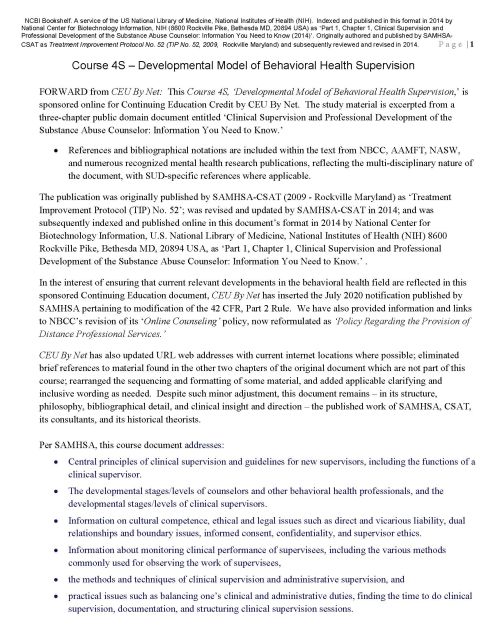
Course 4S - 'The Developmental Model of Clinical Supervision in Behavioral Health' - is sponsored online by CEU By Net and is registered with (CEB) for Texas Clinical Supervision credit. We upload your credits within 60 seconds of course completion to CEB. The course earns 4 Credit Hours in Clinical Supervision for most Texas and states, for social workers, mental health and addiction counselors, LMFTs, NAADAC, IC&RC, TCBAP-TCB-TAAP, Florida Certification Board for CAP. General Credit for Florida Mental Health. Re-approved by EACC for 4 PDHs, Domains I, II, III expires June 13, 2025. For NBCC and California BBS, the course awards 3.0 Credit Hours in Clinical Supervision.
Based on these credentials, the course is accepted by most state boards for behavioral health CE credit. SOME BOARDS may require formal review and approval of the course for purposes of Supervisor Training credit.
This sponsored course presents the Blended or Integrated Developmental Model of Supervision, first articulated and published by Stoltenberg, McNeill, and Delworth (1998), in which both the Supervisee and the Supervisor progress through specific DEVELOPMENTAL LEVELS or STAGES of professional identity and functionality. Originally published by SAMHSA-CSAT (2009 - Rockville Maryland) as part of ‘Treatment Improvement Protocol (TIP) No. 52’, it was revised and updated by SAMHSA-CSAT in 2014 and was subsequently indexed and is currently published online by National Center for Biotechnology Information, U.S. National Library of Medicine, National Institutes of Health (NIH) 8600 Rockville Pike, Bethesda MD, 20894 USA as ‘Part 1, Chapter 1, Clinical Supervision and Professional Development of the Substance Abuse Counselor: Information You Need to Know.’ Mental Healh Clinical Supervision content, references, and bibliographical notations are included within the text from NBCC, AAMFT, NASW, and numerous recognized mental health research publications.
The course addresses in detail the purposes, principles, ETHICS, METHODS, and TECHNIQUES of CLINICAL SUPERVISION of Behavioral Health SUPERVISEES by licensed Supervisors, including the LEGAL necessity of written documentation of all supervisory interactions, observations, and assessments including formative and summative performance evaluations.
The course further addresses the legal issues and vulnerabilities (Risk Management) involved in the supervision of mental health and SUD professionals by licensed supervisors, and the need for ethical and legal DIRECT OBSERVATION of the supervisee's work with clients. The benefits and disadvantages of each of the OBSERVATION METHODS is described.
The course explains the nature of the collaborative relationship between Supervisors and Supervisees, and the Supervisor's function as role model and mentor for Supervisees, as well as the role of GATEKEEPER for licensure in the profession.
GOALS of THIS COURSE:
1. Understand the purpose and essential functions of the supervisory relationship and process -- teacher, consultant, coach, mentor/role model, and guardian of the welfare of the organization's clients.
2. Understand the Supervisor's role as 'Gatekeeper' for the behavioral health professions.
3. Know the central principles and guidelines of Clinical Supervision and Risk Management pertaining to ethical and legal vulnerability of both the supervisor and the supervisee, dual relationships and boundary issues, informed consent, confidentiality, and supervisor-specific responsibilities including prevention of supervisee burnout and compassion fatigue.
4. Understand the legal distinction between 'direct liability' and 'vicarious liability' (respondeat superior), and how these apply to the ethical and legal need for DIRECT OBSERVATION of supervisees' work and DOCUMENTATION of supervisory actions and interactions.
5. Know how to implement the steps in a 'decision tree' to effectively manage a situation in which the supervisor is concerned about a possible ETHICAL or LEGAL violation by a supervisee.
6. According to the Developmental Model of Supervision, know and be able to recognize the levels/stages of development of Behavioral Health Supervisees, and the levels/stages of Supervisor development.
7. Know the various methods and techniques of MONITORING and EVALUATING the development and clinical performance of supervisees, including DIRECT and INDIRECT methods of observation and the benefits and limitations which apply to each.
8. Understand the difference between clinical and administrative supervision, and learn approaches to balancing both responsibilities when necessary.
9. Know how to integrate CULTURAL COMPETENCE into supervision and how to prevent, recognize and address issues of problematic cultural competence between the supervisee and the client, and between the supervisor and the supervisee.
10. Learn about the June 2020 changes in Federal statute ‘42 CFR, Part 2,’ pertaining to confidentiality for persons receiving treatment for SUD, and the revision of NBCC's ETHICS policy for Online Counseling, which was expanded to include Provision of Distance Professional Services in multiple distance media formats.
Note: You are free to read, download, save, and print the Study Guide(s) and Quiz(zes) for this Course, before deciding to enroll in the course. These course materials are public domain, and CEU By Net is sponsoring the course for CE Credit. You may STUDY THIS COURSE and the quiz AT NO CHARGE. You may enroll in the course at any time. You must take the quiz ONLINE, by logging into your
My Home Page
, clicking on the course you want to complete, completing the quiz or quizzes required, and submitting the Feedback Form. You will then instantly receive your course completion certificate! For more information on this course - and to see a COPY of the online quiz - click the '+' symbols, below:
|
|
|
Guide 1_Course 4S |
|
| |
Click here
to view this study material.
Click here
to view and print the quiz you will take for this material.
|
|
|
|
|
Guide 2_Course_4S |
|
| |
Click here
to view this study material.
Click here
to view and print the quiz you will take for this material.
|
|
|
|
|
|
|
|
|
|
Course 3TMH The Ethics and Technical Requirements for Using Telemental Health for Treatment of Persons with PTSD and Associated Conditions |
|
| |
Earn and download a certificate immediately upon completion of this module.
Only $20.00
No charge if you have a subscription
|
|
Course 3TMH The Ethics and Technical Requirements for Using Telemental Health for Treatment of Persons with PTSD and Associated Conditions
This is Course 3TMH - The Ethics and Technical Requirements for Using Telemental Health for Treatment of Persons with PTSD and Associated Conditions. REGISTERED AS DISTINCT POPULATIONS FOR TEXAS WITH CE BROKER for LPC,LMFT,and LCSW.
The continuing education course is sponsored online by CEU By Net, LLC. The course earns 4.0 Credit Hours in DISTINCT POPULATIONS for Texas LCSWs, LPCs, and LMFTs, and 4 CEUs for NAADAC, IC&RC, TCBAP-TCB-TAAP, the Florida Certification Board for CAP, and 4 CEUs for Florida Mental Health. Based upon these credentials, the course is accepted by most state boards for 4 hours of mental health and SUD credit. The course awards 2.75 credit hours for California BBS and NBCC. The course was re-approved by EACC for 3.75 PDHs Domain I, II & III, effective May 6, 2024. Expired May 5, 2025.
The course is a compendium of documents primarily created and published by multiple branches of the US Government's mental health and addiction treatment delivery system. The research described in this course focuses primarily upon Telehealth treatment of PTSD through remote Video Teleconferencing. However, the core premises, consents, provider-client interaction, documentation techniques, follow-up, and training methods also apply to other TMH modalities and diagnoses.
The materials in this course are public domain and are written and published by the US Department of Veteran Affairs' National Center for PTSD, the US Department of Health and Human Services' Substance Abuse and Mental Health Services Administration (SAMHSA), and the Addiction Technology Transfer Center Network (ATTC) - South Southwest ATTC located at the University of Texas School of Social Work, and the National Frontier and Rural ATTC.
The course is divided into two sections, with a quiz for each section - both of which must be passed to download the certificate. The first part of this course is the research-based document written by the VA's National Center for PTSD, focusing on the ethical and therapeutic approach to delivery of Telemental Health assessment and treatment of Military Veterans with PTSD. The materials provide a description of how to implement telemental health through Clinical Video Teleconferencing (CVT) in which clients are not in the same location as the service provider.
The interaction between client and provider can be transmitted via a tablet, phone, computer, and/or video camera. The publication presents research-based data that demonstrate that remote Video Telemental Health is as effective as in-person, in-office treatment of PTSD, and is sometime more effective. Further, providers and clients are able to remotely accomplish all the essential clinical functions required for successful treatment, including:
• clinical assessment
• trauma-focused psychotherapy including CPT for individuals and groups, Prolonged Exposure (PE), and CBT-I for trauma-based insomnia
• psychoeducational interventions
• cognitive testing
• general psychiatry and medication management
Other areas in this first publication include:
• Alliance, Dropout, and Patient Preferences in CVT Treatment
• Clinical and Practical Considerations for CVT
• Pros and Cons of Telemental Health for PTSD
• Considerations for Risk Assessment
• Additional Resources and activity pertaining to informed consent.
Beyond this first publication on the subject of CVT in the treatment of PTSD, the balance of the course contains planning and documentation checklists and guidance for use in setting up a Telemental Health program regardless of the diagnosis of clients served, including activity needed to ensure ethical practice and confidentiality. Topics addressed include:
• Obtaining Informed Consent for Telemental Health Services
• The use and documentation of the Teach-Back method to promote and ensure the client's understanding of information, homework assignments, and medication protocols provided during the tele-session, including checklists for documentation of interventions and response.
• Guidelines, formats, and checklists for assessing the organization's capacity to deliver telemental health services from a technical and manpower perspective.
GOALS of the course:
1. Review current research that demonstrates that treatment of PTSD can be effectively delivered to people with PTSD [Including Veterans of deployment to the Middle East] through remote home-based video teleconferencing—including Cognitive Processing Therapy (CPT) for individuals and groups using Prolonged Exposure (PE) and Cognitive Behavioral Therapy for Insomnia (CBT-I).
2. Know how to remotely implement technical precautions, documentation including informed consent, and intervention approaches which are necessary to ensure the safety, confidentiality, and ethical treatment of clients who receive treatment through remote electronic communication,
3. Learn that the use of Evidence Based Practices (EBPs) in conjunction with home-based Clinical Video Teleconferencing (CVT) is empirically demonstrated to be as effective as - and sometimes more effective than - in-person, in-office treatment of PTSD.
4. Recognize the prevalence of untreated PTSD in tribal reservations, rural areas, post-deployment veteran populations, and nationwide due to the Covid-19 pandemic and other situational trauma, and the role that Telemental Health can play in the remote treatment of affected individuals.
5. Learn the use and documentation of the Teach-Back method to promote and ensure the client's understanding of instructions, homework assignments, and medication protocols provided during the telehealth session, including checklists for documentation of interventions and client response.
6. With structured checklists and recommended actions, providers learn that essential clinical functions can be effectively performed remotely, including clinical assessment, trauma-focused psychotherapy with individuals and groups, psychoeducational interventions, cognitive testing, general psychiatry, and medication management.
7. Learn the details of what has and has not been changed by SAMHSA in its significant modification of 42 CFR Part 2 in July 2020, pertaining to confidentiality and exchange of clinical information.
8. Learn the step-by-step process of evaluating and putting into place the technical requirements and IT hardware and software systems needed for trouble-free Telemental Health sessions.
Note: You are free to read, download, save, and print the Study Guide(s) and Quiz(zes) for this Course, before deciding to enroll in the course. These course materials are public domain, and CEU By Net is sponsoring the course for CE Credit. You may STUDY THIS COURSE and the quiz AT NO CHARGE. You may enroll in the course at any time. You must take the quiz ONLINE, by logging into your
My Home Page
, clicking on the course you want to complete, completing the quiz or quizzes required, and submitting the Feedback Form. You will then instantly receive your course completion certificate! For more information on this course - and to see a COPY of the online quiz - click the '+' symbols, below:
|
|
|
Course 3TMH - Guide 1 |
|
| |
Click here
to view this study material.
Click here
to view and print the quiz you will take for this material.
|
|
|
|
|
Course 3TMH - Guide 2 |
|
| |
Click here
to view this study material.
Click here
to view and print the quiz you will take for this material.
|
|
|
|
|
|
|
|
|
|
Course 2D - The Ethics of Advance Directives: Assisting Clients and Families with Preferences for End of Life Care Including Those with HIV-AIDS |
|
| |

Earn and download a certificate immediately upon completion of this module.
Only $18.00
No charge if you have a subscription
|
|
Course 2D - The Ethics of Advance Directives: Assisting Clients and Families with Preferences for End of Life Care Including Those with HIV-AIDS
This course is sponsored by CEU by Net and is approved and/or pre-approved or automatically approved for 2 credit hours by multiple State Boards including Texas and Florida, TCBAP (Texas Certification Board) and TAAP, IC&RC, NAADAC, Florida Certification Board, and California CCADE and CADTP. EACC - 2 PDHs Domain III expires June 30, 2024. The course also awards 1.25 CA BBS Hours and 1.25 NBCC Hours.
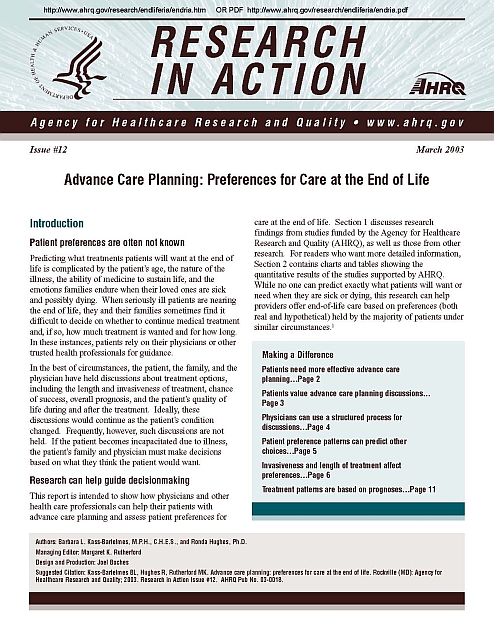
This research-based study is published by the federal Agency for Healthcare Research and Quality (AHRQ), an agency of the US Department of Health and Human Services, and is written by Barbara L. Kass-Bartelmes, M.P.H., C.H.E.S., and Ronda Hughes, Ph.D..
The course is both an ETHICS course and a COUNSELING INTERVENTION course and is appropriate for professionals who are working with [or may encounter] cancer patients, HIV-AIDS patients, stroke patients, terminally ill children, those who are in intractable pain, and others for whom End of Life care is an Issue. Say the authors, "Predicting what treatments patients will want at the end of life is complicated by the patient’s age, the nature of the illness, the ability of medicine to sustain life, and the emotions which patients and families endure."
Counseling dying or gravely ill or at-risk people and their families regarding their decisions for End of Life Care (Advance Directives) is fraught with both ETHICAL and INTERVENTION issues. Such counseling assistance is a delicate matter and can be difficult for counselors to carry out without inadvertently inserting their own biases into the intervention. This course teaches a 5-step research-based method to avoid such conflicts.
This 5-step counseling approach is also appropriate for working with clients who have chronic diseases such as cancer, kidney failure, CHF, and HIV/AIDS -- where there is considerable uncertainty about when death is likely to occur, but which is nevertheless a complex issue which may exacerbate co-occurring disorders including SUDs.
The main issue in working with people who are seriously ill is, how far do you want medical personnel to go, to delay death? HIV-AIDS patients differed significantly from other ill patients, in several areas. There are also circumstances in which the reaction of the patient to discussing such issues varies significantly, depending upon the specific stage or type of illness and age of the individual - including the reaction of terminally ill children.
The research therefore calls upon Behavioral Health and other medical professionals to tailor the approach according to the illness and the situation, i.e., HIV-AIDS vs Cancer vs Stroke vs. Alzheimer's .... and impending death vs. uncertainty of when death will occur.
The approach is, accordingly, a 'KNOWLEDGE FRAMEWORK’ and a 'GUIDELINE' for working with individuals with differing medical issues and life circumstances including HIV-AIDS -- and to do this work ethically. The research included discussion with patients with various medical conditions which they could face when he or she nears the end of life, including severe intractable pain, disabling stroke, permanent coma, mental deterioration, etc.. The patients were then asked to indicate which of these circumstances they would consider worse than death, i.e., under which conditions they would NOT want measures to be taken to prolong life. HIV-AIDS patients differed significantly from other ill patients in not wanting to prolong life under these circumstances.
This course is also helpful for those providers who work with HEALTHY individuals who work in life-threatening situations including MILITARY deployment to war zones, police officers, firemen, SWAT teams, undercover agents and other such at-risk occupations.
GOALS OF THIS COURSE:
1. Learn the terms pertaining to individuals' and surrogates' LEGAL RIGHT to make 'End of Life' care decisions.
2. Based upon the extensive research which produced this document, become aware of the need for clearer documentation and communication of patients' and surrogates' preferences for End of Life Care within the clinical record and in the direct communication provided to the treating physician and other caretakers.
3. Understand the THERAPEUTIC BENEFITS and the ETHICS of engaging in discussions about ‘end of life preferences‘ with applicable clients and their partners, spouses, families or surrogates (representatives).
4. Know that discussion and decisions about Advance Directives are important at multiple stages of proximity to death -- whether death is potentially imminent (as with late-stage AIDS patients and other critically ill people), or when the individual is adjusting to a diagnosis of serious illness which may ultimately result in death including HIV and cancer, or when preparing for high-risk medical procedures, or when coming to terms with the risk of critical injury in high-risk employment (military, law enforcement, etc.).
5. Based upon the extensive research presented in this document, learn that the choices for End of Life Care vary significantly, depending upon the specific type of life-threatening illness or circumstance -- such as the prevalent desire of those with HIV/AIDS to limit or rule out medical interventions to prolong life, vs. the preference of those with a different illness or life threatening situation to extend life through direct medical intervention.
6. Learn a five-part, research-supported PROCESS for structuring discussions about End of Life preferences, which inherently supports our ETHICAL RESPONSIBILITY for assuring the welfare and legal rights of the client.
This publication is dated 2003. However, the AHRQ considers this document to be nevertheless highly relevant to the subject at hand, when compared to other documents available within their research library and available elsewhere on the internet. This article is listed 3rd on the list of 261 AHRQ publications on this topic when most recently reviewed.
Note: You are free to read, download, save, and print the Study Guide(s) and Quiz(zes) for this Course, before deciding to enroll in the course. These course materials are public domain, and CEU By Net is sponsoring the course for CE Credit. You may STUDY THIS COURSE and the quiz AT NO CHARGE. You may enroll in the course at any time. You must take the quiz ONLINE, by logging into your
My Home Page
, clicking on the course you want to complete, completing the quiz or quizzes required, and submitting the Feedback Form. You will then instantly receive your course completion certificate! For more information on this course - and to see a COPY of the online quiz - click the '+' symbols, below:
|
|
|
Course 2D - The Ethics of Advance Directives: Assisting with Preferences for End of Life Care Including Those with HIV-AIDS |
|
| |
Click here
to view this study material.
Click here
to view and print the quiz you will take for this material.
|
|
|
|
|
|
|
|
|
|
Ethics Course 4B_Rights of Persons Living with Serious Mental Illness and Co-Occurring Substance Use Disorders - Our Ethical and Practical Responsibilities |
|
| |

Earn and download a certificate immediately upon completion of this module.
Only $24.00
No charge if you have a subscription
|
|
Ethics Course 4B_Rights of Persons Living with Serious Mental Illness and Co-Occurring Substance Use Disorders - Our Ethical and Practical Responsibilities
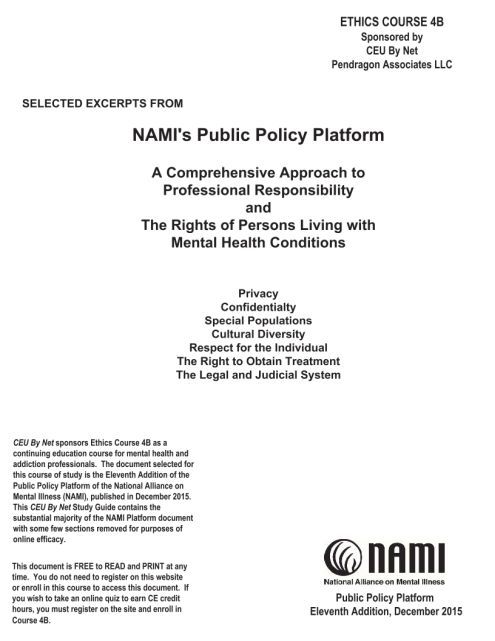
This course, Ethics Course 4B: 'Rights of Persons Living with Serious Mental Illness and Co-Occurring Substance Use Disorders—Our Ethical and Practical Responsibilities', is sponsored online by CEU By Net and earns 4.25 Clock Hours of credit for multiple State Boards for Mental Health and Addiction, including Florida, Texas, and Alabama, TCBAP-TCB-TAAP, NAADAC, IC&RC, Florida Certification Board. The course also awards 3.0 California BBS Hours and 3.0 NBCC Hours. Based upon these credentials, the course is accepted by most state boards for multiple licenses. See our Addiction Course Catalog for our IC&RC and NAADAC approved Status. [Course is no longer offered for EACC PDHs.]
CEU By Net sponsors this course online for Continuing Education credit. The training document is authored by the National Alliance on Mental Illness (NAMI).
The platform addresses the ETHICAL and PRACTICAL RESPONSIBILITY of licensed, certified, and allied professionals to help individuals with serious mental disorders including SUDs to achieve recovery and resiliency in their lives, and to be assured the SAME RIGHTS that are accorded to persons without mental disorders. These materials clearly reflect NAMI's commitment to the principles of recovery and resilience, and the RIGHT of individuals to be intrinsically involved in the planning and review of their own treatment, including medication.
The ethical and professional responsibility to protect the individual's rights in the treatment process—and to reduce the stigma and discrimination associated with mental illness and co-occurring SUDs—are addressed throughout the document. CEU By Net has included the substantial majority of the document as it is published by NAMI, for purposes of this online CE course.
The situational content addresses the circumstances of adults, children, and families who are in crisis or involved in active treatment, as well as those involved with the judicial system, or in a formal educational environment. The oftentimes discriminatory use of seclusion, restraint, solitary confinement, and weapons of force are addressed, including the appropriate use and the negatives of each.
The NAMI platform also addresses the rights and circumstances of underserved populations who are living with mental illness, e.g., people who are difficult to engage in treatment, the homeless, those involved in the criminal justice system and/or veterans or military personnel.
NAMI repeatedly asserts that individuals with serious disorders have the right to INTEGRATED mental health, addiction, and physical health treatment. This approach to treatment is consistent with the requirements of the Affordable Care Act (ACA). Assuring integrated health care for one's clients with serious mental disorders is in keeping with the ETHICAL responsibility to act in the BEST INTEREST of the client.
Issues of the handling of mental illness and co-occurring addiction in the judicial system are also addressed in some detail—including the varying positions of the States in the application of the death penalty vis-à-vis individuals with mental illness. NAMI is clear that when viewing the rights that should be accorded to persons with serious mental illness and co-occurring disorders within the judicial system, mental illness must not be confused with sociopathic behavior.
The course is appropriate for Social Workers, Mental Health and AOD Counselors and Therapists, LMFTs, School Counselors, Psychologists, EAP counselors, teachers, law enforcement professionals, and all allied professionals who serve children, adolescents, and adults with serious mental illness and co-occurring substance use disorders.
THE GOALS of THIS COURSE:
1. Know the ETHICAL and practical responsibilities of licensed, certified, and allied professionals in specific treatment, crisis, educational, and law enforcement situations involving individuals with serious mental illness including co-occurring substance use disorder.
2. Become aware of core principles of PROFESSIONAL RESPONSIBILITY, including protection of individuals from stigma and discrimination, the support of their right to recovery and resiliency in their daily lives, and their right to be intrinsically involved in planning and review of their mental health and/or SUDs treatment including medication.
3.. Understand what is meant by the INTEGRATION of physical health, mental health and addiction treatment, and know how it is best implemented with people living with serious mental illness and co-occurring SUDs.
4. Understand how Integration of Treatment Services relates to our ETHICAL requirement to act in the BEST INTEREST of the client.
5. Become aware of the inappropriate and discriminatory use of certain interventions used to 'control' individuals with mental illness and co-occurring SUDs—including restraint, seclusion, and solitary confinement—and the effective, acceptable, and ETHICAL alternative interventions.
6. Learn NAMI's view of the rights and accommodations that should be accorded to persons with serious mental illness and co-occurring Substance Use Disorders within the judicial system, vs. the handling of individuals with sociopathic behavior.
7. Understand the differing ways that States handle mental illness and co-occurring addiction in the judicial system, including the varying positions of the States in the application of the death penalty to people with mental illness.
Note: You are free to read, download, save, and print the Study Guide(s) and Quiz(zes) for this Course, before deciding to enroll in the course. These course materials are public domain, and CEU By Net is sponsoring the course for CE Credit. You may STUDY THIS COURSE and the quiz AT NO CHARGE. You may enroll in the course at any time. You must take the quiz ONLINE, by logging into your
My Home Page
, clicking on the course you want to complete, completing the quiz or quizzes required, and submitting the Feedback Form. You will then instantly receive your course completion certificate! For more information on this course - and to see a COPY of the online quiz - click the '+' symbols, below:
|
|
|
Ethics Course 4B - Study Guide |
|
| |
Click here
to view this study material.
Click here
to view and print the quiz you will take for this material.
|
|
|
|
|
|
|
|
|
|
[Florida] Ethics 3C - Beyond the Yellow Legal Pad: From Ethics to Practice and Into the Courtroom |
|
| |
Earn and download a certificate immediately upon completion of this module.
Only $24.00
No charge if you have a subscription
|
|
[Florida] Ethics 3C - Beyond the Yellow Legal Pad: From Ethics to Practice and Into the Courtroom
FLORIDA LICENSEES, PLEASE TAKE NOTE: This revised Course 3C is now separately approved in Florida for 3 clock hours in the ETHICS category, as well as for 3 clock hours in the GENERAL category. Enroll in THIS COURSE if you want to take it for ETHICS credit in Florida. Alternatively, if you are wanting this course for GENERAL credit in Florida [or for the CLINICAL EVALUATION-ASSESSMENT CATEGORY for Florida CAPs], enroll in the course listed ABOVE this item in the catalog - i.e., 'Course 3C' WITHOUT 'Florida Ethics' in the course title. (These two instances of the course have the same content, but have different internal codes for Florida - one for Ethics, and one for General.)
This course is authored and copyrighted by CEU By Net and earns 3 Clock Hours of credit for multiple State Boards including Florida,Texas, and Alabama, IC&RC, NAADAC, and Florida Certification Board, and 3 total PDHs in Domains I, III for EACC renewed June 6, 2020. Also earns 2.25 NBCC Hours and 2.25 California BBS hours.
Based upon these credentials, the course is accepted by most state boards for multiple licenses.
This course is authored, copyrighted, and published by Marsha Naylor, MA, LPC, CEU By Net and Pendragon Associates LLC.
What's this course about? Aside from the potential for clinical embarrassment if we make errors in the write-up of an assessment interview or an error in the diagnosis(es), most clinicians do not give much thought to the potential for legal, ethical or other professional repercussions which might result from these routine activities. Nor do they see the development of a treatment plan as a potential for trouble.
Most professionals believe that such things as becoming sexually involved with a client or violating a client's confidentiality are the primary issues which present a potential for ethics violations. They don't realize that 'scope of practice' and 'professional competence' and 'acting in the best interest of the client' are common reasons why providers are disciplined for ethics violations and may be sued for malpractice in a court of law. Further, few realize that the most vulnerable activities which can lead to such allegations are ASSESSMENT, DIAGNOSIS, and TREATMENT PLANNING. Together, these clinical activities are the Achilles Heel for behavioral health providers.
Furthermore, it’s a common assumption that if an assessment (any assessment), treatment plan (any treatment plan), and any reasonable diagnosis are “in the chart” that all is well. Local Program Managers may even audit their charts internally from that perspective. But this, too, has the potential for trouble. Think: ‘Professional Competence’ . . . ‘Ethics’ . . . ‘Scope of Practice’.
This course focuses upon the details of how to perform and DOCUMENT a professionally competent Biopsychosocial Assessment of Children and Adolescents (whether routine or emergency) without the LEGAL, ETHICAL, AND PROFESSIONAL vulnerability which can come back to haunt us long after the fact. Learn why the ETHICAL canons pertaining to Professional Competency, Acting in the Best Interest of the Client, and Scope of Practice are inseparable from how we go about assessing, diagnosing, and documenting treatment of children and adolescents.
Structured Assessments are essential to protect ourselves legally and professionally -- from an ETHICS perspective, a PROFESSIONAL COMPETENCE perspective, and a PROFESSIONAL LIABILITY perspective. And thus we explore the wisdom of foregoing on-the-fly notations put to a 'yellow legal pad' when assessing and diagnosing children and adolescents, in favor of using a more formal, STRUCTURED BIOPSYCHOSOCIAL ASSESSMENT format.
This unique course lays bare the oftentimes overlooked 'traps' which even the most experienced clinicians fall into when assessing and diagnosing children and adolescents without a structured assessment format -- placing us at great LEGAL, ETHICAL, and PROFESSIONAL RISK if overlooked. The course presents a clear description of how such issues can arise when we ASSESS 'ON THE FLY', no matter how many years we have been in this business!
So where’s the ETHICS CONNECTION? The course clarifies the connection between (1) how effectively we perform the task of Assessment and Diagnosis of Children and Adolescents, and (2) the Ethical Standards of Practice – including both demonstration of Professional Competence within Scope of Practice, and responsibility to act in the best interest of the client.
In this course we explain how and why the use of a structured assessment protocol [which addresses and integrates specific issues] is ultimately the only way to assure that we have complied with the PREVAILING STANDARDS OF PROFESSIONAL CARE which are applied to assessment and treatment of children and adolescents with mental health and SUDs issues. We must demonstrate in writing that we have met the ‘ETHICS’ expectation of ‘COMPETENCE’ to treat THIS child for THESE issues, and that your actions are consistent with the prevailing standards of care for the specific issues.
The bottom line here: Assessment Course 3C addresses serious assessment ERRORS to avoid, which can result in ETHICAL AND LEGAL complications. Understand the legal and professional implications of (a) erroneous or ignored DIAGNOSIS(ES) and (b) failure to RESPOND appropriately to a client’s regression or failure to progress in treatment. This type of clinical thoroughness is particularly crucial when working with children and adolescents who present a potential for HARM TO SELF OR OTHERS.
ADDED BONUS: Get FREE Downloadable prototype assessment forms for Biopsychosocial Assessment, and for Risk Assessment, which the user can tailor to his or her own needs if software to modify pdf documents is available. NOTE: It is important to note that all of the assessment forms within this training course are intended to serve as a prototypical RESOURCE from which users can extract or adapt content for their own programmatic use – including the development of screening instruments and electronic medical records.
Specific Goals of the Course:
1. Learn how the use of a structured Biopsychosocial Assessment format [which integrates all key assessment findings] is directly related to two key expectations of Ethical Practice -- i.e., 1) the mandate that we be professionally QUALIFIED to do the work (i.e., having appropriate training and a knowledge base in the specific treatment issues), and 2) the demonstration of professional SKILL or COMPETENCE consistent with the prevailing professional standards for Assessment and Treatment of the assessed youth's presenting issues.
2. Understand why assessing children and adolescents 'on the fly' without a structured Biopsychosocial Assessment format can result in ethical, legal and professional vulnerability and liability for the licensed professional.
3. Learn which omissions and errors in Biopsychosocial Assessment of Children and Adolescents most frequently result in legal and professional liability, in the event of an adverse treatment outcome.
4. Understand how inadvertent omission of clinical details can adversely impact the correctness of diagnosis and the details of the treatment plan - resulting in allegations of clinical incompetence.
5. Understand the need for extra sensitivity to potential or current LGBT issues with children and adolescents.
6. Understand the legal and professional implications of (a) erroneous or ignored DIAGNOSIS(ES) and (b) failure to RESPOND to a client’s regression or failure to progress in treatment, and (c) failure to document the response.
7. Learn how to spot your own flawed documentation patterns which lead to audit woes, ethical issues, and legal problems.
8. Understand the structure and details involved in performing a competent 'Assessment of Acute Risk' with children and adolescents.
9. Learn why detailed written documentation of history, diagnosis(es), and response to treatment is NOT a violation of the principles of 'Client Confidentiality.'
To view the DOCUMENT GO HERE.
To view the QUIZ GO HERE.
|
|
|
|
|
|
|
|
Ethics 4D - Ethics of Treatment Documentation and Other Ethical Dilemmas When Insurance and State Contracts Are Paying the Bill |
|
| |

Earn and download a certificate immediately upon completion of this module.
Only $28.00
No charge if you have a subscription
|
|
Ethics 4D - Ethics of Treatment Documentation and Other Ethical Dilemmas When Insurance and State Contracts Are Paying the Bill
This is an Ethics Course copyrighted and published by CEU By Net. This course is sponsored online by CEU By Net and earns 4 Clock Hours of credit for multiple State Boards including Florida and Texas, TCBAP-TAAP, IC&RC, NAADAC, California CCADE and CADTP, and Florida Certification Board. EACC 4 PDHs Domain I, II, III expires June 30, 2024 The course also awards 3.0 CA BBS Hours and 3.0 NBCC Hours. Based upon these credentials, course is accepted by most state boards for multiple licenses.
NOTE: Ethics 4D contains the same core material as the 3 credit-hour Ethics Course 3D, except that 4D includes additional material regarding these ethical issues, plus one additional Credit Hour. And so take either 3D or 4D, but not both.
This course is appropriate for Professional Counselors, LMHCs, LMFTs, Social Workers, Addiction and Substance Abuse Drug and Alcohol Counselors, CEAP providers, and other behavioral health practitioners.
Ethics 4D is a self-paced 3-part online slide show with content that's easy to understand and never boring - regarding the ETHICAL DILEMMAS and PRESSURES encountered on a daily basis by those whose clients' fees-for-service are paid by insurance, managed care, Employee Assistance Programs, self-insured companies, or other closely monitored state or local contracts which have reduction of healthcare cost as a mandate.
Behavioral health care services is now, more than ever before, carefully monitored for clear documented evidence of 'the medical necessity of treatment'. No longer considered to be a 'social service', mental health and addiction treatment is carefully monitored in terms of 'increments of service', 'duration of service', and 'medical necessity' for the type of service being provided. These issues are the basis for approval or denial of treatment requests, and the decisions are based upon what is DOCUMENTED in the client's treatment record - assessments, treatment plans, and progress notes.
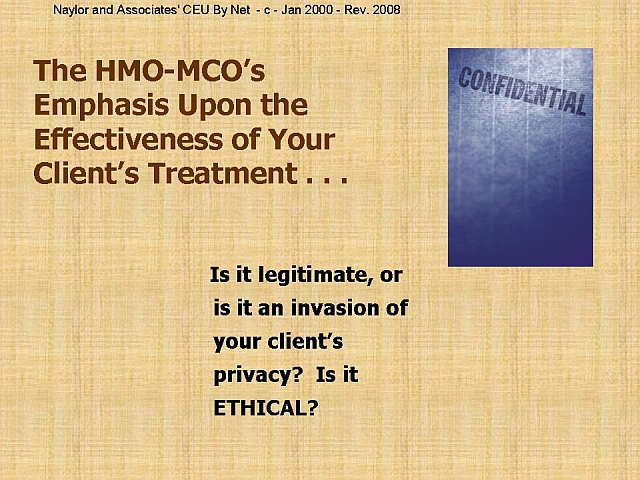
This course is a close-up view of that sticky issue ... what to write (and not write) in a client's treatment record, from an ETHICS perspective, in this new era of tightly controlled health care costs. How much do you divulge about your ASSESSMENT of the client's DIAGNOSIS(ES), his prognosis, his functional status, and his response to treatment? What's ETHICAL - when the payor is demanding details? What's NECESSARY?
Is such scrutiny legitimate and ethical, or is it an invasion of your (and your client's) privacy? And is it ethical to provide the requested information? Do most states’ licensure standards SUPPORT - or OVERRULE - this type of documentation of a client's treatment information? The answer may surprise you.
GOALS of this course:
1. Understand the ETHICAL AND PRACTICAL impact of CARE MANAGEMENT (a.k.a., Managed Care) upon WHO gets treatment or related services, WHAT treatments and related services they may receive, and HOW MUCH of each intervention is allowed.
2. Identify the ETHICAL ISSUES faced by providers due to the Care Management approach to authorization of behavioral health services - in both the delivery of treatment services AND in the DOCUMENTATION of the Assessment, Diagnosis, and Response to treatment of intervention.
3. Understand the connection between the concept of ‘Medically Necessary Treatment’ and what must be DOCUMENTED in clients’ records, vis-à-vis the professional’s ETHICAL PRECEPTS and LICENSURE REQUIREMENTS.
4. Recognize how these new health care system requirements do in fact mesh and correlate with the longstanding ETHICAL and LEGAL requirements for practicing in the mental health and substance abuse treatment profession.
5. Learn how we can ETHICALLY and LEGALLY accommodate these new service and documentation requirements, while simultaneously meeting the requirements of our Provider Agreements.
6. Learn some creative, alternative treatment options which can lessen the provider's ETHICAL concerns when faced with denial of ‘traditional services’.
7. Review and understand additional ethics-related issues involved in the treatment of clients under a managed system of care - such as the health care insurers' contractual right to explore the PROVIDER's effectiveness and adherence to best practices in the treatment of individual clients, through review of the OUTCOME of an individual's treatment or intervention.
To view Study Guide 1 now CLICK HERE
To view Study Guide 2 now CLICK HERE
To view Study Guide 3 now CLICK HERE
To view and print QUIZ 1 for free, CLICK HERE
To view and print QUIZ 2 for free, CLICK HERE
To view and print QUIZ 3 for free, CLICK HERE
|
|
|
|
|
|
|
|
Ethics 3D - The Ethics of Treatment Documentation When Insurance Is Paying The Bill |
|
| |

Earn and download a certificate immediately upon completion of this module.
Only $24.00
No charge if you have a subscription
|
|
Ethics 3D - When Insurance and State Contracts Are Paying the Bill – The Ethics of Treatment Documentation in Today’s World.
This is an ETHICS course copyrighted and published by CEU By Net. This course earns 3 Clock Hours of credit for multiple State Boards including Florida and Texas, and for TCBAP-TAAP, IC&RC, NAADAC, California CCADE and CADTP, and Florida Certification Board. EACC 3 PDHs Domain I expires June 30, 2024. It also awards 2.0 CA BBS Hours and 2.0 NBCC Hours. Based upon these credentials, course is accepted by most state boards for multiple licenses.
NOTE: Ethics 4D contains the same core material found in this Ethics Course 3D, except that Ethics 4D includes additional material pertaining to the ethics of clinical documentation, plus one additional Credit Hour. Therefore, take either 3D or 4D, but not both.
This course is appropriate for Professional Counselors, LMHCs, LMFTs, Social Workers, Addiction and Substance Abuse Drug and Alcohol Counselors, CEAP providers, and other behavioral health practitioners.
You can VIEW the Study Guides and Quizzes for FREE through the links at the bottom of this course description.
Ethics 3D is an online 2-part SLIDE SHOW with content that's easy to understand and never boring. It addresses in clear language the ETHICAL DILEMMAS and PRESSURES encountered on a daily basis by those whose clients' fees-for-service are paid by insurance, managed care, Employee Assistance Programs, self-insured companies, or other closely monitored state or local contracts which have reduction of healthcare cost as a mandate.
The treatment provided by providers is now, more than ever before, carefully monitored for clear documented evidence of 'the medical necessity of treatment'. No longer considered to be a 'social service', mental health and addiction treatment is carefully monitored in terms of 'increments of service', 'duration of service', and 'medical necessity' for the type of service being provided. These issues are the basis for approval or denial of treatment requests, and the decisions are based upon what is DOCUMENTED in the client's treatment record - assessments, treatment plans, and progress notes.
This course is a close-up view of that sticky issue ... what to write (and not write) in a client's treatment record, from an ETHICS perspective, in this new era of tightly controlled health care costs. How much do you divulge about your ASSESSMENT of the client's DIAGNOSIS(ES), his prognosis, his functional status, and his response to treatment. What's ETHICAL - when the payor is demanding details? What's NECESSARY?
Is such scrutiny legitimate and ethical, or is it an invasion of your (and your client's) privacy? And is it ethical to provide the requested information? Do most states’ licensure standards SUPPORT - or OVERRULE - this type of documentation of a client's treatment information? The answer may surprise you.
GOALS of this course:
1. Understand the ETHICAL AND PRACTICAL impact of CARE MANAGEMENT (a.k.a., Managed Care) upon WHO gets treatment or related services, WHAT treatments and related services they may receive, and HOW MUCH of each intervention is allowed.
2. Identify the ETHICAL ISSUES faced by providers due to the Care Management approach to authorization of behavioral health services - in both the delivery of treatment services AND in the DOCUMENTATION of the Assessment, Diagnosis, and Response to treatment of intervention.
3. Understand the connection between the concept of ‘Medically Necessary Treatment’ and what must be DOCUMENTED in clients’ records, vis-à-vis the professional’s ETHICAL PRECEPTS and LICENSURE REQUIREMENTS.
4. Recognize how these new health care system requirements do in fact mesh and correlate with the longstanding ETHICAL and LEGAL requirements for practicing in the mental health and substance abuse treatment profession.
5. Learn how we can ETHICALLY and LEGALLY accommodate these new service and documentation requirements, while simultaneously meeting the requirements of our Provider Agreements.
6. Learn some creative, alternative treatment options which can lessen the provider's ETHICAL concerns when faced with denial of ‘traditional services’.
To view Study Guide 1 now CLICK HERE
To view Study Guide 2 now CLICK HERE
To view and print QUIZ 1 CLICK HERE
To view and print QUIZ 2 CLICK HERE
|
|
|